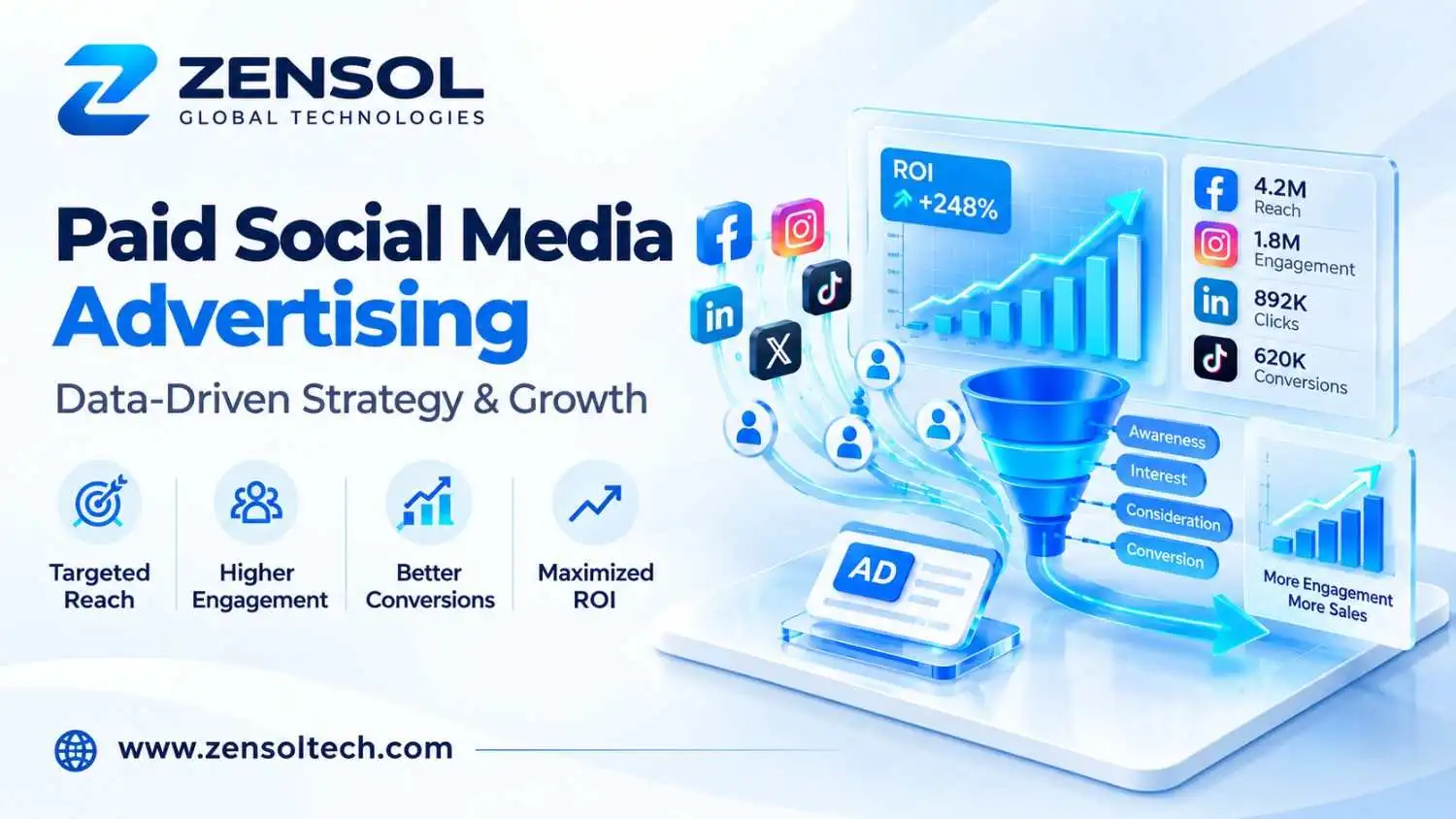
Getting new customers online has become tougher and significantly more expensive than ever before. Ad spaces are crowded, stricter privacy rules make data tracking tricky, and free organic reach has dropped to historic lows. To scale a company predictably in 2026, relying on luck or occasional viral posts will not work. Modern brands need an organized, data-driven approach to paid social media advertising to control customer acquisition cost (CAC) and secure a dependable return on ad spend (ROAS).
What is paid social media advertising?
Paid social media advertising is a digital marketing method where businesses pay social networks to display promotional content to targeted audiences. By utilizing automated bidding, audience signals, and machine learning, platforms deliver these sponsored messages directly to users likely to engage, sign up, or purchase.
A few years ago, media buyers spent hours tweaking narrow demographic settings and manual audience exclusions. Today, ad platforms use artificial intelligence to do the heavy lifting. The algorithms automatically figure out who to target based on how real users react to your visual creative. To win today, business leaders must understand how creative design, server-side data tracking, and modern web platforms work together within an integrated acquisition system.
What Is Paid Social Media Advertising and Why Does It Dominate in 2026?
The way digital ads operate has completely changed. In the past, advertisers manually adjusted bids by pennies every single day. Today, platforms like Meta, TikTok, and LinkedIn run on autonomous machine learning models that optimize auctions in real time.
These automated systems test thousands of combinations every minute. They look at user interactions instantly to predict which prospects are most likely to convert. When your business feeds clean, first-party data into these networks, the system identifies high-value customers far better than any manual setup could manage.
At the same time, free organic reach for business accounts has dropped near zero. Social networks are now strictly pay-to-play ecosystems. While posting regular organic updates remains helpful for validating brand credibility and answering customer questions, it cannot reliably generate predictable enterprise revenue on its own.
Without targeted paid social media advertising, your company stays invisible to potential buyers who do not know your brand yet. Paid campaigns solve this cold-start problem by proactively introducing your value proposition directly to qualified prospects before they even think to type a search prompt.
Paid Social vs. Organic Social vs. Paid Search: Where Does It Fit?
To build an efficient marketing budget, you must understand the difference between creating demand and capturing demand.
Paid search, such as Google Ads, captures people who are already actively looking for a product or service. The user enters a specific query, and your ad appears at the moment of intent. In contrast, paid social media advertising generates latent demand. It places an attractive solution in front of a decision-maker while they are scrolling through their feed. Organic social media sits in the middle, helping you nurture existing followers and display social proof.
Here is a clear breakdown of how these three channels work side by side:
| Channel | Primary Goal | Cost Model | Best Funnel Stage | Typical Conversion Cycle |
|---|---|---|---|---|
| Paid Social Media Advertising | Create Demand (Discovery & Interruption) | Cost per thousand impressions (CPM) / Click (CPC) | Full Funnel (Awareness to Retargeting) | 14 to 90 Days |
| Organic Social Media | Brand Trust, Social Proof & Retention | Free media (Production time only) | Middle of Funnel & Retention | 90+ Days |
| Paid Search (Google Ads) | Capture Demand (Direct Search Intent) | Cost per Click (CPC) | Bottom of Funnel (Ready to buy) | 1 to 14 Days |
When combined properly, these three channels strengthen each other. Paid social introduces your product, organic profiles confirm your business is legitimate during customer due diligence, and targeted Google Ads campaigns capture high-intent prospects when they actively search your brand name to finalize a purchase.
The Core Platforms: Strategic Fit and Budget Allocation
You do not need to run campaigns on every single network. Spreading your budget across five or six apps wastes capital and makes it hard to gather meaningful conversion data. Focus your spend on the specific channels where your ideal buyers actually spend time.
Meta (Facebook & Instagram): The Direct-Response and Visual Engine
Meta remains the top direct-response ad platform in the world. With automated tools like Advantage+ shopping campaigns, Meta’s machine learning engine finds buyers at lower costs than almost any competitor.
Even for B2B brands, Meta works exceptionally well for retargeting. Business owners and managers scroll Instagram and Facebook in their free time. Showing a short video customer story or a clean carousel ad to people who visited your website keeps your brand top-of-mind at a much lower cost than professional networks. When folded into a broader social media marketing roadmap, this retargeting layer ensures no warm leads slip through the cracks.
LinkedIn: The Enterprise B2B & High-Ticket Pipeline Driver
LinkedIn is the undisputed leader for business-to-business marketing. Its real superpower is accurate professional data: verified job titles, company sizes, industries, and executive seniority levels.
LinkedIn ads cost more per click than consumer platforms, but the leads are far more qualified. If you sell enterprise software, custom development, or high-ticket contracts, being able to show ads directly to CEOs and IT directors easily justifies the higher price tag.
TikTok & YouTube Shorts: High-Velocity UGC and Top-of-Funnel Scale
Short vertical videos have changed how people consume content online. TikTok and YouTube Shorts allow brands to tell quick stories, show off real product demos, and share educational tips at massive scale.
On these channels, simple user-generated content (UGC) shot on a smartphone usually performs better than expensive studio commercials. Ads that feel natural, honest, and easy to watch grab attention quickly and pull new prospects into your sales pipeline for less money.
The 5-Pillar Framework for Modern Paid Social Media Advertising Campaigns
Running profitable ad campaigns requires more than just launching ads in an ad manager. If your website is slow, your tracking scripts fail, or your lead capture forms break on mobile screens, ad dollars go to waste. Paid acquisition only generates predictable pipeline when it is integrated into a unified digital marketing strategy that connects technical web performance with audience demand.
| Pillar | Core Focus | Strategic Objective |
|---|---|---|
| 1. Full-Funnel Design | Awareness to Retargeting | Guide prospects from discovery to sale |
| 2. CAPI & Data Tracking | Server-Side Data Connection | Protect conversion signals from tracking loss |
| 3. Creative Engine | Rapid Testing & Iteration | Stop scroll fatigue with modular creatives |
| 4. Algorithmic Bidding | Broad Audience Delivery | Let machine learning optimize target auctions |
| 5. Blended Attribution | Multi-Touch Tracking & MER | Measure actual cross-channel profitability |
Pillar 1: Full-Funnel Architecture
A healthy ad campaign guides a person step-by-step from stranger to customer:
- Top of Funnel (Awareness): Catch attention with helpful tips, industry insights, or surprising facts. The goal is to get interested people to stop scrolling and watch.
- Middle of Funnel (Evaluation): Show real customer testimonials, product walkthroughs, and comparison charts to people who engaged with your first ad.
- Bottom of Funnel (Decision): Give warm prospects a clear reason to act today—such as a free consultation, a software demo, or an introductory discount.
Pillar 2: Server-Side Tracking and Conversions API (CAPI) Architecture
Old browser-based tracking pixels lose a lot of data today because of modern ad blockers and mobile privacy settings. If an ad network cannot see which ads lead to real sales, its algorithm cannot optimize your campaigns.
Modern marketing setups connect your website directly to the ad network using a Conversions API (CAPI). When a customer books a call or buys a product, your server sends that verified event straight back to the ad platform. This clear signal gives the ad system the exact data it needs to go find more people just like that buyer.
Pillar 3: Creative Testing Engines and Real-World Execution
In modern paid social media advertising, your ad visual is your primary targeting tool. The headline, image, or first three seconds of your video decide who stops to pay attention.
To keep results steady and stop creative fatigue—where people get tired of seeing the same ad over and over—you should test new creative regularly:
- The First 3 Seconds: Try three different hooks for the same video message (e.g., asking a question, stating a surprising statistic, or calling out a common problem).
- Multiple Formats: Mix things up with clean static graphics, short video walkthroughs, and simple customer quote cards.
- Iterate on Winners: When an ad performs well, do not replace it entirely. Make small variations of the winning headline or background color to extend its life.
Real-World Scenario: Consider a B2B software company struggling with a high $310 cost-per-lead using generic stock images on LinkedIn. By switching to a structured creative test featuring a simple 45-second screen recording of their actual software dashboard and a customer case study graphic, their lead cost dropped to $138 within 30 days. Creative clarity always beats polished corporate stock photos.
Pillar 4: Autonomous Bidding and Broad Targeting
Splitting your budget into ten tiny audiences hurts your results because the ad network cannot gather enough conversion data to learn.
Instead, group your budget into broader, simpler campaigns. Give the platform a clear cost goal (such as a target cost per lead), choose a broad audience, and let the algorithm do the sorting. Your ad copy and visuals will naturally attract the right people, while the automated bidder finds the lowest-cost conversions available.
Pillar 5: Measurement, Blended ROAS, and First-Party Attribution
Ad platform dashboards often take too much credit for sales. Facebook might claim an ad made a sale, while Google claims that exact same sale.
Smart businesses track overall business health instead of relying on one dashboard:
- Marketing Efficiency Ratio (MER): Divide your total business revenue by your total ad spend across all channels to see if you are truly profitable.
- Blended Return on Ad Spend (Blended ROAS): Look at your total return across all paid channels combined, rather than stressing over individual daily fluctuations.
- Simple "How Did You Hear About Us?" Forms: Add a quick dropdown question on your checkout or contact form to catch word-of-mouth and social recommendations that ad pixels miss.
Common Pitfalls That Drain Paid Social Budgets (And How to Fix Them)
Even established businesses often waste money on preventable mistakes:
1. Narrowing Audiences Too Much
Picking too many specific interests cuts your audience down to a tiny group. This causes your ads to show to the same few people repeatedly, driving up your costs.
- The Fix: Keep your targeting broader. Write ad copy that speaks directly to your ideal customer so wrong prospects scroll past while the right ones click.
2. Slow and Confusing Landing Pages
Getting a cheap click means nothing if your website loads slowly or looks confusing on a smartphone. Visitors leave within three seconds if a page does not load instantly.
- The Fix: Make sure your landing page loads fast, matches the headline in your ad, and uses a short form with only essential questions.
3. Raising Daily Budgets Too Quickly
When an ad set does well, it is tempting to double the budget immediately. Doing this resets the platform's learning phase and spikes your costs because the system rushes to spend the new money.
- The Fix: Scale up gradually. Increase budgets by 15% to 20% every two to three days to keep delivery steady and predictable.
Building an End-to-End Growth Engine with Zensol Technologies
Running profitable ad campaigns requires more than just launching ads in an ad manager. If your website is slow, your tracking scripts fail, or your lead capture forms break on mobile screens, ad dollars go to waste.
Experienced technical teams like Zensol Technologies help companies fix these critical gaps. By building fast web platforms, setting up clean server-side data tracking, and designing smooth user experiences, Zensol Technologies makes sure your digital infrastructure converts incoming ad traffic into paying customers. When your technical foundation is solid, every marketing dollar works much harder.
Through custom web engineering and streamlined digital interfaces, companies partnering with Zensol Technologies ensure their acquisition funnels turn high-intent traffic into qualified enterprise pipeline. Teams ready to diagnose signal loss or optimize their conversion infrastructure can reach out directly to start an architecture and funnel evaluation.
Conclusion: The Path Forward for Scalable Growth
Winning in the digital space does not come from passive ad boosts or guesswork. Succeeding with paid social media advertising in 2026 takes an organized strategy, regular creative testing, and clean data tracking.
Keep your audience setup simple, let smart bidding tools work for you, and build landing pages that make taking action easy. Businesses that connect great creative ads with strong web systems will lower their acquisition costs, outperform competitors, and build a dependable engine for steady long-term growth.