
Healthcare organizations are dealing with increasing operational pressure as patient volumes grow, administrative requirements become more complex, and healthcare teams manage large amounts of digital information every day. Robotic Process Automation in Healthcare helps address these challenges by automating repetitive processes such as insurance verification, claims processing, appointment management, and medical documentation. These manual tasks often require significant effort, creating delays, increasing administrative workload, and reducing staff productivity.
By using software bots to handle rule-based workflows, RPA solutions enable healthcare providers to complete routine digital tasks faster, more accurately, and consistently. Instead of spending hours on repetitive administrative activities, healthcare teams can focus more on responsibilities that require human expertise, communication, and patient care.
RPA does not replace healthcare professionals. Instead, it works alongside them by reducing repetitive workload, improving operational efficiency, and supporting better healthcare service delivery.
Quick Answer: Robotic Process Automation in Healthcare is the use of software bots to automate repetitive healthcare workflows such as claims processing, patient registration, appointment scheduling, data entry, and compliance reporting. RPA helps healthcare organizations reduce manual work, minimize errors, and optimize daily operations.
As healthcare continues its digital transformation journey, RPA is becoming an important technology for improving healthcare workflow automation while supporting better patient experiences.
What Is Robotic Process Automation in Healthcare?
RPA software bots interact with existing healthcare applications, including electronic health record (EHR) systems, billing platforms, insurance portals, and administrative tools, to complete repetitive digital workflows that traditionally require manual employee involvement.
These bots follow predefined rules to execute tasks consistently, helping healthcare organizations automate administrative processes without requiring major changes to their existing technology infrastructure.
Common tasks handled by RPA include:
- Entering and updating patient information
- Processing insurance claims
- Verifying eligibility details
- Generating reports
- Sending automated notifications
- Managing administrative documentation
Unlike physical robots used in manufacturing, RPA software bots operate entirely in digital environments. They can work with existing healthcare systems and applications by mimicking human interactions and completing repetitive workflows efficiently.
For example, a healthcare provider may use RPA to collect information from an insurance portal, validate patient details, and automatically update internal records.
Why Healthcare Organizations Are Adopting Automation
Healthcare providers manage thousands of repetitive workflows every day, including patient registration, insurance verification, claims processing, medical documentation, and compliance reporting. While these tasks are essential, manual handling increases administrative workload, slows operations, and creates opportunities for errors.
Healthcare automation helps organizations streamline repetitive processes, improve accuracy, and allow healthcare teams to focus more on patient care.
Reducing Administrative Workload
Healthcare employees spend significant time on repetitive non-clinical tasks such as:
- Patient registration and data updates
- Insurance verification
- Claims processing
- Appointment coordination
- Documentation and reporting
By automating these workflows, Robotic Process Automation in Healthcare reduces manual effort and allows employees to focus on higher-value activities that require human expertise.
Improving Accuracy and Reducing Errors
Healthcare depends on accurate information across patient records, billing systems, and insurance workflows. Manual data entry can lead to incorrect records, claim delays, and additional administrative work.
RPA improves consistency by completing repetitive tasks according to predefined rules. This is especially useful for patient data management, medical billing, compliance reporting, and insurance processing.
Improving Patient Experience
Patients expect faster services and smoother healthcare interactions. Automation helps reduce delays in appointment scheduling, documentation, and administrative processes.
By removing unnecessary manual steps, healthcare providers can improve response times and create a more efficient patient experience.
Robotic Process Automation in Healthcare: Key Use Cases
Healthcare RPA is most effective when applied to repetitive, high-volume processes that follow clear rules.
Automated Patient Appointment Management
Appointment scheduling requires constant coordination between patients, healthcare staff, and providers.
RPA can automate:
- Appointment scheduling
- Confirmation messages
- Reminder notifications
- Rescheduling requests
- Calendar updates
Example Workflow:
Before RPA:
A receptionist manually checks available schedules, contacts patients, updates records, and sends reminders.
After RPA:
A software bot checks availability, schedules appointments, updates the system, and sends automatic confirmations.
This reduces administrative pressure and improves patient communication.
Insurance Verification and Claims Processing
Insurance-related workflows are among the most time-consuming healthcare processes.
RPA can assist with:
- Insurance eligibility checks
- Claim validation
- Document preparation
- Missing information identification
- Claim status tracking
Example Workflow:
A healthcare organization receives hundreds of claims daily. Instead of employees manually reviewing each claim, RPA bots can verify required information, identify missing fields, and prepare claims for faster processing.
This helps reduce claim delays and improves revenue cycle efficiency.
Patient Data Management
Healthcare organizations manage large amounts of patient information across multiple systems.
RPA can support:
- Patient record updates
- Data transfer between systems
- Document processing
- Information verification
Many healthcare providers use different applications for scheduling, billing, and patient records. RPA helps automate information movement between these systems.
Prior Authorization Automation
Prior authorization is often a slow process because it requires communication between healthcare providers and insurance companies.
RPA can automate:
- Document collection
- Authorization requests
- Status monitoring
- Follow-up notifications
This reduces administrative delays and helps patients receive services faster.
Healthcare Reporting and Compliance
Healthcare providers must maintain accurate documentation for regulatory and operational purposes.
RPA can automate:
- Report generation
- Data collection
- Audit preparation
- Compliance tracking
This allows healthcare teams to spend less time preparing reports manually.
RPA vs AI Automation in Healthcare: What Is the Difference?
RPA and artificial intelligence are often discussed together, but they solve different problems.
| RPA | AI Automation |
|---|---|
| Uses predefined rules | Learns from data and patterns |
| Best for repetitive tasks | Best for complex analysis |
| Works with structured information | Can process structured and unstructured data |
| Follows workflows | Supports decision-making |
For example:
A healthcare organization may use RPA to automatically transfer patient information between systems.
AI may be used to analyze medical data, identify patterns, or support predictive insights.
Many organizations are combining RPA with AI automation solutions to create smarter workflows that can handle repetitive tasks while supporting advanced decision-making.
Healthcare Interoperability: How RPA Works With Existing Systems
Healthcare organizations often operate multiple systems, including electronic health records (EHR), billing platforms, and patient management applications.
One major challenge is ensuring these systems exchange information correctly.
Healthcare interoperability standards such as:
- HL7 (Health Level Seven)
- FHIR (Fast Healthcare Interoperability Resources)
help healthcare systems communicate and share information more effectively.
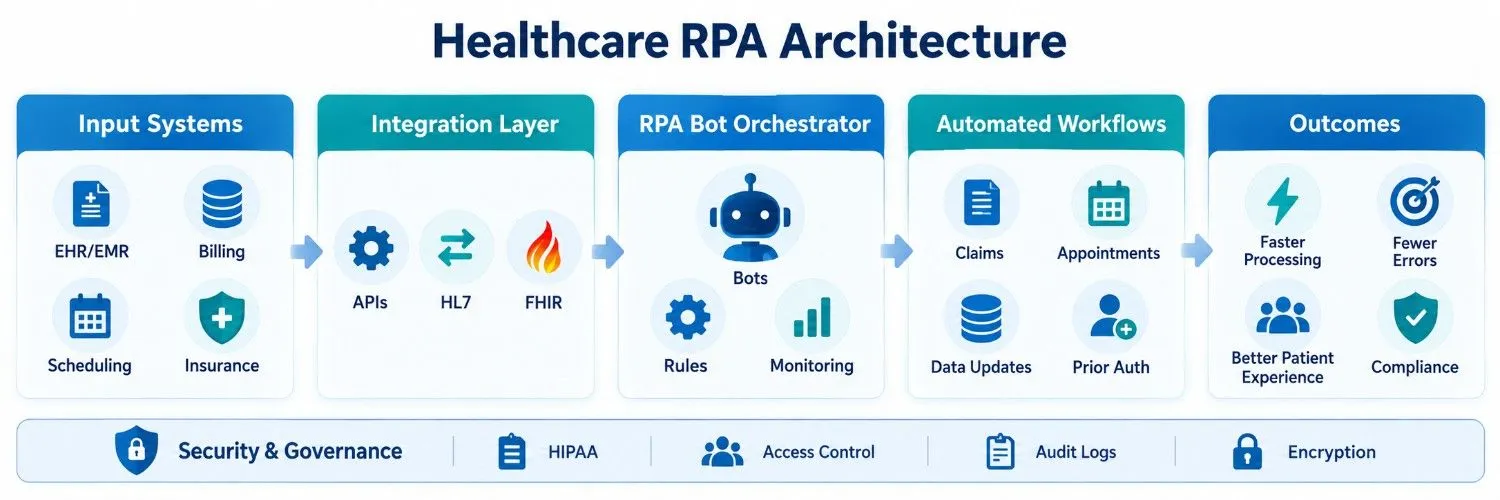
RPA can support interoperability by automating workflows between existing systems, especially where manual data transfer is still required.
For example:
A healthcare provider may use RPA to collect information from one application, validate it, and update another system while maintaining accurate data flow.
This makes RPA valuable for organizations that need automation without disrupting their existing healthcare technology environment.
Benefits of RPA in Healthcare
| Benefit | How RPA Helps |
|---|---|
| Faster Processing | Completes repetitive workflows quickly |
| Reduced Manual Effort | Allows employees to focus on important tasks |
| Improved Accuracy | Minimizes human data entry mistakes |
| Better Compliance | Creates consistent documentation processes |
| Enhanced Patient Experience | Enables faster healthcare services |
By automating repetitive administrative workflows, RPA allows healthcare organizations to improve operational efficiency while helping employees focus on higher-value responsibilities. The biggest impact is not replacing human expertise but creating more time for healthcare teams to deliver better patient care.
Security and HIPAA Considerations for Healthcare RPA
Healthcare data requires strong security protection because it includes sensitive patient information.
Before implementing RPA, organizations should consider:
- HIPAA compliance requirements
- Data encryption
- User access controls
- Audit logs
- Secure credential management
A properly designed RPA solution should protect protected health information (PHI) while maintaining transparency and accountability.
Security should be considered from the beginning rather than added after implementation.
Best Practices Before Implementing RPA in Healthcare
Successful automation requires careful planning.
Identify the Right Processes
The best automation opportunities are usually:
- Repetitive
- Rule-based
- High-volume
- Time-consuming
Organizations should avoid automating processes that require complex human decisions.
Improve Workflows First
Automation cannot fix inefficient processes.
Healthcare providers should review existing workflows and remove unnecessary steps before applying RPA.
Start With Small Projects
A pilot project allows organizations to test automation, measure results, and improve processes before expanding.
Involve Healthcare Teams
Employees who perform daily tasks understand workflow challenges better. Their involvement improves adoption and implementation success.
When RPA Is Not the Right Solution
Although RPA provides significant benefits, it is not suitable for every healthcare process.
RPA may not be the right choice when:
- A Process Requires Clinical Judgment: Activities involving diagnosis, medical decisions, or patient interaction require human expertise.
- The Workflow Changes Frequently: RPA works best with stable and predictable processes.
- The Process Is Poorly Defined: Automating an unclear process can create additional problems instead of improving efficiency.
Healthcare organizations should carefully evaluate each workflow before automation.
How Healthcare Organizations Can Successfully Implement RPA
A successful Robotic Process Automation in Healthcare strategy requires more than choosing an automation tool. Healthcare organizations should first understand their workflows, identify the right automation opportunities, and measure the impact of automation on efficiency, accuracy, and patient services.
1. Identify Automation Opportunities
Start by analyzing daily healthcare operations and identifying repetitive tasks that require significant manual effort.
Common opportunities include:
- Insurance eligibility verification
- Claims processing
- Patient data updates
- Appointment management
- Compliance reporting
The best candidates for automation are workflows that are repetitive, rule-based, and performed frequently.
2. Evaluate Business Impact
Before implementing RPA, organizations should evaluate the expected benefits and define measurable goals.
Important factors include:
- Time savings
- Reduction in manual errors
- Operational cost improvements
- Faster service delivery
- Better patient experience
Measuring outcomes helps organizations understand the real value of automation.
3. Select the Right Automation Approach
Healthcare organizations should consider important factors before deployment, including:
- Data security and HIPAA requirements
- System compatibility
- Scalability
- Long-term maintenance and support
The chosen approach should integrate smoothly with existing healthcare workflows and technology systems.
4. Test and Optimize
Start with a controlled pilot project before expanding automation across departments.
During testing, organizations should monitor:
- Workflow performance
- Accuracy improvements
- Employee feedback
- Process efficiency
Continuous optimization ensures that RPA delivers long-term value.
Organizations looking to implement scalable healthcare automation solutions can work with technology providers like Zensol Global Technologies to identify automation opportunities and design efficient workflows tailored to their operational needs.
The Future of Healthcare Automation
The future of healthcare automation will involve greater collaboration between RPA, artificial intelligence, and healthcare data systems.
Organizations are moving toward intelligent automation where technology can handle repetitive operations while supporting better decision-making.
Future opportunities include:
- Smarter patient communication
- Automated documentation
- Advanced workflow optimization
- Improved healthcare operations
As healthcare continues evolving, automation will play an important role in creating faster, more efficient, and patient-focused services.
Final Thoughts
Robotic Process Automation in Healthcare is helping healthcare organizations improve efficiency by automating repetitive workflows, reducing administrative burden, and improving accuracy.
From appointment management and claims processing to patient data workflows and compliance reporting, RPA provides practical solutions for modern healthcare challenges.
However, successful automation requires careful planning, secure implementation, and selecting the right processes. Organizations that combine healthcare expertise with automation technology can achieve better operational outcomes.
Zensol Global Technologies helps organizations explore healthcare automation opportunities by creating scalable solutions that support efficient workflows and long-term digital transformation goals.