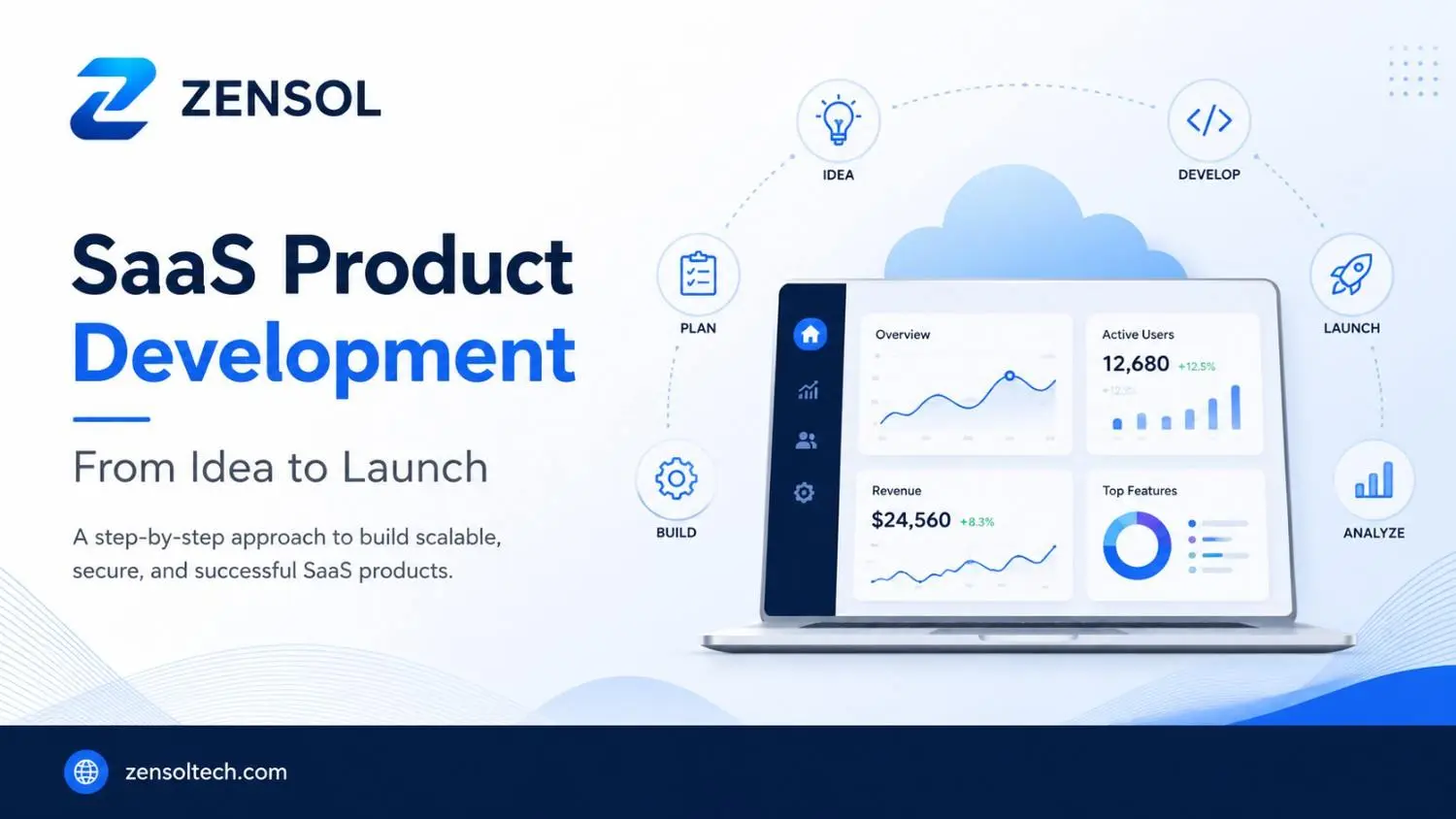
A SaaS product can be technically impressive and still fail because it solves the wrong problem, takes too long to show value, or becomes expensive to operate as customers grow. That is why SaaS product development should begin with product decisions, not programming decisions.
Before choosing frameworks or cloud services, teams need to understand who the product is for, which workflow it improves, what customers may pay for, how data will be separated, which integrations are essential, and what success will look like after launch. When standard platforms cannot support those requirements, custom software development can provide greater control over workflows, integrations, and future product growth.
In 2026, these decisions are increasingly connected. AI features create new cost and reliability questions. Usage-based pricing requires accurate metering. Enterprise customers expect stronger access controls. A good development process deals with these realities early instead of discovering them after the product reaches customers.
What Is SaaS Product Development?
SaaS product development is the process of turning a recurring software-service idea into a usable, secure, maintainable product that customers access online. It includes validation, product strategy, UX design, software architecture, development, integrations, billing, testing, deployment, analytics, and continuous improvement.
The recurring-service model changes the engineering challenge. You are not simply delivering software once. The product must continue working as customers join, usage grows, requirements change, and new versions are released.
That makes retention, operating cost, reliability, onboarding, security, and scalability part of product development rather than post-launch concerns.
Why SaaS Products Need a Different Development Approach
A SaaS platform may serve many companies or customer groups through shared infrastructure. That creates decisions around tenant isolation, permissions, billing, data ownership, availability, and upgrades.
AWS describes tenant isolation as a foundational SaaS concern because a shared environment still has to prevent one tenant from accessing another tenant's resources.
This is why a SaaS application can “work” in development and still be poorly designed as a business. Slow onboarding hurts activation. Weak tenant controls create risk. Expensive infrastructure damages margins. Missing product analytics leaves teams guessing about what customers actually use.
SaaS Product Development Stages at a Glance
| Stage | Primary Goal | Key Output | Common Risk |
|---|---|---|---|
| Validation | Confirm a real problem | Defined user and use case | Building on assumptions |
| Strategy | Set product direction | Value proposition and roadmap | Feature overload |
| MVP | Validate the core workflow | Small useful release | Oversized scope |
| Architecture | Create a reliable foundation | Data, tenancy and integration model | Premature complexity |
| UX & Development | Deliver usable value | Working product | Slow time-to-value |
| Testing | Validate real workflows | Release-ready product | Testing screens in isolation |
| Launch & Learning | Improve using evidence | Usage and customer insights | Treating launch as the finish |
SaaS Product Development Process: From Idea to Launch
1. Validate the Problem and Customer
Start with evidence that a problem exists.
Who experiences it? How frequently? What are they doing today instead? Is the existing workaround frustrating enough that someone would change products, change processes, or pay for a better solution?
Customer interviews are useful when they focus on actual behaviour. Asking, “Would you use this?” often produces polite but weak evidence. Understanding what people currently spend time or money solving is more valuable.
Competitor research matters too, but the purpose is not to copy feature lists. Look for gaps in workflow, positioning, pricing, onboarding, integrations, or customer experience.
The goal at this stage is simple: reduce the risk of building something people do not need.
2. Define the Product Strategy and MVP
Once the problem is clear, define the ideal customer profile, core use case, value proposition, business model, and first measurable outcome. These decisions give the product a clear direction before features start expanding.
Then decide what genuinely belongs in the MVP. A strong SaaS MVP is not simply a product with fewer features. It should contain the shortest complete workflow that allows a target customer to achieve a meaningful result.
For early-stage teams, software development for startups often follows the same principle: prove the core value first and delay features that do not help validate the product. A document-approval SaaS platform, for example, may initially need document upload, reviewer assignment, status tracking, notifications, and permissions. Advanced reporting, white-labelling, and complex automation can come later.
Keep the scope focused without compromising security, usability, or reliability. The first release should be small enough to test quickly but complete enough for real users to judge whether the product solves the problem.
3. Design the Architecture Around the Business Model
Architecture choices should reflect how the SaaS product will actually operate.
Decide how tenants are identified, how customer data is isolated, where permissions are enforced, which system owns important data, and how services communicate. AWS's SaaS guidance shows that tenant context can affect authentication, service calls, data access, logs, and metrics rather than being a single database setting.
Do not design for imaginary scale.
A startup serving its first customers rarely needs the same architecture as an established platform handling millions of events. Premature microservices, excessive infrastructure, or unnecessary abstraction can increase cost and development time before they create business value.
For a deeper look at infrastructure, deployment, scalability, and cloud architecture decisions, read our guide to cloud application development.
4. Choose a Maintainable Tech Stack and Design the User Journey
There is no universal “best SaaS tech stack.”
Technology should fit the product requirements, integrations, engineering skills, security needs, expected scale, ecosystem support, and long-term maintenance burden.
A stack your team understands deeply is often more valuable than a fashionable combination that creates operational complexity.
At the same time, design how customers reach value.
SaaS UX begins before the dashboard. Signup, workspace creation, invitations, permissions, data import, first-run setup, and onboarding can determine whether a new customer ever reaches the feature you worked hardest to build.
Measure time-to-value: how quickly can a new user complete the first action that demonstrates why the product is worth keeping?
5. Build Integrations, Billing and Analytics Into the Product
Development includes more than frontend screens and backend endpoints. Payments, notifications, APIs, search, analytics, deployment pipelines, monitoring, and third-party services can become part of the core experience.
Verify important integrations before committing them to scope. An API may exist without exposing the exact data, permissions, or write operations your workflow requires.
Pricing deserves similar attention.
Stripe currently supports flat-rate, per-seat, tiered, usage-based, and other recurring pricing structures. Usage-based billing depends on capturing and aggregating customer usage, which means the pricing model can create technical requirements for metering, event reliability, billing logic, and customer reporting.
Product analytics should also be planned before launch. Decide how you will measure activation, drop-off, feature adoption, and retention before those events start happening.
6. Build Security and Testing Into Development
Security should influence design from the beginning.
Authentication, authorization, tenant isolation, encryption, API protection, logging, backups, secrets management, dependency security, and recovery all become harder to retrofit once customers and data are already inside the system.
CISA's Secure by Design guidance similarly encourages software manufacturers to make security a core part of product design rather than shifting the burden to customers.
Testing should focus on complete user journeys.
Can a new organization register, invite team members, assign the correct permissions, change plans, recover an account, complete the main workflow, and receive the correct notifications?
Also test what happens when things fail. Third-party APIs go offline. Payments fail. Requests are retried. Permissions change. Real SaaS reliability depends on handling these cases predictably.
7. Launch to Learn, Not Just to Ship
A controlled launch gives the team something specifications cannot: evidence from real behaviour.
Measure whether customers reach the core outcome, where they leave onboarding, which features they return to, what creates support requests, and why active users stop returning.
Usage alone is not enough. A feature may receive many clicks because it is valuable, confusing, or unavoidable.
Combine product analytics with customer conversations.
The roadmap after launch should respond to observed problems and opportunities rather than becoming a queue of every feature somebody requests.
How Much Does SaaS Product Development Cost in 2026?
There is no responsible universal price for building a SaaS product. The useful question is what is creating the engineering effort?
A focused MVP with one core workflow, limited roles, straightforward billing, and few integrations is fundamentally different from a B2B SaaS platform requiring SSO, granular permissions, audit trails, migration, AI features, mobile applications, and several external systems.
Cost commonly increases with:
- workflow and UX complexity
- number of roles and permission levels
- third-party integrations
- data migration
- security or regulatory requirements
- AI processing
- mobile development
- infrastructure requirements
- testing depth
- post-launch support
A credible estimate should explain its assumptions. If API access, migration volume, security scope, or major workflows are still unknown, the estimate should acknowledge that uncertainty rather than hide it behind a fixed number.
How Long Does SaaS Product Development Take?
Think in planning scenarios rather than promises.
A narrowly scoped MVP with a proven workflow and limited dependencies may move from validated requirements to launch in a few months. A product with multiple roles, billing rules, integrations, migration, enterprise security requirements, or complex AI workflows can take considerably longer.
Timeline risk usually comes from uncertainty more than coding speed.
Projects slow down when teams discover late that an integration cannot support a required operation, permissions are more complex than expected, the MVP keeps expanding, or architecture has to be redesigned.
The more uncertainty you remove during validation and technical discovery, the more reliable the delivery plan becomes.
SaaS Product Development Decisions That Matter More in 2026
AI Should Have a Defined Job
Adding AI because competitors have an AI button is not a product strategy.
Define which user task it improves, what data it needs, how success will be measured, what happens when the output is wrong, and whether a person needs to review the result.
AI features also introduce operational considerations such as model cost, latency, evaluation, logging, and output reliability. NIST's Generative AI Profile reinforces the need to identify and manage risks specific to generative AI systems rather than treating them like ordinary deterministic software.
Pricing Is Becoming an Architecture Decision
Metered and hybrid models deserve early technical consideration.
Stripe removed its legacy usage-based billing approach in 2025 in favour of its newer meter-based model, an example of how modern billing infrastructure is becoming more explicit about usage measurement.
If customers pay per API request, generated report, processed document, storage unit, or AI action, inaccurate event tracking can become a billing problem as well as an analytics problem.
Scalability Should Include Unit Economics
“Can it handle more users?” is only half the question.
Teams should also ask what each additional customer costs to serve.
A technically scalable architecture that causes infrastructure, AI inference, support, or data-processing costs to rise faster than revenue is not economically scalable.
That is why capacity, observability, product pricing, and infrastructure efficiency should be considered together.
Common SaaS Product Development Mistakes
One common mistake is building too much before learning enough. A six-month feature roadmap cannot compensate for weak demand.
Another is treating integrations as simple connectors. External systems have permission models, limits, data inconsistencies, outages, and vendor dependencies that can reshape scope.
Teams also underestimate onboarding. A strong feature that customers cannot configure or discover quickly may never get a fair chance to prove its value.
Finally, avoid scaling architecture for prestige. Build enough flexibility to support credible growth, then use real usage patterns to decide where engineering investment is justified.
When Should You Work With a SaaS Development Partner?
External development support can make sense when a company has validated the product opportunity but lacks engineering capacity, SaaS architecture experience, integration expertise, cloud skills, or specialised AI capability.
The right partner should question assumptions, clarify dependencies, and help reduce technical uncertainty before expanding scope.
Zensol Global Technologies provides software development services for SaaS applications, custom software, cloud-based systems, and API integrations, helping businesses move from product requirements into architecture and development when external expertise is needed.
Final Thoughts
Successful SaaS product development is a process of reducing uncertainty in the right order.
Validate the problem before expanding scope. Build the MVP around a complete user outcome, and let the business model shape architecture, billing, analytics, and integrations. Security and testing should be part of development from the beginning, while real customer behaviour should guide what deserves further investment after launch.
The strongest SaaS products rarely begin with the most features. They learn quickly, make deliberate technical choices, and grow without unnecessary complexity. If you already have a SaaS idea or an existing platform and need help planning the next stage, you can discuss your SaaS project with Zensol Tech.