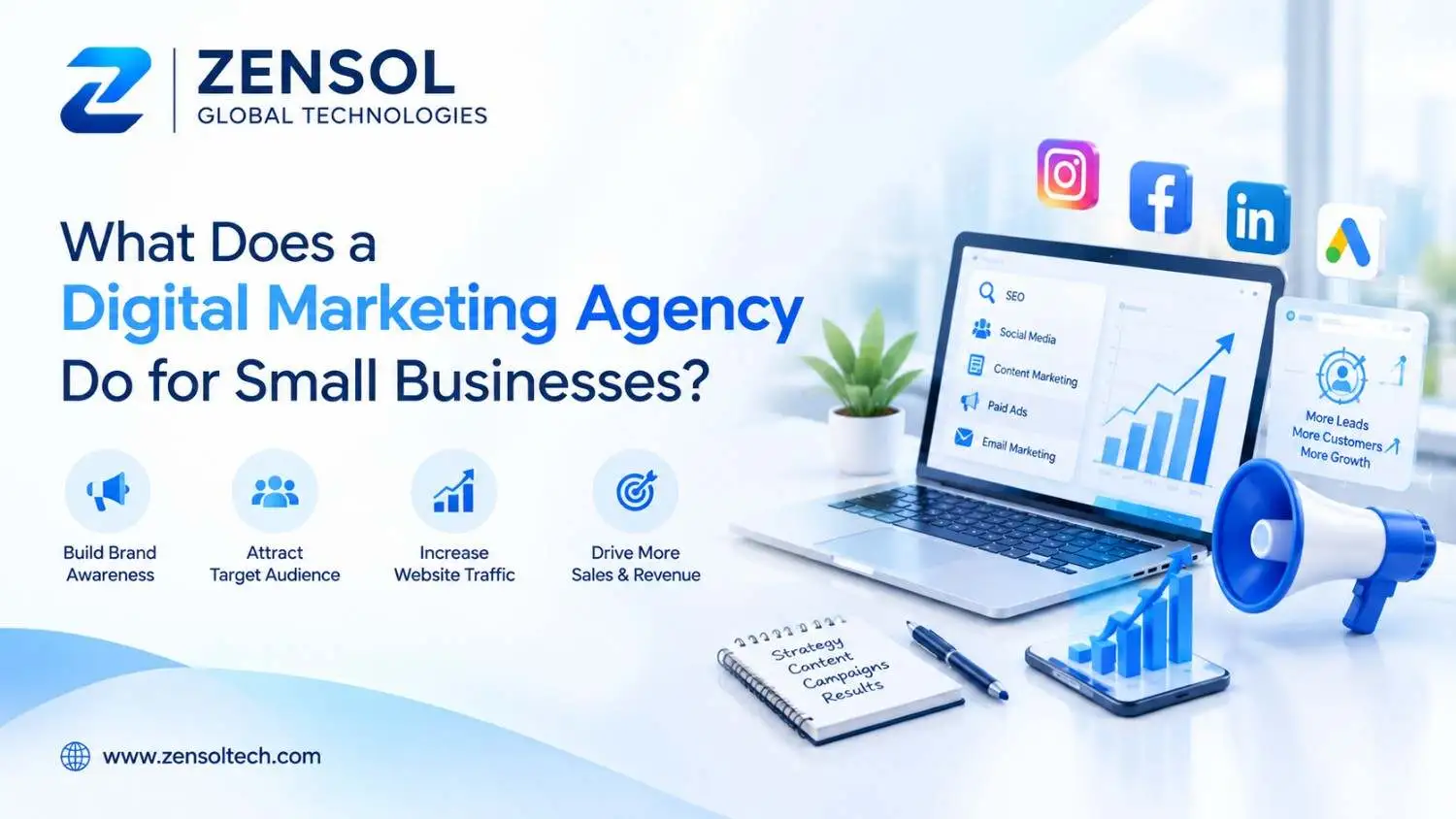
A digital marketing agency helps small businesses attract potential customers, generate qualified leads, and increase sales through search engines, paid advertising, social media, email, and website optimization. It develops marketing strategies, manages campaigns, and measures results to help businesses make better decisions about their budgets.
Understanding what a digital marketing agency does for small businesses helps owners choose the right services, avoid wasted spending, and identify opportunities for growth. The goal is not to use every marketing channel. It is to reach the right customers and turn marketing activity into measurable business outcomes.
What Does a Digital Marketing Agency Do Day to Day?
An agency identifies marketing opportunities, plans the work, manages agreed activities, and evaluates performance. Its responsibilities depend on the services included in the contract.
Typical responsibilities include:
- Research: Analyze the website, competitors, target audience, and existing marketing performance.
- Strategy: Select suitable channels, establish priorities, and define measurable objectives.
- Implementation: Create campaigns, improve landing pages, publish content, and configure tracking.
- Optimization: Identify underperforming activities and make evidence-based improvements.
- Reporting: Explain results, highlight problems, and recommend next steps.
The business owner also has responsibilities. The agency needs accurate information, timely approvals, and feedback about whether incoming leads become paying customers.
For example, a plumbing company might receive 40 inquiries in a month, but only 15 may come from customers within its service area. The agency should investigate targeting and messaging instead of celebrating all 40 inquiries as equally valuable.
Good marketing management connects completed work to a business decision. A report should explain what happened, why it matters, and what should happen next.
Which Digital Marketing Services Do Small Businesses Need?
The right services depend on how customers find a business, how they make purchasing decisions, and how quickly the company needs results. Most small businesses should prioritize a few suitable channels instead of spreading their budgets across everything.
Search Engine Optimization (SEO)
SEO helps a website appear in relevant unpaid search results. It can include technical improvements, keyword research, service-page optimization, useful content, internal linking, and local SEO.
A roofing company might improve its roof replacement page, explain its storm damage repair services, and provide accurate information about the areas it serves. These improvements help potential customers understand the business before requesting an estimate.
SEO is generally a longer-term investment. Results depend on competition, website condition, content quality, and implementation. No agency can guarantee a specific search ranking.
Pay-Per-Click Advertising (PPC)
PPC advertising allows businesses to pay for ad interactions, commonly clicks. Search ads can reach people looking for particular services, while paid social campaigns can target selected audiences.
An agency may manage keyword targeting, ad copy, bidding, budgets, landing pages, and conversion tracking.
Paid advertising can help test demand or generate traffic relatively quickly. However, clicks do not guarantee customers. Businesses should evaluate qualified leads, booked appointments, sales, and acquisition costs before deciding whether to increase spending.
Social Media Marketing
Social media marketing helps businesses build awareness, communicate with customers, and promote products or services.
An agency may create content calendars, design posts, produce videos, manage approved interactions, or run paid campaigns.
A restaurant might promote seasonal menus and local events, while a business-to-business consultant could share professional insights on LinkedIn. The right platform depends on the target audience and business objective, not the number of profiles an agency can manage.
Content Marketing and Email Marketing
Content marketing uses articles, buying guides, service pages, case studies, and videos to answer customer questions and build trust. Email marketing helps businesses communicate with subscribers and past customers who have agreed to receive messages.
A remodeling company could publish a guide explaining the factors that affect kitchen renovation costs. It could then share relevant planning advice with subscribers who want to learn more.
Content should help readers make informed decisions. Publishing repetitive articles solely to target keywords is not a substitute for useful information.
Website Design, Conversion Optimization, and Analytics
A website can attract visitors without generating enough inquiries or sales. Confusing service descriptions, poor mobile usability, unclear offers, and difficult contact forms can prevent visitors from taking action.
An agency may improve landing pages, navigation, forms, calls to action, and conversion tracking. Analytics helps connect marketing activity to phone calls, form submissions, purchases, and booked appointments.
If visitors regularly reach a service page but rarely submit an inquiry, improving the page may be more valuable than buying additional traffic.
Which Services Should Your Small Business Prioritize?
Choose services according to the problem you need to solve, rather than simply purchasing everything an agency offers.
| Business problem | Services to consider | Primary measure |
|---|---|---|
| Customers cannot find you locally | Local SEO and Google Business Profile optimization | Qualified local inquiries |
| Relevant organic traffic is low | SEO and content marketing | Qualified organic leads |
| You need to test demand quickly | Paid search advertising | Cost per qualified lead |
| Visitors rarely contact you | Landing page improvements and conversion optimization | Conversion rate |
| Existing customers rarely return | Email marketing and CRM automation | Repeat purchases |
| Marketing performance is unclear | Analytics and conversion tracking | Acquisition cost and sales |
These are starting points, not universal rules. A business with a weak offer, poor customer service, or insufficient capacity may need to address those problems before increasing marketing spending.
Before choosing a service, establish a baseline, identify one primary objective, and agree on how progress will be measured.
How Much Does a Digital Marketing Agency Cost for a Small Business?
Digital marketing costs depend on the services required, provider experience, competition, campaign complexity, and amount of work involved. A focused local SEO engagement differs significantly from a multi-channel campaign involving advertising, content production, website improvements, and analytics.
For initial planning, small businesses may encounter the following illustrative monthly budget ranges:
| Engagement | Indicative monthly budget | Possible scope |
|---|---|---|
| Limited or specialized support | $500–$1,500 | Consulting or a narrow set of tasks |
| Focused ongoing service | $1,500–$3,000 | One primary marketing channel |
| Broader marketing support | $3,000–$6,000 | Several coordinated activities |
| Extensive multi-channel program | $6,000+ | Greater campaign complexity and specialist involvement |
These are broad planning estimates, not verified market averages or guaranteed quotes. Actual prices can fall outside these ranges, and some providers charge project fees or hourly rates instead of monthly retainers.
Common pricing models include monthly retainers for ongoing services, project fees for defined work, hourly consulting, and management fees based on advertising spend.
When comparing proposals, separate the agency's management fee from advertising spend, setup costs, software, content production, and other expenses. Confirm the deliverables, reporting responsibilities, contract length, and cancellation terms.
The best choice is not automatically the cheapest agency or the largest package. It is the proposal that funds the right work for your business goals and available budget.
How Do You Measure Whether Digital Marketing Is Working?
Traffic and impressions provide context, but they do not automatically translate into revenue. Small businesses should track what happens between the first interaction and the completed sale.
Consider a hypothetical home services company that spends $2,000 on advertising in one month. It receives 40 inquiries, of which 15 are qualified. Five result in booked appointments, and three become paying customers.
| Metric | Calculation | Result |
|---|---|---|
| Cost per inquiry | $2,000 ÷ 40 | $50 |
| Cost per qualified lead | $2,000 ÷ 15 | $133.33 |
| Cost per booked appointment | $2,000 ÷ 5 | $400 |
| Advertising cost per acquired customer | $2,000 ÷ 3 | $666.67 |
These illustrative figures exclude agency fees, sales labor, software, and other acquisition expenses.
Now suppose each customer generates $2,000 in revenue and the business retains 40% as gross profit after direct service costs. Three customers would generate $2,400 in gross profit before marketing and other overhead. After the $2,000 advertising spend, only $400 remains before agency fees and other acquisition expenses.
This example shows why revenue alone can be misleading. A campaign may generate sales but still deliver weak profitability once all costs are included.
A useful agency report should identify which channels generate qualified leads, how many leads become customers, what acquisition costs include, and which changes could improve the result.
What Should You Expect From an Agency Each Month?
Agree on deliverables and reporting before signing a contract. The precise scope depends on the services, but a useful framework includes:
| Stage | Expected output | Purpose |
|---|---|---|
| Assessment | Baseline, tracking checks, and priorities | Identify the main problems |
| Planning | Agreed scope and objectives | Direct resources toward business goals |
| Execution | Completed campaigns or website improvements | Deliver the agreed work |
| Reporting | Leads, conversions, costs, and limitations | Explain performance |
| Review | Next actions and budget recommendations | Support informed decisions |
During the first month, work may focus on audits, tracking, and setup. Later months may involve more execution and optimization. Timelines vary, so agree on milestones rather than expecting immediate results from every channel.
Should You Hire an Agency, a Freelancer, or an In-House Marketer?
Each option has different costs and capabilities.
- Freelancer: Suitable for a specific task, such as SEO consulting, content writing, or advertising management.
- In-house marketer: Useful when the business needs daily support and has a consistent workload.
- Digital marketing agency: Worth considering when several skills must work together and the business lacks the time or resources to coordinate them internally.
A business with one clearly defined need may start with a freelancer. An agency may be more convenient when multiple channels require coordination, while an in-house hire can make sense when the workload is substantial and ongoing.
Choose according to the skills required, available budget, and level of coordination your business needs.
How Do You Choose the Right Digital Marketing Agency?
Evaluate potential agencies against five practical criteria.
1. Relevant experience: Ask for case studies involving similar customers or business challenges. Find out what work was performed and how results were measured.
2. A clear scope: The proposal should define deliverables, responsibilities, fees, exclusions, and reporting.
3. Meaningful metrics: Local service companies may prioritize qualified calls and booked appointments, while online stores may focus on purchases and acquisition costs.
4. Account ownership: Retain appropriate access to your website, advertising accounts, analytics, and customer data.
5. Realistic expectations: Be cautious of guaranteed rankings, unsupported revenue promises, unclear reporting, or pressure to buy unnecessary services.
A trustworthy agency explains its approach, acknowledges uncertainty, and recommends changes based on evidence rather than promises it cannot control.
When Should a Small Business Hire a Digital Marketing Agency?
Consider professional support when your website attracts few qualified inquiries, relevant search visibility is weak, advertising costs are difficult to justify, or your team lacks the time and skills to manage marketing consistently.
You do not need to outsource everything at once. A business with a limited budget could begin with a website audit, a local SEO project, or an assessment of existing advertising campaigns.
Before investing, make sure your business has a clear offer, the capacity to serve additional customers, and a process for following up with leads. Marketing can create opportunities, but operational problems may prevent those opportunities from becoming sales.
Final Thoughts
A digital marketing agency can help small businesses attract relevant customers, improve their online presence, and make better-informed marketing decisions. Its value depends on choosing appropriate services, setting clear expectations, and measuring outcomes that matter to the business.
Before hiring an agency, identify your biggest marketing challenge, establish a realistic budget, and ask how the proposed work will address it.
If you are evaluating marketing support, explore Zensol Technologies' digital marketing services. Review the available options and discuss your business goals, current challenges, and budget to determine which activities deserve priority.