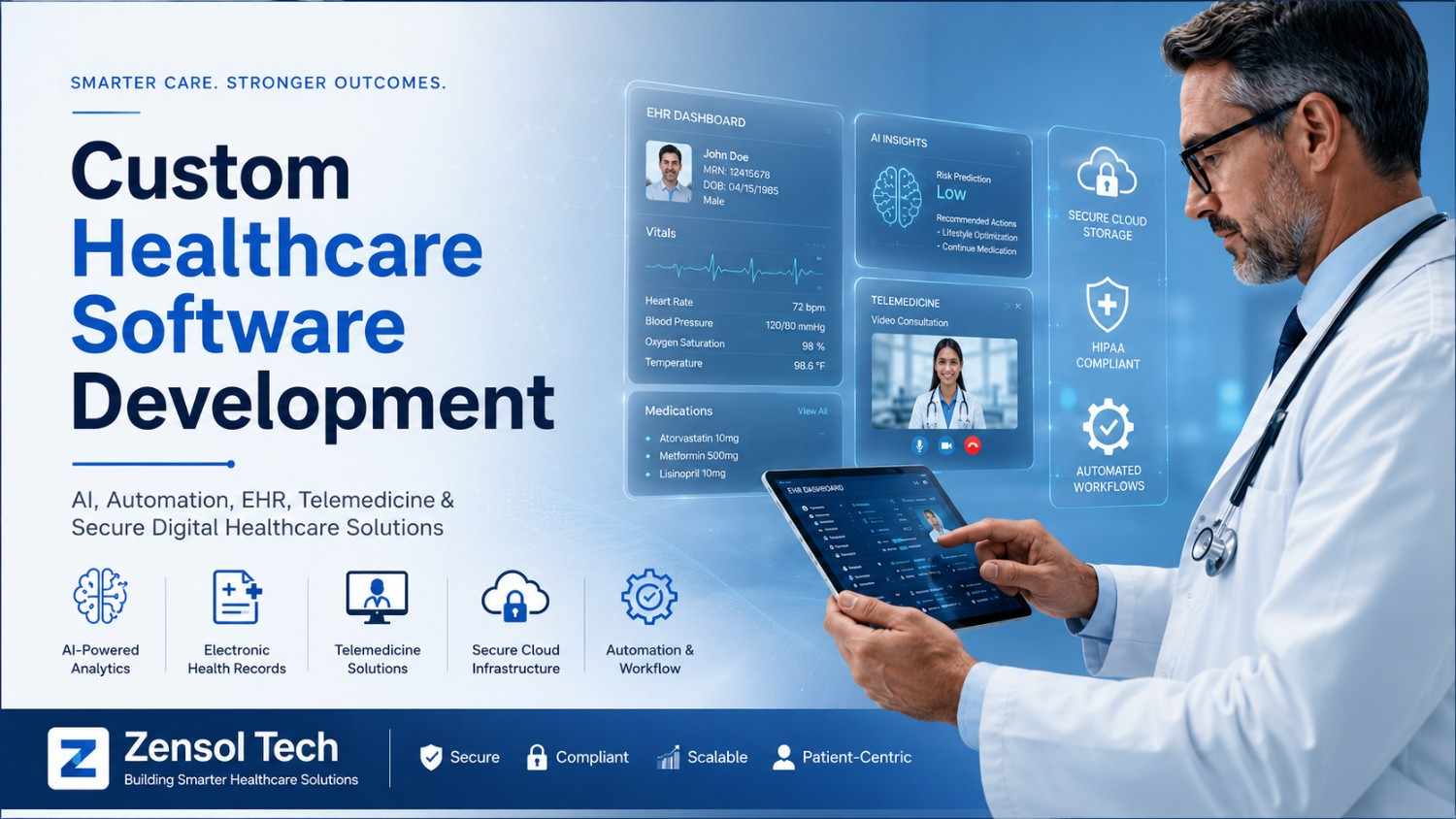
Custom healthcare software development has become a critical foundation for modern healthcare systems that aim to improve patient care, operational efficiency, and data-driven decision-making. As healthcare organizations grow more complex, traditional software systems are no longer able to support the speed, accuracy, and integration required in today’s digital-first environment.
In many hospitals and clinics, fragmented systems still cause delays in accessing patient records, inefficient communication between departments, and errors in manual workflows. These challenges not only increase operational costs but also directly impact the quality of patient outcomes.
To overcome these limitations, healthcare providers are now shifting toward custom healthcare software development solutions that are built specifically around their clinical workflows, compliance requirements, and long-term scalability needs rather than relying on generic platforms.
At Zensol Tech, we design and develop intelligent healthcare software systems powered by AI, automation, and secure architecture to help healthcare organizations modernize their operations and deliver faster, safer, and more efficient patient care.
What is Custom Healthcare Software Development?
It is the process of designing, building, and deploying software solutions tailored specifically to the needs of healthcare organizations.
These solutions are created to support real-world healthcare workflows such as:
- Patient data management
- Hospital administration
- Telemedicine services
- Electronic Health Records (EHR)
- Medical billing systems
Custom healthcare software improves efficiency, reduces human errors, and ensures compliance with healthcare regulations like HIPAA and GDPR.
Custom healthcare software ensures that hospitals and clinics are not restricted by limitations of pre-built platforms and can scale according to their operational needs.
Why Healthcare Needs Custom Software Solutions
Healthcare is one of the most complex industries in the world due to its dependency on accuracy, speed, and compliance, where even small system errors can directly impact patient outcomes. Custom software helps solve these challenges by aligning technology with real-world medical workflows and improving overall healthcare delivery.
It enhances clinical efficiency by automating routine processes such as appointment scheduling, patient record updates, billing, and reporting workflows, allowing medical staff to focus more on patient care instead of administrative work.
It also improves decision-making with data by integrating AI and analytics that provide real-time insights into patient conditions, resource utilization, and treatment effectiveness, helping both clinical and administrative teams make more informed decisions.
To better understand how these systems are structured and implemented, let’s explore their key features.
Key Features of Healthcare Software Solutions
A well-designed healthcare software system includes powerful modules that streamline both clinical and administrative operations, improve patient care, and enhance overall efficiency.
Patient Management System
Centralized patient records with complete medical history tracking, appointment scheduling, and seamless inter-department coordination for better care delivery.
Electronic Health Records (EHR)
Secure and digital storage of patient health data, enabling authorized healthcare professionals to access real-time information for accurate diagnosis and treatment.
Telemedicine Integration
Remote consultation features through video, audio, or chat, allowing patients to connect with doctors anytime, improving accessibility and reducing hospital load.
Billing and Insurance Management
Automated billing workflows integrated with insurance providers to reduce errors, speed up claim processing, and improve financial operations.
AI-Powered Healthcare Analytics
Advanced AI-driven insights that help in early disease detection, predictive diagnosis, treatment optimization, and patient monitoring.
Data Security & Compliance
Strong security framework including encryption, role-based access control, and compliance with healthcare regulations like HIPAA and GDPR to ensure complete data protection.
Custom Healthcare Software vs. Off-the-Shelf Software
| Factor | Custom Healthcare Software | Off-the-Shelf Software |
| Flexibility | Fully tailored | Limited customization |
| Scalability | Built for growth | May have restrictions |
| Compliance | Designed around requirements | Depends on provider |
| Integration | Custom integrations possible | Limited integration options |
| Cost | Higher upfront cost | Lower initial cost |
| Long-term value | Higher ROI | May become limiting |
Types of Healthcare Software
Healthcare software comes in various forms depending on its purpose and functionality.
1.Hospital Management Systems (HMS)
Hospital Management Systems (HMS) are comprehensive platforms used to manage hospital operations such as patient admissions, staff scheduling, billing, inventory, and overall administrative workflows.
2.Electronic Medical Records (EMR)
Electronic Medical Records (EMR) systems store patient medical data digitally within a single healthcare organization, enabling quick access to medical history, diagnosis, and treatment records.
3.Telemedicine Software
Telemedicine platforms enable remote healthcare services through video, audio, or chat consultations, improving accessibility for patients in remote and underserved areas.
4.Laboratory Information Systems (LIS)
Laboratory Information Systems manage laboratory workflows including test processing, sample tracking, result reporting, and integration with hospital systems.
5.Healthcare CRM Systems
Healthcare CRM systems help manage patient relationships, communication, appointment follow-ups, and engagement to improve overall patient experience and retention.
Each type of healthcare software contributes to improving operational efficiency, reducing manual workload, enhancing patient care, and enabling data-driven decision-making in modern healthcare organizations.
Development Process of Healthcare Software
Developing healthcare software requires a structured and secure lifecycle that ensures performance, scalability, and compliance.
Requirement Analysis
This phase focuses on understanding healthcare workflows, user roles, and system requirements to define a clear project scope.
Design & Planning
UI/UX design and system architecture are created to ensure usability, scalability, and smooth user experience.
Development & Integration
The core system is built using modern technologies and integrated with third-party services like labs, pharmacies, and insurance systems.
Testing & Deployment
The system is tested for security, performance, and compliance before being deployed into a live environment.
Maintenance & Scaling
Continuous updates, performance improvements, and feature enhancements ensure long-term system stability.
At Zensol Tech, we follow an agile development methodology that ensures faster delivery, flexibility, and continuous improvement throughout the development lifecycle.
Cost of Healthcare Software Development
The cost of developing healthcare software depends on system complexity, features, integrations, security requirements, and scalability needs.
| Type of System | Features Included | Estimated Cost (USD) |
| Basic Healthcare System | Patient management, appointment scheduling, basic admin dashboard | $20,000 – $50,000 |
| Mid-Level Healthcare System | Electronic Health Records (EHR), billing system, reporting dashboard, third-party integrations | $50,000 – $150,000 |
| Advanced Hospital Platform | AI-powered analytics, telemedicine integration, multi-department management, real-time reporting | $150,000 – $300,000 |
| Enterprise AI Healthcare Ecosystem | Predictive analytics, workflow automation, cloud infrastructure, large-scale hospital network support | $300,000 – $500,000+ |
Note:
The final cost may vary depending on project scope, feature complexity, security requirements, integrations, and development timeline.
Healthcare software is a long-term investment that improves operational efficiency, reduces manual workload, and enhances patient care outcomes.
Benefits, Challenges & Solutions in Healthcare Software Development
Custom healthcare software development offers significant advantages for modern healthcare organizations, but it also comes with certain challenges that must be addressed using the right strategies.
Key Benefits
- Operational Efficiency: Automation reduces administrative workload and improves workflow speed across healthcare systems.
- Enhanced Patient Experience: Patients receive faster services, better communication, and easier access to healthcare platforms.
- Strong Data Security: Encryption, access control, and secure system architecture protect sensitive medical data.
- Scalability for Growth: Custom solutions can scale easily as healthcare organizations expand.
- AI and Automation Integration: AI enables smarter diagnostics, predictive analytics, and improved healthcare decision-making.
Key Challenges & Solutions
Data Security Risks: Healthcare systems handle highly sensitive data, making them a target for cyber threats.
Solution: Use encryption, multi-factor authentication, role-based access control, and continuous monitoring.
Regulatory Compliance: Healthcare software must follow regulations such as HIPAA and GDPR.
Solution: Build compliance-first systems with proper governance and audit trails.
Integration Issues: Healthcare platforms must connect with labs, pharmacies, and legacy systems.
Solution: Use API-based and modular architecture for seamless integration.
High Development Costs: Custom healthcare software requires significant investment.
Solution: Start with an MVP and scale gradually based on real usage.
Future of Healthcare Software (AI-Driven Transformation)
The future of healthcare will be fully connected, intelligent, and driven by data, improving both patient outcomes and operational efficiency.
AI in Healthcare Diagnostics
AI-powered systems can support earlier disease detection by analyzing medical data, imaging, and patient history, helping healthcare professionals make faster and more informed decisions.
Predictive Healthcare Systems
Next-generation healthcare platforms will anticipate patient risks before symptoms appear, enabling preventive care and reducing critical health emergencies.
Smart Hospitals
Hospitals will become fully intelligent environments where AI and automation manage staffing, resource allocation, patient flow, and operational decisions seamlessly.
Digital Health Ecosystems
Healthcare will evolve into interconnected digital ecosystems where hospitals, labs, pharmacies, insurers, and patients operate in a unified, real-time network.
Final Thoughts
Custom healthcare software development is transforming the medical industry by improving efficiency, accuracy, and patient care. With the rise of AI and automation, healthcare systems are becoming smarter and more connected than ever before.
Businesses that invest in custom healthcare solutions gain a strong competitive advantage in the digital era.
If your healthcare organization is planning to modernize operations, improve patient experience, or build an AI-powered healthcare platform, Zensol Tech can help you design, develop, and scale a secure custom healthcare software solution tailored to your needs.
Frequently Asked Questions
It is the process of building tailored software systems designed specifically for healthcare organizations.
AI, cloud computing, machine learning, and secure backend frameworks are commonly used.
Custom healthcare software development ensures secure, scalable, and efficient healthcare systems tailored to hospital workflows. It improves data accuracy, patient management, and operational efficiency through automation and integration.