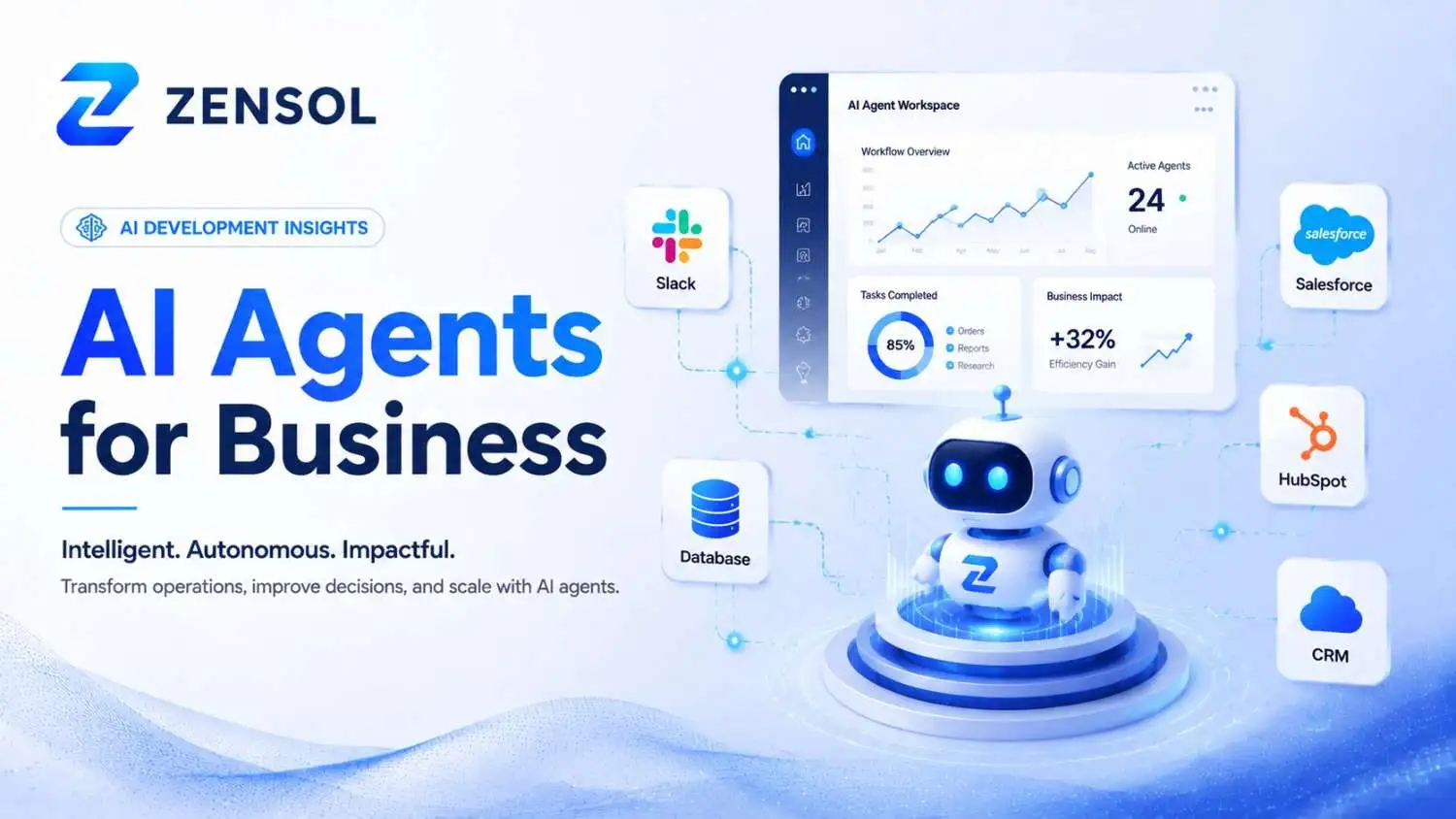
Businesses are entering a new phase of digital transformation where automation is no longer limited to simple repetitive tasks. Companies today need intelligent systems that can understand information, make decisions, communicate with different platforms, and complete complex workflows efficiently. This is where AI Agents for Business are creating new opportunities by helping organizations automate processes, improve productivity, and deliver better customer experiences.
Traditional automation systems are effective for predictable tasks, but they often struggle when workflows require judgment, context, or decision-making. AI agents overcome this limitation by combining artificial intelligence, business data, and software integrations to perform tasks with greater flexibility.
From sales and customer support to finance, marketing, healthcare, and operations, companies are adopting AI-powered agents and AI solutions for businesses to reduce manual work and build smarter business processes. As businesses continue investing in artificial intelligence, AI agents are becoming an important part of modern AI workflow automation strategies.
What Are AI Agents for Business?
AI Agents for Business are intelligent software systems that use artificial intelligence models, business data, and connected tools to analyze information, make decisions, and complete tasks automatically.
Unlike traditional automation, which follows fixed rules, AI agents can understand goals and determine the best way to achieve them.
For example:
A traditional automation system may send a confirmation email after a customer submits a form.
An AI sales agent can go further by analyzing the customer request, checking previous interactions, identifying buying intent, creating a personalized response, updating the CRM, and scheduling follow-up actions.
This ability makes AI agents valuable for businesses because they can manage workflows that require reasoning, communication, and interaction between multiple systems.
Modern AI agents commonly use technologies such as:
- Large Language Models (LLMs)
- Natural Language Processing (NLP)
- Machine Learning
- APIs and software integrations
- Business databases
- Automation platforms
The goal of AI agents is not simply replacing employees. Instead, they act as intelligent assistants that help teams work faster, reduce repetitive tasks, and focus on higher-value activities.
How AI Agents Work in Business Operations
AI agents work by combining reasoning capabilities with access to business information and external tools. They receive a goal, analyze available data, plan actions, and execute tasks through connected systems.
A simplified AI agent workflow looks like this:
Business Data → AI Agent → AI Model → Tools & APIs → Business Action
The process usually involves several stages.
Understanding Business Goals
The AI agent first identifies what needs to be achieved.
For example:
"Find potential customers who are ready to purchase and prepare personalized outreach."
The agent understands the objective instead of only following a predefined command.
Analyzing Data and Context
AI agents can collect information from different business sources, including:
- Customer relationship management systems
- Internal documents
- Databases
- Knowledge bases
- Analytics platforms
This allows them to make decisions based on relevant business information.
Planning and Executing Tasks
Unlike traditional automation tools, AI agents can determine the steps required to complete a workflow.
For example, a customer support AI agent can:
- Understand a customer complaint
- Review previous conversations
- Search company knowledge resources
- Generate a suitable response
- Update the support ticket
Connecting Business Systems
The real power of AI agents comes from integration.
Through APIs, secure connections, and AI integration services, AI agents can connect with existing business applications and automate workflows across different platforms.
- CRM platforms
- ERP systems
- Helpdesk software
- Marketing platforms
- Financial applications
This allows businesses to automate complete workflows instead of individual tasks.
AI Agents and Agentic AI: Moving Beyond Traditional Automation
The evolution of agentic AI is changing how businesses use artificial intelligence.
Traditional AI applications usually respond to specific instructions. Agentic AI systems are designed to work toward goals by analyzing situations, creating plans, using tools, and improving outcomes.
For example, an AI operations agent can monitor workflow performance, identify inefficiencies, analyze possible solutions, and recommend improvements.
Many enterprise AI agents also use technologies such as Retrieval-Augmented Generation (RAG). RAG allows AI systems to retrieve accurate information from company documents and databases before generating responses, making AI outputs more reliable and relevant.
Benefits of AI Agents for Business Automation
Companies are adopting AI agents because they provide measurable improvements across different departments.
Automating Repetitive Workflows
Many employees spend hours completing repetitive activities such as document processing, data entry, reporting, and information searching.
AI agents can automate these processes while maintaining consistency and improving efficiency.
For example, a finance AI agent can review invoices, extract important details, categorize expenses, and update financial records automatically.
Improving Employee Productivity
AI agents work as digital assistants that help employees complete tasks faster.
Instead of manually searching through multiple systems, employees can use AI tools to quickly access information, generate reports, and complete workflows.
This allows teams to focus more on strategic decision-making and creative work.
Enhancing Customer Experience
Customers expect faster and more personalized support.
AI customer service agents help companies provide 24/7 assistance by answering questions, analyzing requests, recommending solutions, and supporting advanced AI chatbot development services for better customer communication.
For ecommerce businesses, an AI shopping assistant can help customers discover products, answer questions, and improve purchasing decisions.
Reducing Operational Costs
AI-powered automation can reduce the time and resources required for manual processes.
Businesses can improve efficiency by:
- Reducing repetitive workload
- Minimizing processing errors
- Improving response times
- Optimizing employee productivity
How Companies Use AI Agents to Automate Workflows
Different departments use AI agents to improve specific business processes.
| Department | AI Agent Application | Business Impact |
|---|---|---|
| Sales | Lead qualification and customer follow-ups | Faster sales cycles |
| Customer Support | Automated assistance and ticket management | Improved response time |
| Marketing | Campaign analysis and content workflows | Better targeting |
| Finance | Invoice processing and reporting | Reduced manual tasks |
| HR | Candidate screening and onboarding | Faster recruitment |
| Operations | Workflow monitoring and optimization | Improved efficiency |
AI Agent Use Cases Across Industries
AI agents are becoming valuable across industries because organizations need faster processes and better decision-making.
| Industry | AI Agent Example | Benefit |
|---|---|---|
| Healthcare | Patient assistance agents | Faster information access |
| Finance | Risk analysis agents | Improved fraud detection |
| Ecommerce | AI shopping assistants | Personalized experiences |
| Manufacturing | Predictive maintenance agents | Reduced downtime |
| Logistics | Route optimization agents | Better delivery planning |
| SaaS | Customer success agents | Improved customer retention |
AI Agents vs Chatbots vs Traditional Automation
Although these technologies are connected, they serve different purposes.
| Feature | AI Agents | Chatbots | Traditional Automation |
|---|---|---|---|
| Decision-making | Advanced | Limited | Rule-based |
| Workflow execution | Multi-step tasks | Mainly conversations | Fixed processes |
| System integration | Multiple platforms | Limited | Specific systems |
| Adaptability | Context-aware | Response-based | Low flexibility |
Chatbots are useful for communication, while traditional automation works well for predictable tasks. AI agents combine communication, reasoning, and action capabilities to manage more complex business workflows.
How Much Do AI Agents Cost for Businesses?
The cost of implementing AI agents depends on several factors, including business requirements, workflow complexity, data preparation, integrations, and technology choices.
A simple AI assistant may require fewer resources, while enterprise AI agents connected with multiple systems require more advanced development and security planning.
Businesses should evaluate AI investment based on potential value, including:
- Time saved through automation
- Improved customer experience
- Reduced operational costs
- Increased employee productivity
The right AI solution is not always the most complex one. Successful implementations focus on solving specific business problems.
How Businesses Can Implement AI Agents Successfully
A successful AI implementation requires planning and a clear understanding of business objectives.
Identify Suitable Workflows
Companies should begin by finding processes where AI can create measurable improvements, such as repetitive tasks, customer support challenges, or manual data analysis.
Prepare Data and Security
AI agents require reliable information. Businesses should organize data sources, improve data quality, and establish security controls before deployment.
Choose the Right AI Approach
Depending on business needs, organizations may choose custom AI solutions, AI assistants, generative AI systems, or autonomous AI agents.
- AI assistants
- Generative AI solutions
- Autonomous AI agents
- Custom enterprise AI systems
Integrate and Monitor Performance
AI agents should connect smoothly with existing software systems. After deployment, businesses should monitor performance and continuously improve workflows.
Challenges of Implementing AI Agents
Although AI agents provide significant advantages, businesses should consider several challenges.
- Data Security: AI agents may process sensitive business information. Organizations need proper security policies, access controls, and privacy practices.
- Integration Complexity: Connecting AI agents with existing applications requires technical expertise and careful planning.
- Human Oversight: AI agents should support employees, not operate without supervision. Important business decisions should include human review.
- Accuracy and Reliability: AI systems can sometimes produce incorrect information. Testing, monitoring, and quality control are necessary for reliable results.
Future of AI Agents in Business
The future of business automation will increasingly focus on intelligent systems that can manage complex workflows independently.
AI agents will continue evolving with better reasoning capabilities, improved integrations, and stronger decision-making abilities.
Businesses that strategically adopt AI agents will have opportunities to improve operational efficiency, deliver personalized customer experiences, and build competitive advantages in the digital economy.
How Zensol Global Technologies Helps Businesses Adopt AI Solutions
Implementing AI agents requires more than selecting an artificial intelligence model. Businesses need workflow analysis, data preparation, system integration, and a clear automation strategy.
Zensol Global Technologies helps organizations identify AI automation opportunities and develop solutions that connect modern AI capabilities with practical business needs.
By combining AI expertise with software development knowledge, Zensol helps businesses create scalable AI-powered systems designed to improve efficiency, automate workflows, and deliver measurable results.
The objective is not simply adopting AI technology but building intelligent solutions that create long-term business value.
Final Thoughts
AI Agents for Business represent the next generation of intelligent automation. By combining artificial intelligence, business data, and connected software systems, AI agents enable companies to automate complex workflows and improve operational performance.
From customer support and sales automation to finance, marketing, and operations, AI agents provide businesses with a flexible approach to building smarter processes.
Organizations that focus on the right use cases, reliable data, and strategic implementation will be better prepared to take advantage of the growing opportunities created by AI-powered automation.