Businesses are rapidly adopting artificial intelligence to improve efficiency, automate repetitive work, and make better decisions from their data. However, many organizations already have existing software systems, databases, and workflows that were not designed with AI capabilities. AI Integration Services help businesses connect artificial intelligence technologies with their current applications and processes to create smarter, more efficient operations.
AI integration is not simply about adding an AI chatbot or using a new automation tool. It involves carefully connecting AI models, APIs, business applications, and data systems to solve specific operational challenges. When implemented correctly, AI can enhance customer experiences, automate manual processes, improve business intelligence, and help teams work more effectively.
For companies exploring digital transformation, AI integration provides a practical way to adopt artificial intelligence without replacing their entire technology infrastructure.
What Are AI Integration Services?
AI Integration Services are professional solutions that help businesses connect artificial intelligence capabilities with existing software, platforms, and workflows. Instead of building completely new systems, organizations can enhance their current technology environment by adding intelligent features where they provide the most value.
For example, a company using a CRM platform can integrate AI to analyze customer conversations, identify sales opportunities, and provide recommendations to sales teams. Similarly, a business using an ERP system can connect AI tools to improve reporting, forecasting, and operational decision-making.
AI integration typically combines different technologies, including:
- Artificial intelligence models
- Machine learning algorithms
- Large Language Models (LLMs)
- Generative AI applications
- AI APIs
- Natural Language Processing (NLP)
- Cloud-based AI platforms
- Business automation workflows
The goal is not to implement AI everywhere. The goal is to identify areas where AI can improve business outcomes, reduce unnecessary manual work, and create measurable value.
Why Businesses Need AI Integration Services
Many businesses already collect large amounts of information through their software systems, but they struggle to convert that data into useful insights. Employees often spend hours handling repetitive tasks, searching for information, preparing reports, or manually moving data between different platforms.
AI integration helps solve these challenges by creating connected systems that can understand information, automate workflows, and support employees with intelligent recommendations.
Automating Repetitive Business Processes
A large amount of business time is consumed by repetitive activities such as data entry, document processing, email management, customer responses, and reporting.
By integrating AI into these workflows, businesses can reduce manual effort and allow employees to focus on higher-value activities.
For example, a financial services company can integrate AI with document management software to extract information from financial documents, identify important details, and organize data automatically. This reduces processing time while improving accuracy.
Improving Customer Experience
Customer expectations have changed significantly. People expect fast responses, personalized recommendations, and convenient digital experiences.
AI integration allows businesses to improve customer interactions through intelligent systems such as AI assistants, recommendation engines, and automated support solutions.
A retail company, for example, can connect AI with customer purchase data to recommend relevant products based on previous behavior. A software company can integrate AI into customer support platforms to provide instant answers while allowing human agents to handle complex issues.
Making Better Data-Driven Decisions
Businesses generate valuable data from sales platforms, customer systems, marketing tools, and operational software. However, collecting data alone does not create business value.
AI integration helps organizations analyze information faster and identify patterns that may be difficult to discover manually.
AI-powered systems can help teams understand:
- Customer preferences and behavior
- Sales opportunities
- Operational performance
- Business trends
- Potential risks
This allows companies to make decisions based on real-time insights rather than assumptions.
Connecting Existing Business Systems
One of the biggest advantages of AI integration is improving existing technology investments.
Many organizations use separate systems for CRM, ERP, customer support, marketing, and analytics. When these platforms operate independently, employees often need to manually transfer information.
AI integration creates a connected environment where systems can communicate and intelligent automation can happen across departments.
How AI Integration Services Work: Step-by-Step Process
Successful AI implementation requires more than selecting an AI tool. Businesses need a structured approach that considers goals, technology infrastructure, data quality, and long-term scalability.
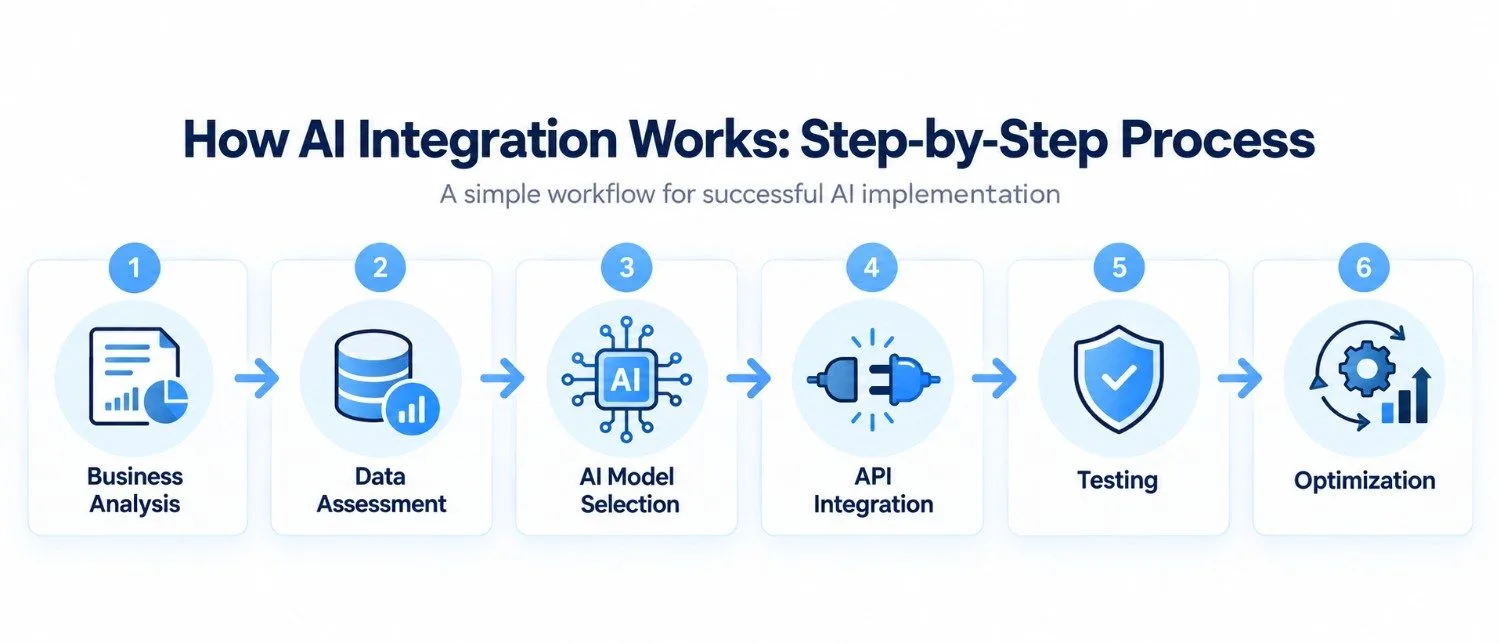
Business Requirement Analysis
The first step is understanding the business problem AI needs to solve.
Before implementation, companies should identify:
- Which processes consume excessive time
- Where automation can create value
- What information needs better analysis
- Which systems need AI capabilities
A clear objective prevents businesses from adopting AI solutions that do not address real operational needs.
Data and System Assessment
AI solutions depend heavily on available data and existing technology infrastructure.
During this stage, businesses evaluate their current systems, databases, security requirements, and integration possibilities.
Important considerations include:
- Data quality and availability
- Existing software compatibility
- API accessibility
- Privacy and security requirements
A strong foundation ensures that AI systems can deliver reliable results.
Selecting the Right AI Technology
Different business requirements require different AI approaches.
Some organizations may benefit from generative AI tools, while others may need machine learning models, AI agents, or automation workflows.
The right solution depends on factors such as:
- Business objectives
- Data complexity
- Industry requirements
- Existing software environment
Integration and Development
After selecting the right AI approach, developers connect AI capabilities with existing applications.
This process may include API connections, database integration, workflow automation, and custom software development supported by experienced software development services.
For example, an AI assistant may be connected with internal company documents so employees can quickly find information without manually searching through multiple systems.
Testing and Continuous Improvement
AI systems should be tested before full deployment to ensure accuracy, security, and usability.
After launch, businesses should continuously monitor performance and improve the system based on user feedback and changing requirements.
Understanding AI Integration Architecture
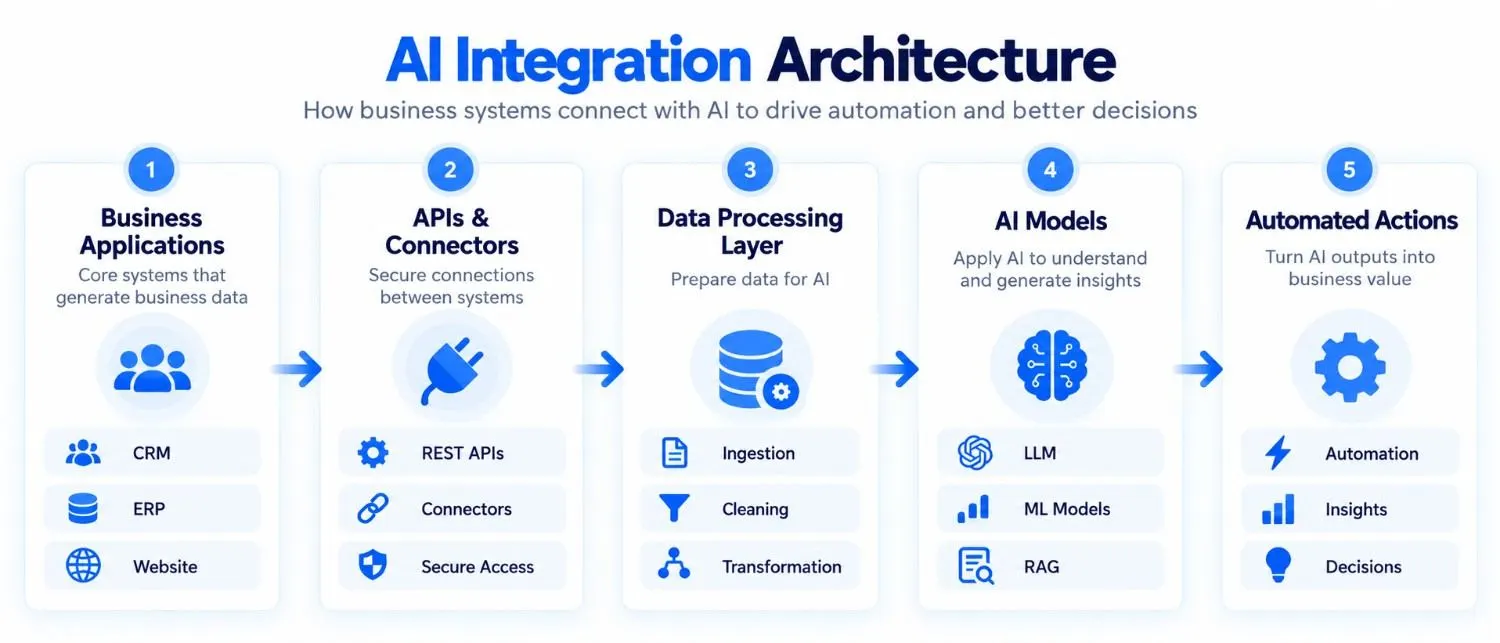
A typical AI integration environment connects multiple layers of technology:
Business Applications
↓
APIs and Data Connectors
↓
Data Processing Layer
↓
AI Models (LLMs / Machine Learning Models)
↓
Automated Actions and User Interfaces
For example, an AI customer support system may receive a customer question through a website, process the request using an AI model, retrieve relevant information from company knowledge sources, and provide an accurate response.
Modern AI integration solutions often use technologies such as Retrieval-Augmented Generation (RAG), which allows AI systems to access company-specific information before generating responses. This improves accuracy and makes AI solutions more useful for business environments.
Types of AI Integration Services
Generative AI Integration
Generative AI integration connects advanced AI models with business applications to create, analyze, and automate content-based tasks, often supported by specialized generative AI development services.
Businesses use generative AI for:
- Internal knowledge assistants
- Automated documentation
- Content generation
- Report summaries
- AI-powered search
For example, a company can integrate an AI assistant with internal documents to help employees quickly access policies, technical information, or business procedures.
AI Agent Integration
AI agents represent a more advanced form of automation. Unlike traditional chatbots, AI agents can perform multi-step tasks by interacting with connected systems.
An AI sales agent, for example, may analyze customer activity, identify opportunities, prepare recommendations, and update CRM records automatically.
AI agents are becoming increasingly useful for businesses that want automation beyond simple question-and-answer systems.
AI Chatbot Integration
AI chatbot integration connects conversational AI with websites, applications, and customer support platforms, allowing businesses to create intelligent assistants through AI chatbot development services.
Businesses use AI chatbots to handle common customer requests, provide product information, and assist employees.
When integrated properly, AI chatbots improve response times while allowing human teams to focus on more complex customer issues.
AI Workflow Automation
AI workflow automation combines artificial intelligence with business processes to reduce repetitive manual tasks.
Common examples include:
- Automated data processing
- Lead qualification
- Invoice analysis
- Email classification
- Document extraction
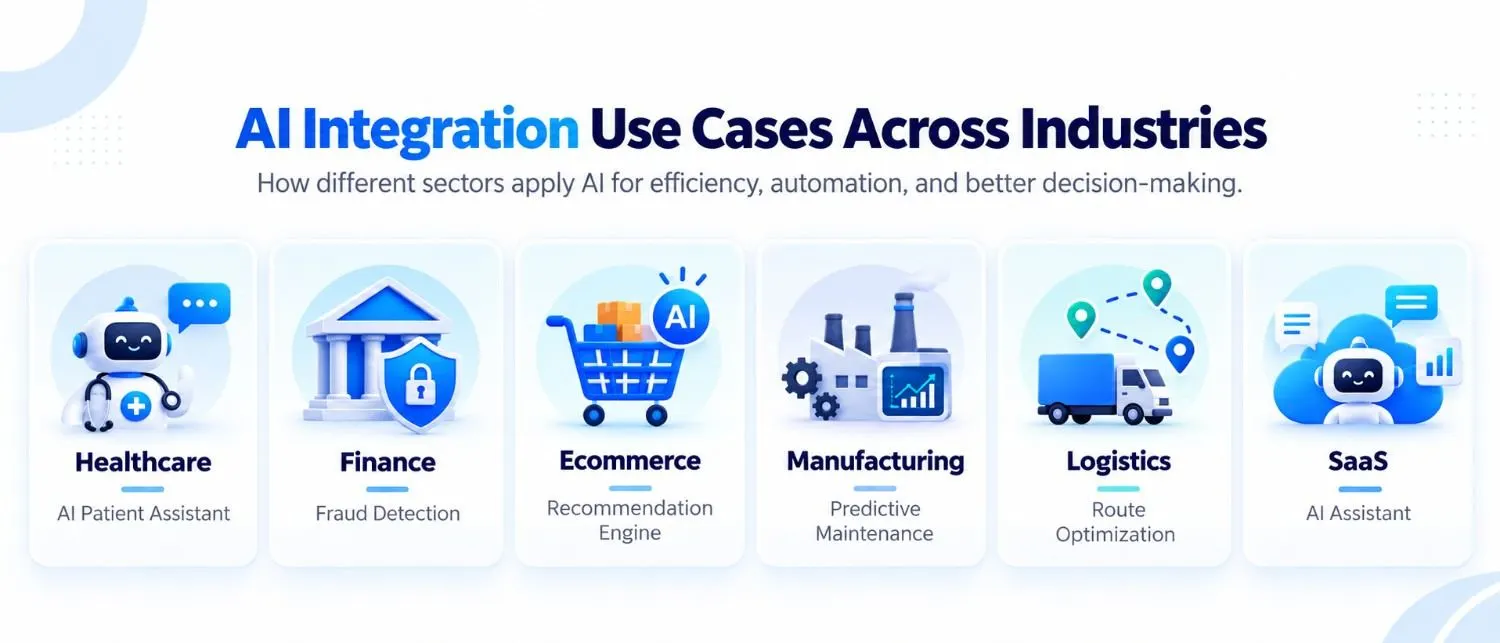
AI Integration Use Cases Across Industries
| Industry | AI Integration Example | Business Benefit |
|---|---|---|
| Healthcare | AI assistants connected with patient systems | Faster access to information and improved support |
| Finance | AI fraud detection and reporting automation | Better risk management |
| Ecommerce | AI recommendations connected with customer data | More personalized experiences |
| Manufacturing | AI connected with operational data | Predictive maintenance and efficiency |
| Logistics | AI route optimization | Improved planning and reduced delays |
| SaaS | AI assistants integrated into products | Better user experience |
AI Integration With Existing Business Systems
AI can enhance many existing business platforms without requiring complete replacement.
CRM Integration
AI can analyze customer interactions, identify potential opportunities, and support sales teams with recommendations.
ERP Integration
AI connected with ERP systems can improve forecasting, reporting, inventory management, and operational planning.
Customer Support Integration
AI can categorize support requests, suggest responses, and help agents resolve customer issues faster.
Data Platform Integration
AI can connect with analytics platforms to identify trends and provide actionable business insights.
AI Integration Cost: Factors That Affect Pricing
The cost of AI integration depends on the complexity of the project and the requirements of the business.
Important factors include:
- Number of systems being connected
- AI model requirements
- Data preparation needs
- Security requirements
- Custom development needs
- Maintenance and support requirements
A simple AI chatbot integration requires fewer resources than an enterprise AI solution connecting multiple databases, applications, and workflows.
Businesses should evaluate AI investment based on long-term value rather than only initial development cost.
AI Integration vs AI Development: What Is the Difference?
| AI Integration | AI Development |
|---|---|
| Connects existing AI solutions with business systems | Builds new AI applications or models |
| Focuses on implementation | Focuses on creating technology |
| Often faster to deploy | Usually requires more development effort |
| Uses existing AI platforms and APIs | May require custom AI research |
Many organizations do not need to build AI models from scratch, but companies with unique requirements may require custom AI development to create solutions designed around specific business processes.
When Does Your Business Need AI Integration Services?
Businesses should consider AI integration when they experience challenges such as:
- Too much manual work in daily operations
- Slow customer response times
- Disconnected software systems
- Difficulty analyzing business data
- Need for smarter automation
- Lack of real-time business insights
The right AI solution depends on the organization's goals, processes, and technology environment.
Benefits of Working With an AI Integration Partner
AI integration requires knowledge of software development, data systems, security, and artificial intelligence.
A reliable AI integration partner can help businesses:
- Identify valuable AI opportunities
- Select suitable technologies
- Build secure integrations
- Improve scalability
- Maintain AI solutions over time
Zensol Technologies helps businesses develop and implement technology solutions by combining software expertise with modern AI capabilities. A strategic approach ensures AI is connected to real business needs rather than added as an isolated feature.
Common AI Integration Challenges
Although AI integration provides significant opportunities, businesses should prepare for potential challenges.
Data quality is one of the biggest factors affecting AI performance. Poor or incomplete information can reduce the accuracy of AI outputs.
Security is another important consideration. Businesses must protect sensitive customer and company data while ensuring proper access controls.
Compatibility issues can also occur when integrating AI with older software systems. Careful planning and technical expertise help overcome these challenges.
How to Choose the Right AI Integration Company
Choosing the right AI integration partner is important because AI affects business processes, data, and customer experiences.
Companies should evaluate:
- Previous AI implementation experience
- Technical expertise
- Understanding of business requirements
- Security approach
- Scalability planning
- Long-term support
A strong partner focuses on understanding the business problem first and recommending technology second.
Final Thoughts
AI integration is not about adding artificial intelligence to every business process. It is about identifying where AI can create meaningful improvements and connecting those capabilities with existing systems.
With the right strategy, businesses can use AI to automate workflows, improve customer experiences, analyze data more effectively, and build smarter operations.
AI Integration Services provide a practical path for organizations that want to adopt artificial intelligence while maximizing the value of their existing technology investments.