Businesses are under increasing pressure to deliver faster services, improve customer experiences, and operate efficiently while managing growing complexity. Generative AI Development Services are helping organizations solve these challenges by creating intelligent systems that can automate workflows, analyze information, generate content, and support better business decisions.
Unlike traditional software automation, generative AI can understand context and create new outputs using advanced technologies such as large language models (LLMs), machine learning models, and natural language processing. Companies are using these capabilities to build AI-powered business solutions that improve productivity while allowing employees to focus on strategic work.
According to McKinsey, generative AI has the potential to create between $2.6 trillion and $4.4 trillion in annual economic value across industries. However, achieving real business value requires more than adopting a public AI tool. Organizations need secure, scalable, and customized solutions designed around their specific workflows.
This is why businesses are increasingly investing in professional AI development services to build practical applications that solve real operational problems.
What Are Generative AI Development Services?
Generative AI Development Services focus on designing, developing, and integrating AI-powered applications that can create content, analyze business data, automate workflows, and support smarter decision-making. These solutions use technologies such as large language models (LLMs), machine learning, natural language processing, and retrieval systems to build customized AI applications for specific business needs.
Unlike traditional AI, which mainly analyzes data and predicts outcomes, generative AI can create new outputs such as reports, customer responses, summaries, product descriptions, and business insights. Companies use custom AI solutions to connect AI with existing systems like CRM, ERP, and internal databases, helping improve productivity, automate processes, and solve real operational challenges.
How Generative AI Development Are Reshaping Businesses
Generative AI Development Services are changing business operations by improving efficiency, enhancing customer interactions, and enabling faster decision-making.
Companies are moving from basic automation toward intelligent business processes where AI supports employees and improves operational performance.
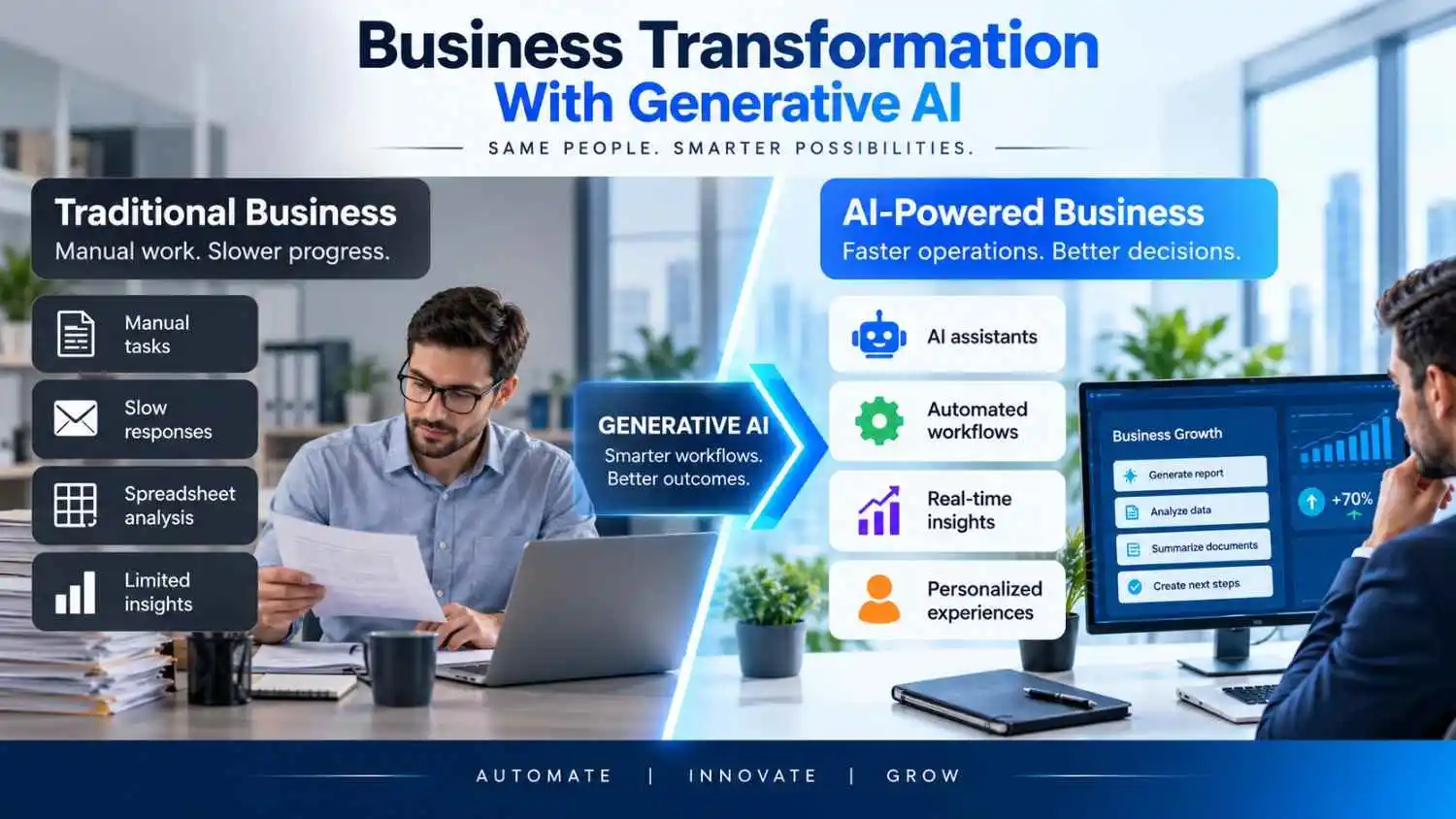
Improving Operational Efficiency Through AI Automation
Many organizations spend thousands of employee hours completing repetitive tasks such as documentation, reporting, data processing, and customer communication.
Generative AI can automate these activities through intelligent AI automation solutions while maintaining accuracy and consistency.
For example, a logistics company can use AI to analyze shipment data, generate delivery reports, identify delays, and automatically communicate updates to customers.
Instead of replacing employees, AI reduces manual workload and allows teams to focus on tasks requiring creativity and human judgment.
Creating Better Customer Experiences
Customer expectations have changed. People want faster responses, personalized recommendations, and immediate support.
AI-powered customer assistants help businesses provide 24/7 support by answering common questions, explaining services, and guiding customers through purchasing decisions.
An e-commerce company, for example, can use an AI assistant connected with its product database to recommend products, explain features, and assist customers during shopping.
Improving Business Decision-Making
Modern organizations collect large amounts of data, but extracting useful insights can be challenging.
Generative AI can analyze reports, customer feedback, market trends, and internal documents to provide understandable summaries.
A business executive can ask an AI system:
“Why did sales decrease in this region last quarter?”
Instead of manually reviewing multiple reports, the AI can analyze available information and provide a structured explanation.
Supporting Product Innovation
Companies are also using generative AI to accelerate innovation.
Software companies use AI assistants to generate code suggestions, improve documentation, and identify potential errors. Product teams use AI for market research analysis, customer feedback summaries, and prototype ideas.
This helps organizations reduce development time and respond faster to market demands.
Key Business Applications of Generative AI Solutions
Generative AI solutions are being adopted across industries because they can be customized for different business requirements.
AI Customer Support Assistants
AI customer assistants are among the most common enterprise applications.
These systems can connect with company knowledge bases and provide accurate answers based on approved information.
For example, a telecom company can use an AI assistant to handle billing questions, service requests, and account information while transferring complex cases to human agents.
Intelligent Business Process Automation
AI automation helps organizations streamline repetitive workflows.
Businesses can automate:
- Document processing
- Internal reporting
- Email responses
- Compliance checks
- Data classification
- Knowledge management
A legal company, for example, can use AI to review contracts, identify important clauses, and create summaries for lawyers.
Personalized Customer Experiences
Businesses can use AI to create personalized interactions based on customer preferences.
Online retailers use AI to generate product recommendations, personalized campaigns, and shopping assistance.
Banks can use AI systems to provide customized financial guidance based on customer behavior and goals.
AI-Powered Data Analysis
Generative AI makes complex data easier to understand.
Business teams can interact with data using natural language instead of relying completely on technical analysts.
A marketing manager can ask:
“Which campaign generated the highest customer engagement?”
The AI system can analyze available marketing data and provide insights within seconds.
Content and Knowledge Generation
Organizations create large volumes of content, including reports, training documents, product descriptions, and internal resources.
Generative AI helps teams create drafts faster while keeping humans involved for quality control and approval.
Retrieval-Augmented Generation (RAG) for Enterprise AI Applications
One major challenge with generative AI is ensuring accurate and company-specific responses.
Large language models are powerful, but they do not automatically know an organization’s private documents, policies, customer information, or internal processes.
Retrieval-Augmented Generation (RAG) solves this problem by connecting AI models with trusted company data.
A RAG-based AI system retrieves relevant information from business databases, documents, or knowledge systems before generating an answer.
This improves accuracy and makes AI applications more useful for enterprise environments.
Examples include:
- A manufacturing company creating an AI assistant that searches equipment manuals before answering maintenance questions.
- A healthcare organization building an AI knowledge system based on approved internal documentation.
- A financial institution developing an AI assistant that retrieves compliance policies before generating recommendations.
For companies investing in Generative AI Development Services, RAG is becoming an important approach for building reliable, secure, and business-focused AI solutions.
Benefits of Implementing Generative AI Development Services
Businesses adopting AI strategically can achieve significant operational improvements.
Key benefits include:
- Reduced Operational Costs: Automation reduces the time required for repetitive processes and improves resource efficiency.
- Increased Employee Productivity: Employees can use AI assistants for research, documentation, analysis, and communication support.
- Faster Decision-Making: AI systems process large amounts of information quickly and provide actionable insights.
- Improved Customer Engagement: Personalized AI interactions help companies deliver better customer experiences.
- Scalable Business Operations: AI solutions can support growing workloads without requiring equal increases in manual resources.
- Competitive Advantage: Organizations using custom AI solutions can differentiate themselves through improved services and smarter processes.
Industries Using Generative AI for Business Growth
Generative AI adoption is expanding across multiple sectors.
| Traditional Business Process | Generative AI Approach | Business Impact |
|---|---|---|
| Manual customer support | AI-powered virtual assistants | Faster responses and improved satisfaction |
| Reviewing documents manually | AI document analysis | Reduced processing time |
| Creating marketing content | AI-assisted content generation | Faster campaigns |
| Business reporting | AI-generated insights | Better decisions |
| Employee knowledge search | Enterprise AI assistants | Improved productivity |
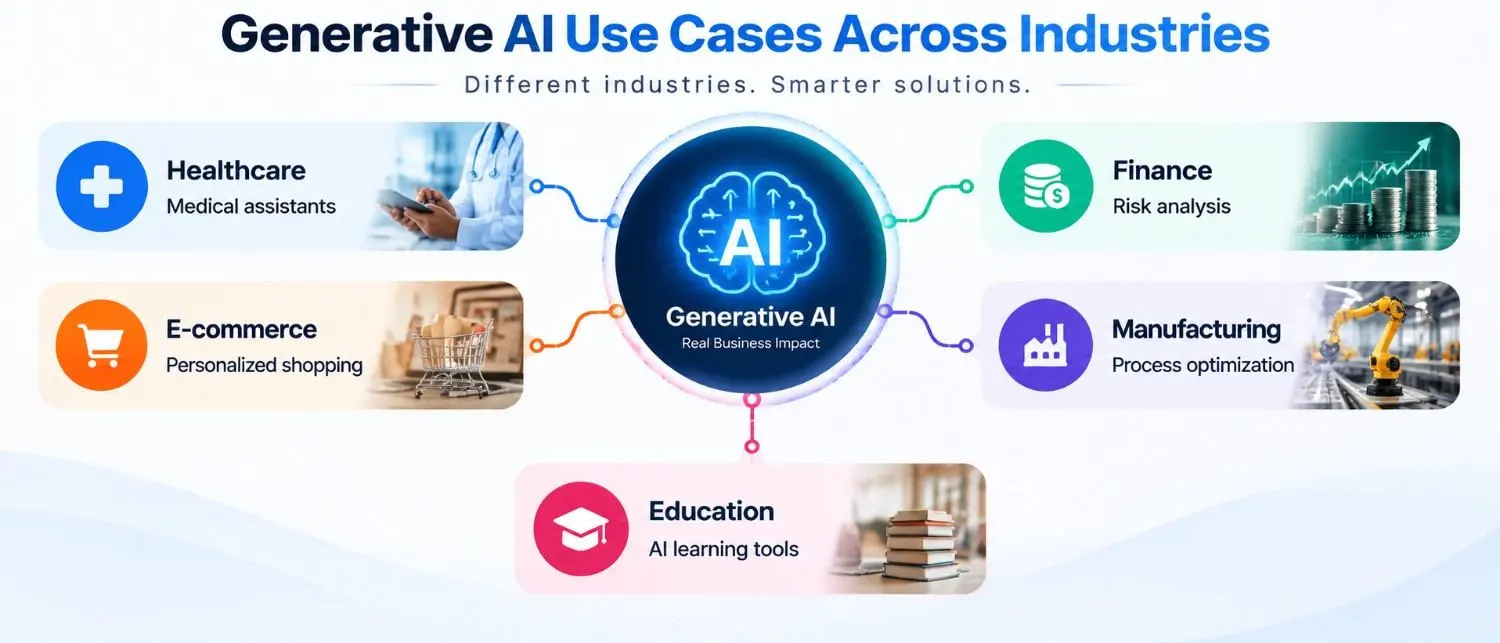
Healthcare
Healthcare organizations use AI for documentation support, patient communication, research assistance, and administrative automation.
Finance
Financial companies use AI for fraud detection support, customer service, risk analysis, and document processing.
E-commerce
Online businesses use AI for recommendations, customer support, inventory insights, and personalized marketing.
Education
Educational platforms use AI to create personalized learning experiences and intelligent tutoring systems.
Manufacturing
Manufacturers apply AI for predictive maintenance, quality control, and operational optimization.
Challenges Businesses Face During AI Implementation
Although AI provides significant opportunities, organizations must address several challenges.
- Data Privacy and Security: Businesses must protect sensitive information through encryption, access controls, and responsible data management.
- Poor Data Quality: AI systems depend on accurate information. Incorrect or outdated data can reduce AI performance.
- Integration Complexity: AI solutions must work with existing business systems to create real value.
- Employee Adoption: Teams need proper training to understand how AI can support their work effectively.
- Maintaining Human Oversight: AI outputs should be reviewed, especially in industries involving financial, legal, or healthcare decisions.
Responsible AI adoption requires balancing automation with human expertise.
How Businesses Can Successfully Adopt Generative AI
Successful AI implementation requires a structured approach.
Businesses should:
- Identify specific problems where AI can create measurable value.
- Select suitable AI models based on business requirements.
- Prepare secure and high-quality data.
- Build and test solutions using real business scenarios.
- Monitor performance and improve continuously.
The most successful companies treat AI as a long-term business capability rather than a one-time technology project.
Why Choosing the Right AI Development Partner Matters
Selecting the right AI development company plays an important role in achieving successful outcomes.
Businesses need partners that understand both technology and business strategy.
Zensol Global Technologies focuses on developing practical AI-powered solutions that align with business objectives, including automation systems, intelligent applications, and scalable AI architectures.
A strong AI partner should provide expertise in:
- AI model selection
- Software integration
- Data security
- Cloud infrastructure
- Enterprise scalability
- Continuous improvement
The right partner helps companies avoid common mistakes such as choosing unsuitable AI models, ignoring security requirements, or developing solutions that cannot scale.
Future of Generative AI in Business
The next stage of AI adoption will focus on advanced automation, AI agents, and smarter decision-support systems.
Businesses are also exploring AI agents for business to automate complex workflows and improve decision-making.
Organizations will continue adopting enterprise AI applications to improve productivity and create better customer experiences.
However, successful AI transformation will depend on combining artificial intelligence with human expertise, ethical practices, and strong business strategies.
Conclusion
Generative AI is becoming an important capability for businesses looking to improve efficiency, customer experiences, and decision-making.
Through well-planned Generative AI Development Services, organizations can create customized solutions that address real business challenges instead of relying only on generic AI tools.
From AI assistants and automation platforms to advanced analytics and RAG-powered enterprise systems, generative AI offers practical opportunities across industries.
Businesses that approach AI adoption strategically, prioritize security, and choose experienced technology partners can build smarter operations and create long-term competitive advantages. If your organization is exploring how generative AI can support your business goals, you can connect with our team at Zensol Global Technologies to discuss customized AI solutions tailored to your needs.