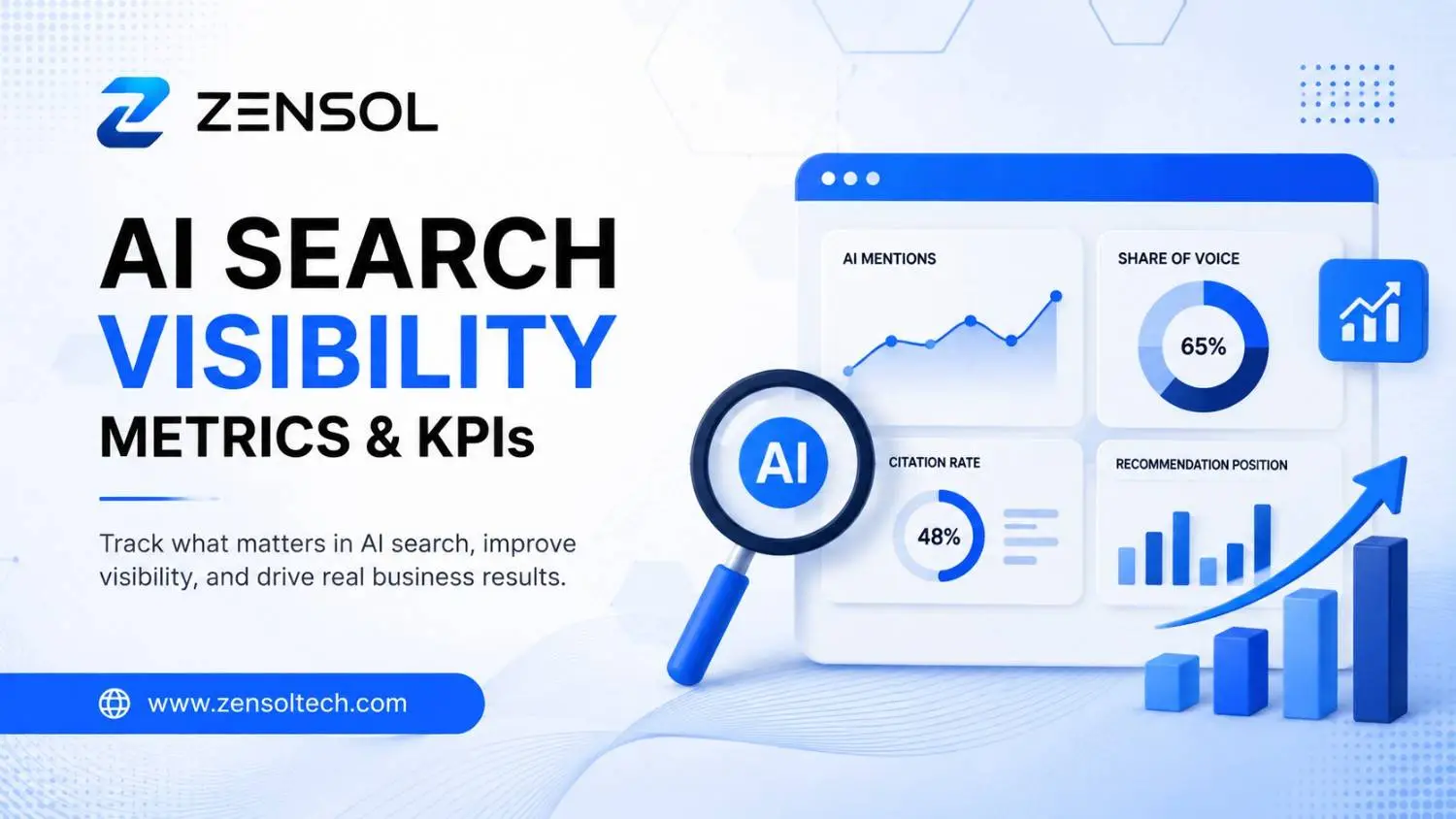
Search visibility no longer ends with rankings and organic clicks. Buyers now use ChatGPT, Gemini, Perplexity, Microsoft Copilot, and Google’s generative search features to compare providers and shortlist solutions. That makes AI search visibility metrics KPIs essential for measuring whether a brand appears, earns citations, is represented accurately, and contributes to business results.
Traditional SEO data still matters, but it cannot explain the whole journey. A prospect may discover a company in an AI answer, return through branded search, and convert without producing a direct AI referral. Measurement must connect visibility with authority, traffic quality, and revenue.
What Are AI Search Visibility Metrics KPIs?
AI search visibility metrics KPIs evaluate how often and how effectively a brand appears in AI-generated search experiences. They cover mentions, citations, recommendation position, answer quality, referrals, leads, and influenced revenue.
A metric describes what happened. A KPI shows whether the result supports a business objective. Mentions and prompt coverage are leading indicators. Qualified enquiries, pipeline, and revenue are outcomes.
A Five-Layer Model for Measuring AI Visibility
Organize the measurements into five layers:
- Presence: Does the brand appear?
- Authority: Is the website cited?
- Position: Is the brand recommended ahead of competitors?
- Quality: Is the answer accurate and stable?
- Performance: Does visibility contribute to visits, leads, or revenue?
This model turns separate GEO metrics, AEO metrics, and LLM visibility indicators into one diagnostic system.
Why Traditional SEO Metrics Are Not Enough
Rankings, impressions, clicks, backlinks, and conversions cannot reveal whether an AI system recommends a competitor, cites a third-party page, or describes your services incorrectly.
Google introduced separate generative AI performance views in Search Console on June 3, 2026. The reports show impressions, pages, countries, devices, and trends for AI Overviews, AI Mode, and generative features in Discover. The initial rollout was limited to a subset of websites.
Google also says established SEO practices remain relevant to generative search. Its guidance prioritizes crawlable technical foundations and unique, expert-led content, while rejecting the need for special AI markup, exact-match rewriting, or artificial mentions.
12 AI Search Visibility Metrics KPIs to Track
1. Non-Branded AI Mention Rate
This measures how often your brand appears when the prompt does not contain your company or product name.
Formula: Non-branded answers mentioning your brand ÷ all tested non-branded answers × 100
It is a stronger discovery indicator than branded prompts. Improve it with content around customer problems, industries, use cases, and buying criteria.
2. AI Citation Rate
Citation rate measures how often an answer links to or attributes information to your website.
Formula: Answers citing your website ÷ all tested answers × 100
A brand can be mentioned while another site earns the citation. Original data, transparent methods, precise definitions, and expert analysis can make a page more source-worthy.
3. Citation Prominence
Citation prominence measures how important your page is to the answer.
Classify citations as primary, supporting, or incidental. A source used for the central recommendation is more valuable than one supporting a minor detail.
4. AI Share of Voice
AI share of voice compares your mentions with those of selected competitors.
Formula: Your brand mentions ÷ all tracked brand mentions × 100
Use the same prompts, platforms, locations, and test frequency. Focus on direct competitors serving a similar audience and need.
5. Prompt Coverage
Prompt coverage measures how broadly your brand appears across relevant questions.
Separate informational, problem-aware, service-discovery, comparison, local, and transactional prompts. Fill genuine content gaps instead of creating near-duplicate pages for keyword variations.
6. Recommendation Position
Recommendation position records where your brand appears when an answer presents several options.
Track first, second, third, mentioned without ranking, or absent. Improve it by clearly stating your audience, services, locations, differentiators, evidence, and limitations.
7. Answer Accuracy Rate
Answer accuracy rate measures the proportion of verifiable statements about your organization that are correct.
Formula: Correct factual statements ÷ all reviewed factual statements × 100
Check services, locations, leadership, pricing model, industries, certifications, and contact details. Correct inconsistencies across owned and credible external sources.
8. Brand Framing and Sentiment
This metric records how AI systems characterize the brand, not simply whether the wording is positive or negative.
Use categories such as recommended, credible, neutral, uncertain, outdated, or unsuitable. Manual review matters because neutral wording can still contain a serious error.
9. Response Stability
Response stability measures whether a visibility result persists across repeated runs.
Formula: Runs producing the same outcome ÷ total runs × 100
Run priority prompts at least two or three times under documented conditions. Treat unstable outcomes as directional evidence, not established visibility.
10. Platform Coverage
Platform coverage shows where visibility exists across the AI products your audience uses.
Perplexity says its responses include citations and links to original sources. Microsoft says grounded Copilot answers provide reviewable citations, although availability varies by product and account settings.
Track AI search visibility metrics KPIs separately by platform before calculating an overall average.
11. AI Referral Quality
Referral quality evaluates what identifiable AI visitors do after reaching the site.
Track engaged sessions, landing-page relevance, return visits, and qualified actions. GA4’s session source and medium dimensions identify what originated a session. OpenAI states that ChatGPT search referral URLs include utm_source=chatgpt.com, making some ChatGPT traffic identifiable.
12. AI-Assisted Leads, Pipeline, and Revenue
This KPI connects AI discovery with commercial outcomes.
Attribution is incomplete because buyers move between AI tools, search engines, social platforms, and direct visits. Combine analytics, CRM source fields, assisted conversions, call tracking, sales notes, and customer-source questions. Measure lead quality, pipeline, close rate, and revenue rather than treating mentions as sales.
Key Metrics at a Glance
| Metric or KPI | What It Reveals |
|---|---|
| Non-branded mention rate | Discovery beyond searches for your name |
| Citation rate | How often your website supports an answer |
| Share of voice | Visibility compared with direct competitors |
| Response stability | Whether results persist across repeated tests |
| AI-assisted revenue | Commercial value influenced by AI discovery |
How to Build a Defensible AI Visibility Benchmark
Start with 40 to 100 prompts from Search Console, sales calls, customer questions, and competitor research. Group them by intent, funnel stage, market, and commercial value.
Test the same prompts against three to five competitors across the same AI platforms. Record mentions, citations, recommendation position, accuracy, and sentiment. Run high-value prompts several times and repeat the benchmark monthly.
Use the best SEO reporting tools to organize AI visibility data alongside rankings, traffic, and conversions. This makes AI search visibility metrics KPIs more consistent and measurable.
A Transparent Worked Example
Consider a B2B software company that tracks 50 prompts across four AI platforms and runs each prompt three times, producing 600 answers. The brand appears in 180 answers and receives 84 website citations.
This gives it a 30 percent mention rate and a 14 percent citation rate. If the brand appears in at least two runs for 38 prompts, its stable prompt coverage is 76 percent. If 100 AI-referred sessions generate 12 qualified enquiries, the referral conversion rate is 12 percent.
These metrics should be reviewed together. A high mention rate can still hide weak citations, poor answer accuracy, or limited commercial value.
How to Prioritize the Metrics
Use AI search visibility metrics KPIs according to the business goal.
For awareness, prioritize non-branded mentions, prompt coverage, share of voice, and brand framing. For authority, focus on citation rate and prominence. For reputation, emphasize accuracy and recurring outdated claims. For lead generation, prioritize referral quality, qualified conversions, pipeline, and assisted revenue.
Connecting these measurements with broader customer-acquisition data often requires coordinated analytics, content, SEO, and data-driven digital marketing services
Weighted dashboards are useful only when the weights are visible and tied to strategy. They should not imitate an unsupported industry standard.
How to Improve Weak AI Visibility Metrics KPIs
Improvement starts with the specific weakness. Low mentions require better topic and intent coverage. Low citations require original evidence, clear definitions, transparent methodology, and expert review. Poor accuracy requires consistent entity information across your website and trusted external profiles.
Create material competitors cannot easily reproduce:
- Original benchmarks and first-party observations
- Named expert commentary
- Detailed case studies with limitations
- Comparison criteria based on real buying decisions
- Calculators, templates, and downloadable tools
- Screenshots that demonstrate a process
Google says its systems understand synonyms and general meaning. Publishers do not need to rewrite every paragraph around an exact keyword or create special AI markup for generative search.
Keep important pages crawlable, indexable, fast, mobile-friendly, and internally linked. Publishers seeking discovery in ChatGPT search should also confirm they are not unintentionally blocking OAI-SearchBot.
Zensol Global Technologies operates across SEO, digital marketing, and AI development, placing this subject at the intersection of content, technical access, analytics, and business measurement.
Common Measurement Mistakes
Do not use one favourable answer as proof of visibility. Do not mix branded and non-branded prompts into one percentage. Do not compare platforms using different prompt sets. Do not report a proprietary score without exposing its formula.
A citation is not automatically a click, and a visit is not automatically a qualified lead. Preserve the underlying answers and report uncertainty when results are unstable.
Final Thoughts
AI visibility is a chain that begins with presence, develops through authority and accurate representation, and creates value only when it supports customer action.
Establish a repeatable baseline for AI search visibility metrics KPIs, separate branded recognition from non-branded discovery, and preserve the evidence behind every conclusion. For Zensol Technologies, publishing a first-party benchmark with the prompt set, scoring rules, dashboard, and downloadable worksheet would turn this guide into a source that other publishers and AI systems have a reason to cite.
Unsure how often your business appears in AI-generated answers? Request an AI visibility assessment to establish your baseline across priority prompts, platforms, and competitors.