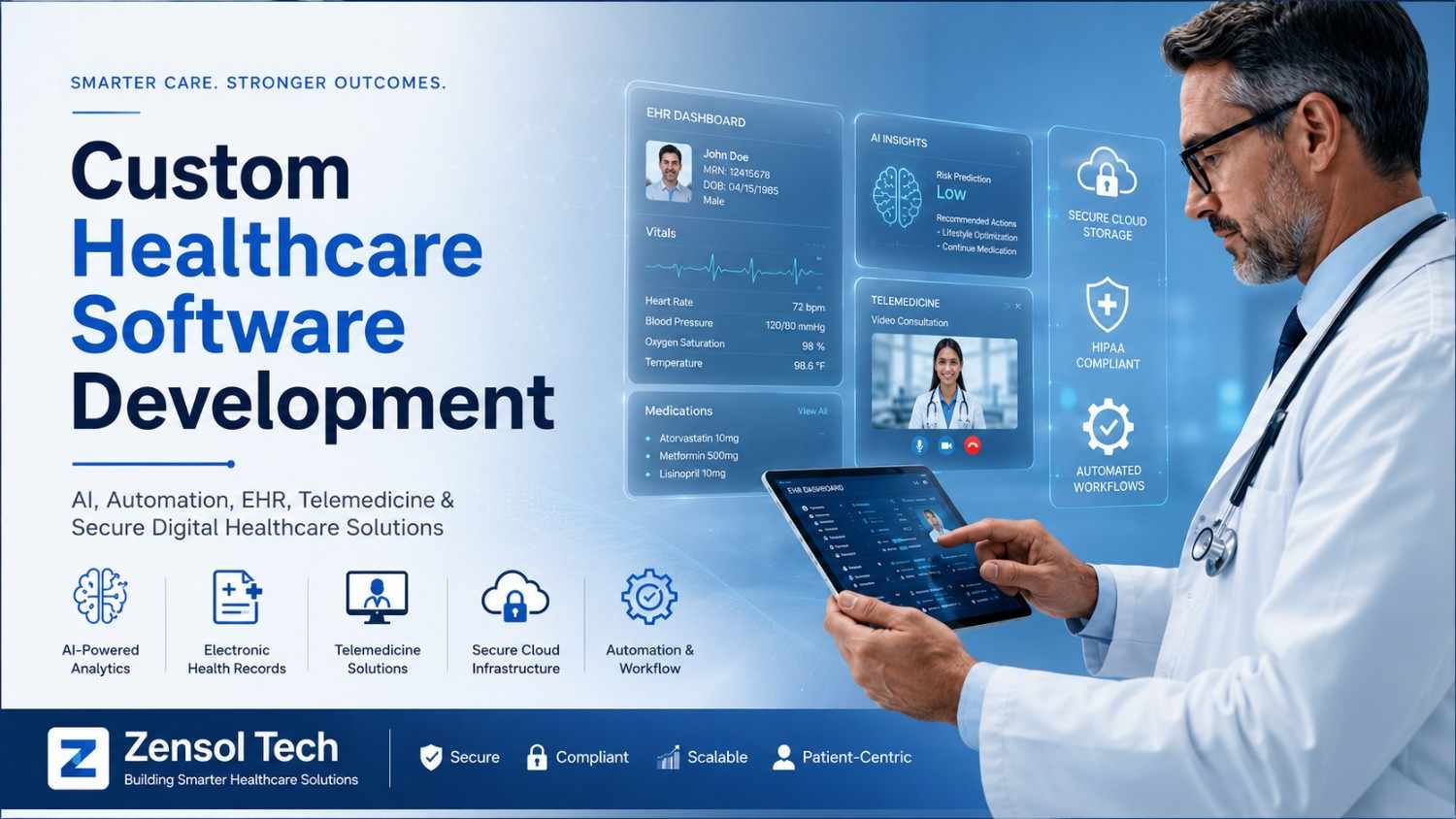
Healthcare organizations are rapidly adopting digital technologies to improve patient care, optimize operations, and create more connected healthcare experiences. However, many hospitals, clinics, and healthcare businesses still struggle with disconnected systems, inefficient workflows, and software platforms that cannot fully support their unique operational requirements. Custom Healthcare Software Development helps organizations overcome these challenges by creating secure, scalable solutions tailored to their clinical workflows, compliance needs, and long-term business goals.
Unlike generic healthcare platforms, custom software is designed around how healthcare teams actually work. Whether it is connecting EHR and EMR systems, automating administrative processes, building patient portals, or developing telemedicine applications, customized healthcare solutions enable organizations to improve efficiency, enhance patient engagement, and deliver better digital health services.
This complete guide explores everything healthcare leaders need to know about custom healthcare software development in 2026, including its benefits, types of solutions, development process, security and compliance considerations, cost factors, emerging trends, and how to choose the right healthcare software development company.
What Is Custom Healthcare Software Development?
Custom Healthcare Software Development is the process of designing, building, testing, and maintaining healthcare software specifically created for the needs of a healthcare organization.
Unlike off-the-shelf healthcare platforms, custom solutions are built around unique operational requirements, user expectations, integration needs, and compliance standards.
For example:
- A hospital may need software that connects patient records, laboratory systems, pharmacy platforms, and billing workflows.
- A clinic may require customized patient management software to automate appointments and improve communication.
- A healthcare startup may need a scalable digital health platform for telemedicine, remote monitoring, or patient engagement.
Custom healthcare software solutions help organizations create technology that supports:
- Better patient experiences
- Improved operational efficiency
- Secure healthcare data management
- Healthcare workflow automation
- Connected healthcare systems
- Scalable digital services
The objective is not simply to build an application. The objective is to solve real healthcare challenges through reliable, secure, and flexible technology.
Why Healthcare Organizations Need Custom Software Solutions in 2026
Healthcare is becoming more technology-driven every year. Patients expect convenient digital experiences, providers need faster access to information, and organizations must maintain strict security and compliance standards.
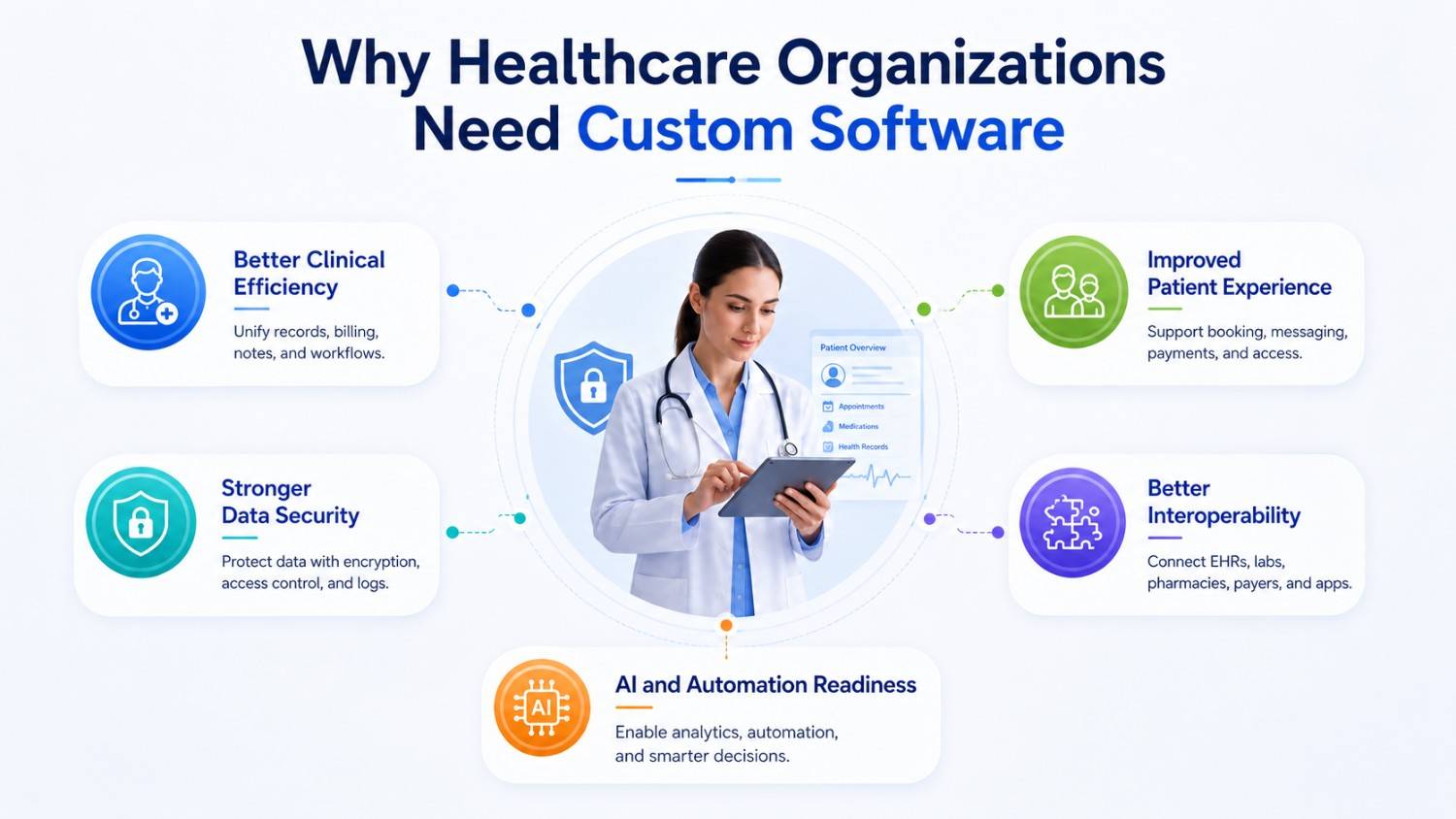
Generic software can work for basic requirements, but many healthcare organizations eventually face limitations because their workflows are unique.
Improving Healthcare Workflow Efficiency
Healthcare teams often manage repetitive administrative activities that consume valuable time.
Custom solutions can automate:
- Appointment scheduling
- Patient reminders
- Documentation processes
- Internal communication
- Reporting tasks
- Administrative workflows
For example, a multi-specialty clinic can use a customized healthcare platform that automatically manages appointments, updates provider schedules, and improves patient communication.
This allows healthcare professionals to spend more time focusing on patient care instead of manual processes.
Connecting Disconnected Healthcare Systems
Many healthcare organizations use multiple software systems, including:
- Electronic Health Records (EHR)
- Electronic Medical Records (EMR)
- Laboratory systems
- Pharmacy platforms
- Billing solutions
- Patient engagement tools
When these systems operate separately, healthcare teams may struggle to access complete patient information.
Custom Healthcare Software Development enables healthcare interoperability through:
- EHR integration
- EMR integration
- HL7-based communication
- FHIR APIs
- Secure healthcare data exchange
For example, a hospital network with different departments can create an integrated healthcare platform that allows authorized users to access accurate information across the organization.
Enhancing Patient Engagement
Patients now expect healthcare experiences similar to other digital services.
Custom healthcare applications can provide:
- Online appointment booking
- Secure messaging
- Digital health records access
- Prescription management
- Virtual consultations
- Health tracking
A well-designed patient portal improves communication between patients and providers while making healthcare services more accessible.
Problems Solved by Custom Healthcare Software Development
Healthcare organizations typically invest in custom software because existing solutions do not fully solve their challenges.
Problem: Limited System Integration
Challenge: Different healthcare systems cannot communicate effectively.
Solution: Custom integrations connect platforms and improve information sharing.
Problem: Manual Administrative Processes
Challenge: Staff spend excessive time on repetitive tasks.
Solution: Healthcare workflow automation reduces manual effort and improves productivity.
Problem: Poor Patient Experience
Challenge: Patients face difficulty accessing services and communicating with providers.
Solution: Digital health solutions create convenient patient-focused experiences.
Problem: Limited Business Insights
Challenge: Healthcare organizations collect large amounts of data but lack useful analytics.
Solution: Custom healthcare analytics platforms transform data into actionable insights.
Types of Custom Healthcare Software Solutions
These requirements are often addressed through custom software development solutions built around specific healthcare workflows.
Patient Management Software
Patient management software helps healthcare providers organize patient information, appointments, communication, and care coordination.
Common features include:
- Patient profiles
- Appointment scheduling
- Medical history management
- Provider communication
- Follow-up tracking
These solutions help clinics and hospitals improve daily operations and patient relationships.
Telemedicine Software Development
Telemedicine software development allows healthcare providers to deliver remote healthcare services.
Common features include:
- Video consultations
- Secure communication
- Online scheduling
- Digital prescriptions
- Remote patient monitoring
Healthcare startups often choose custom telemedicine solutions when they require unique workflows, branding, or scalability.
Healthcare SaaS Solutions
Healthcare SaaS solutions provide cloud-based software that can scale with organizational growth.
Examples include:
- Healthcare management platforms
- Patient engagement systems
- Analytics solutions
- Remote monitoring platforms
SaaS-based healthcare solutions allow organizations to access modern technology without managing complex infrastructure.
Hospital Software Solutions
Hospitals often require advanced software to manage complex operations.
Hospital software solutions may include:
- Hospital management systems
- Laboratory management platforms
- Pharmacy systems
- Clinical documentation tools
- Resource management solutions
These platforms improve coordination between medical teams and administrative departments.
Healthcare Mobile Applications
Healthcare app development enables organizations to deliver healthcare services through mobile devices.
Applications may include:
- Patient apps
- Doctor communication apps
- Wellness platforms
- Medication reminder apps
- Remote monitoring applications
Key Features of Custom Healthcare Software
The best custom healthcare software is designed around healthcare workflows, patient needs, operational goals, and security requirements. Depending on the organization’s objectives, these solutions can include:
Patient Experience Features
- Patient portals for accessing medical records, appointments, and healthcare information
- Online appointment scheduling to simplify booking and reduce administrative workload
- Secure messaging for communication between patients and healthcare providers
- Telemedicine capabilities for virtual consultations and remote care
- Digital prescription management for easier medication tracking and access
Healthcare Provider Features
- Clinical dashboards for viewing patient information and improving decision-making
- Electronic documentation tools for managing clinical records efficiently
- EHR and EMR integration for seamless access to healthcare data
- Care coordination workflows to improve communication between healthcare teams
- Patient management features for tracking appointments, treatments, and follow-ups
Administrative & Business Features
- Billing and payment management for improving financial workflows
- Insurance verification workflows to reduce manual processes
- Reporting dashboards for operational visibility
- Healthcare analytics for data-driven decisions
- Workflow automation to reduce repetitive administrative tasks
Security & Integration Features
- Role-based access control to manage user permissions
- Data encryption to protect sensitive healthcare information
- Audit logs for tracking system activity and compliance requirements
- Secure APIs for connecting healthcare applications
- HL7 and FHIR interoperability for reliable healthcare data exchange
By combining these capabilities, custom healthcare software helps organizations create secure, scalable, and workflow-driven solutions that improve operational efficiency and patient care.
Custom Healthcare Software vs Off-the-Shelf Software
Choosing between custom software and existing platforms depends on organizational needs.
| Factor | Custom Healthcare Software | Off-the-Shelf Healthcare Software |
|---|---|---|
| Flexibility | Designed around specific workflows | Limited customization |
| Scalability | Can grow with business needs | Depends on vendor limitations |
| Integration | Built for specific EHR/EMR connections | May require additional integration work |
| Cost | Higher initial investment | Lower upfront cost |
| Best For | Hospitals, startups, complex healthcare operations | Organizations with standard requirements |
Many organizations choose a hybrid approach by combining existing systems with custom healthcare solutions.
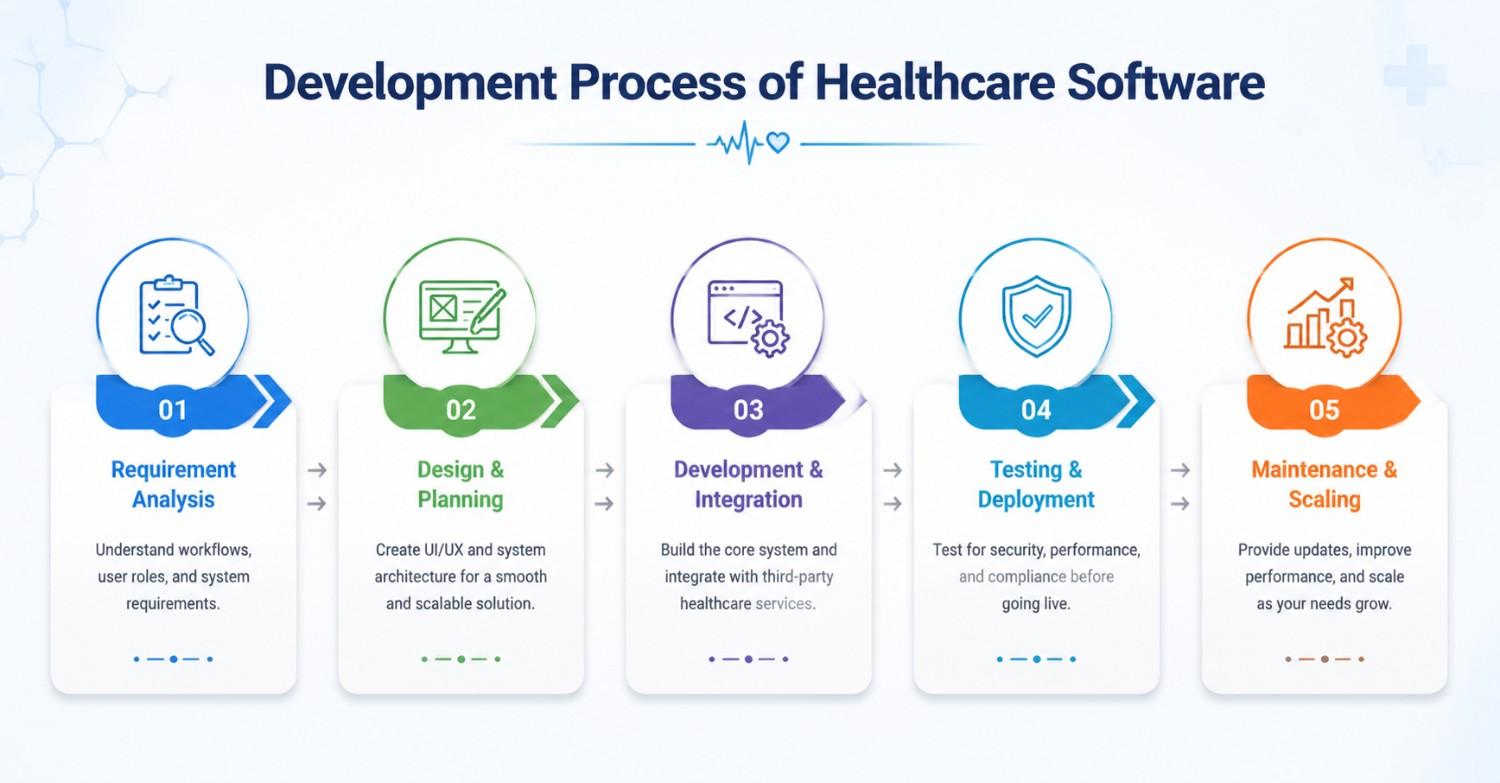
A Better Custom Healthcare Software Development Process
The strongest projects do not begin with a list of technologies. They begin with a problem, followed by a structured software development process that aligns technology decisions with business objectives.
Step 1: Define the Outcome
“We need a patient portal” is a feature request.
“Our staff spend 30 hours each week processing requests that patients could securely complete themselves” is a business problem.
The second statement gives the project something measurable.
Step 2: Observe the Real Workflow
Map what users actually do, not only what the process document says they do.
A practical workflow map should identify the trigger, user, information needed, systems involved, decision points, exceptions, and final outcome.
This is where hidden manual work often appears.
Step 3: Build a Data Ownership Map
For every important data element, decide which system is the source of truth.
Patient demographics might belong to one system. Billing status may belong to another. Lab results may arrive from an external platform.
Without clear ownership, two-way synchronization can create duplicate or conflicting records.
Step 4: Audit Integrations Before Finalizing Scope
Do not assume that because an EHR advertises an API, every required workflow is available through it.
Confirm access, supported standards, available resources, authentication, vendor requirements, rate limits where relevant, sandbox availability, and write permissions before promising features.
Step 5: Define Security and Regulatory Scope
Determine what information the system handles, which organizations and users interact with it, where the data moves, and what rules apply.
Not every healthcare product is regulated in exactly the same way.
Step 6: Prototype the Highest-Risk Workflow
Do not prototype only the easiest screen.
Test the workflow most likely to fail because of usability, integration complexity, permissions, or clinical context.
Solving the difficult part early can prevent months of development around a flawed assumption.
Step 7: Build the Smallest Useful Release
An MVP should be small in scope, not careless in security or reliability.
Launch the smallest version that solves a meaningful problem and can be evaluated with real users.
Step 8: Measure the Workflow After Launch
Do not stop at uptime and bug counts.
Measure what the software was supposed to improve: processing time, duplicate entry, patient completion rates, manual calls, referral delays, staff workload, or another defined outcome.
That is how you determine whether the software created value.
Healthcare Software Security and HIPAA Compliance
Healthcare organizations manage highly sensitive information, making security a critical requirement.
HIPAA compliant software development focuses on protecting patient data through strong security practices.
Important security measures include:
- Data encryption
- Multi-factor authentication
- Role-based access controls
- Audit logs
- Secure APIs
- Backup and recovery planning
Healthcare data security should be considered from the beginning of development rather than added later.
A reliable healthcare software development company should understand both technology requirements and healthcare compliance expectations.
Custom Healthcare Software Development Cost and Timeline
The cost of Custom Healthcare Software Development depends on several factors:
- Software complexity
- Number of features
- Integration requirements
- Security needs
- AI capabilities
- Development expertise
Typical estimates:
| Project Type | Estimated Cost |
|---|---|
| Basic healthcare application | $30,000–$80,000 |
| Medium healthcare platform | $80,000–$250,000 |
| Enterprise healthcare system | $250,000+ |
The healthcare software development timeline also varies:
- Simple applications: 3–6 months
- Medium platforms: 6–12 months
- Enterprise solutions: 12+ months
Organizations should focus on long-term value, security, and scalability instead of selecting a partner only based on the lowest price.
How to Choose the Right Healthcare Software Development Company
Choosing a healthcare software development partner is not about selecting the company with the longest technology list. The right partner should understand healthcare workflows, compliance requirements, integration challenges, and the operational goals behind the software.
- Ask the team to explain your workflow back to you.
- Ask which system owns the important data.
- Ask how integrations will be validated.
- Ask what assumptions are behind the estimate.
- Ask how security, permissions, testing, and monitoring will be handled.
- Ask whether custom development is actually the right solution.
Future Trends in Healthcare Software Development
Healthcare technology will continue evolving through several major trends.
AI in Healthcare Software
Artificial intelligence is helping healthcare organizations improve:
- Healthcare analytics
- Clinical decision support
- Documentation automation
- Patient communication
However, AI implementation requires careful governance, accuracy validation, and privacy protection.
Advanced Healthcare Automation
Automation will continue improving:
- Administrative processes
- Scheduling
- Communication
- Healthcare operations
Personalized Digital Health Solutions
Future healthcare platforms will focus on personalized patient experiences using data-driven insights and connected healthcare systems.
Conclusion
Custom Healthcare Software Development enables healthcare organizations to build technology solutions that improve efficiency, strengthen security, and deliver better patient experiences.
From healthcare interoperability and EHR integration to AI-powered platforms and workflow automation, custom software helps hospitals, startups, and healthcare businesses solve complex challenges with solutions designed specifically for their needs.
Choosing an experienced healthcare software development company is essential for creating secure, scalable, and future-ready healthcare technology.
Zensol Global Technologies works with organizations developing healthcare platforms, custom healthcare applications, integrations, and digital solutions that support modern healthcare transformation.
Organizations planning their next healthcare software initiative can discuss their project requirements with our team.