Artificial intelligence is changing how businesses operate. From automating customer support and improving marketing workflows to helping teams analyze data and build software faster, AI has become an important part of modern business strategy.
However, as companies expand their AI adoption, a new challenge is becoming increasingly common: AI costs are growing faster than the value businesses receive from their investments.
Understanding how to reduce AI costs for work is not about using fewer AI tools or choosing the cheapest software available. It is about creating a smarter AI strategy — one where businesses select the right technology, optimize workflows, manage AI usage, and measure real business outcomes.
Many companies do not have an AI cost problem. They have an AI implementation problem.
Businesses often increase AI expenses because they:
- Purchase multiple tools with overlapping features
- Use advanced AI models for simple tasks
- Automate inefficient processes instead of improving them first
- Lack clear AI usage policies
- Do not measure AI return on investment (ROI)
A strategic approach to AI cost optimization helps businesses reduce unnecessary spending while maintaining productivity and improving operational efficiency.
Zensol Global Technologies helps organizations identify practical AI opportunities, build automation systems, and implement scalable artificial intelligence solutions designed around business goals.
Why AI Cost Optimization Matters for Businesses
AI adoption is increasing across industries. Companies are using AI for:
- Customer service automation
- Sales assistance
- Marketing workflows
- Data analysis
- Software development
- Internal knowledge management
- Business process automation
While AI creates significant opportunities, unmanaged adoption can lead to unnecessary expenses.
For example, a company may have separate AI subscriptions across departments:
- Marketing uses one AI writing platform
- Sales uses another AI assistant
- Support uses a separate chatbot solution
- Developers use different AI APIs
Individually, these tools may seem affordable. Together, they can create significant monthly expenses without a clear understanding of business impact.
Expert Insight: AI Savings Start With Strategy, Not Cutting Tools
The biggest AI cost reductions usually do not come from finding cheaper software.
They come from answering three important questions:
- Where does AI create measurable value?
- Which workflows actually need automation?
- How can AI resources be used more efficiently?
Companies that answer these questions before investing in more technology usually achieve better long-term results.
How to Reduce AI Costs for Work Without Sacrificing Business Productivity
Reducing AI costs requires a structured approach. Businesses need to optimize technology decisions, improve workflows, and ensure AI investments support measurable objectives.
Below are practical strategies organizations can use to reduce AI expenses while continuing to improve productivity.
1. Perform an AI Spending Audit Before Buying More Tools
The first step in reducing AI costs is understanding current spending.
Many businesses focus on adding new AI capabilities but never review whether existing tools are being used effectively.
An AI spending audit should examine:
| Area | Questions to Evaluate |
|---|---|
| AI subscriptions | Which tools are actively used by teams? |
| Duplicate software | Are multiple tools solving the same problem? |
| AI workflows | Are processes designed efficiently? |
| API usage | Are AI requests optimized? |
| Business impact | Is each AI investment creating measurable value? |
A simple audit can reveal opportunities such as:
- Removing unused subscriptions
- Combining similar tools
- Improving team adoption
- Reallocating AI budgets toward higher-impact solutions
Many businesses discover that their biggest savings opportunity is not reducing AI usage — it is eliminating inefficient AI usage.
2. Choose AI Models Based on Business Requirements
One of the most common mistakes businesses make is using expensive AI models for every task.
Different workflows require different levels of AI capability.
A simple task such as:
- Summarizing information
- Classifying documents
- Generating basic responses
may not require the same resources as:
- Advanced business analysis
- Complex reasoning workflows
- Enterprise AI applications
A smarter AI cost optimization strategy involves selecting technology based on:
- Task complexity
- Accuracy requirements
- Data sensitivity
- Processing volume
- Long-term scalability
The goal is not choosing the cheapest AI solution.
The goal is choosing the most cost-effective solution.
3. Improve AI Workflows Before Adding More Technology
Many companies believe buying more AI tools will automatically improve productivity.
In reality, inefficient workflows often create unnecessary costs.
Before adding another AI platform, businesses should analyze:
- Which tasks consume employee time?
- Which processes are repetitive?
- Where are delays happening?
- Which activities require human decision-making?
For example, a company may use separate systems for customer inquiries, reporting, and follow-ups.
Instead of adding another tool, connecting existing processes through automation may create better results.
Businesses looking to streamline operations can explore AI automation solutions to create intelligent workflows that reduce repetitive manual work.
4. Use AI Automation to Reduce Operational Expenses
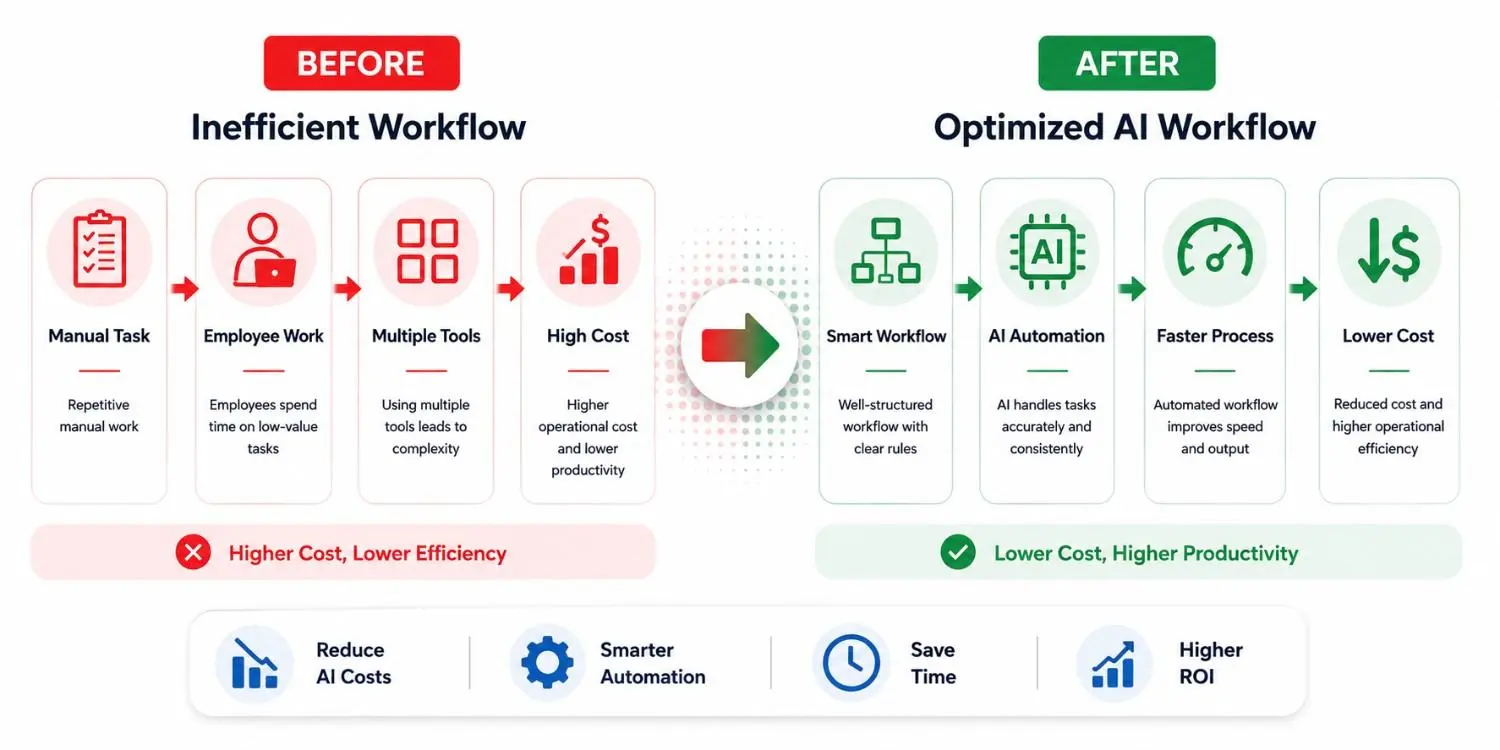
AI automation is one of the most effective ways businesses can improve efficiency while controlling costs.
The purpose of automation is not to remove human involvement. It is to allow employees to spend more time on valuable activities.
Common AI automation applications include:
- Customer support assistance
- Automated reporting
- Document processing
- Lead qualification
- Internal knowledge systems
- Workflow approvals
Example: Reducing Manual Customer Support Work
Consider a business receiving thousands of customer requests every month.
A large percentage of those requests may involve repetitive questions:
- Order updates
- Account information
- Product details
- Common troubleshooting steps
An AI-powered workflow can:
- Identify the customer request
- Retrieve relevant information
- Provide an initial response
- Route complex cases to the right employee
The result is a more efficient support process where employees focus on situations requiring human expertise.
The key lesson:
AI creates savings when it improves a process, not when it is simply added to a process.
5. Optimize LLM Usage and AI API Costs
For companies building AI-powered applications, AI API expenses can become a major cost factor.
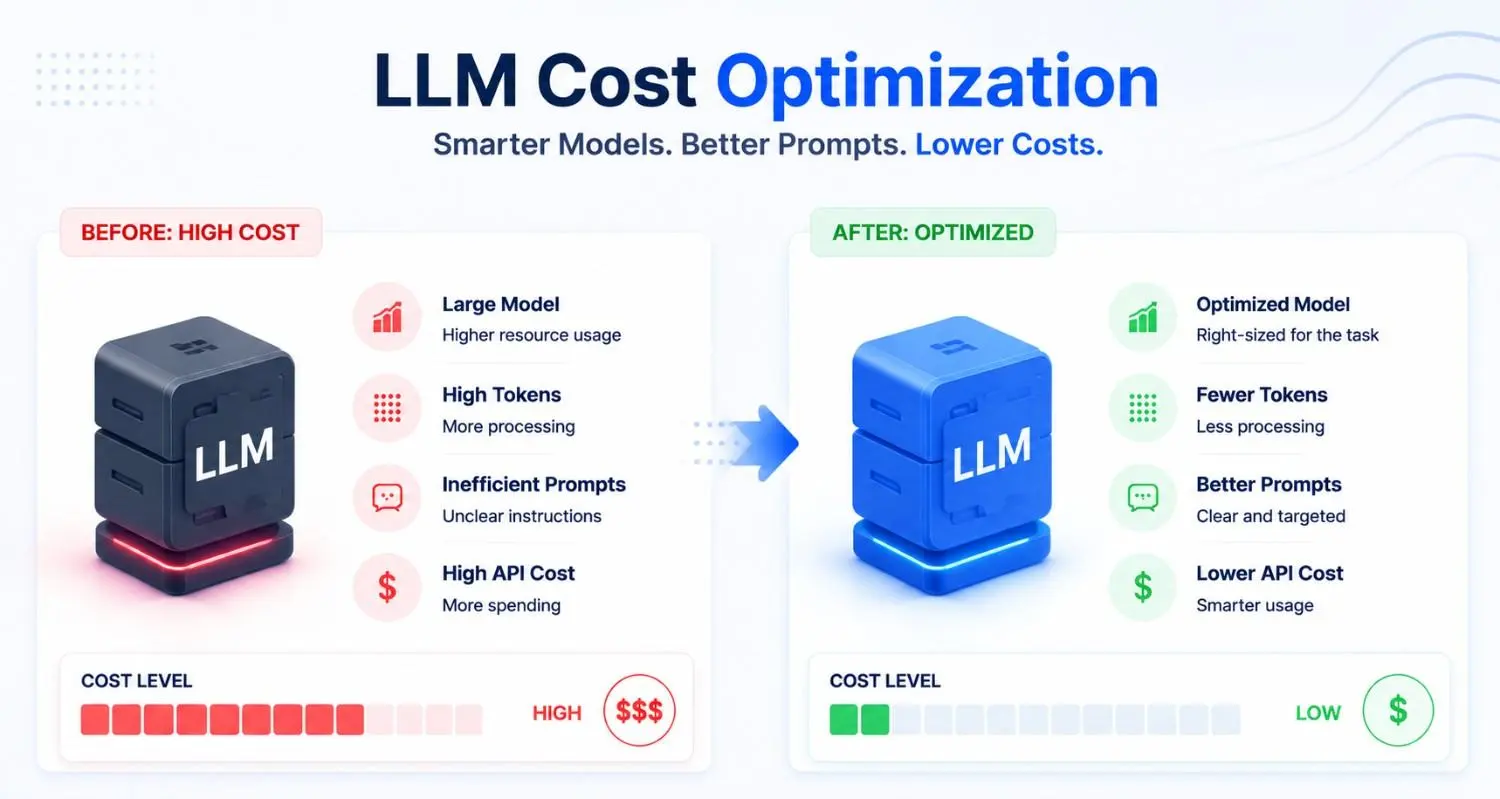
Poorly designed AI systems may increase costs through:
- Unnecessary model requests
- Inefficient prompts
- Repeated processing
- Poor data retrieval methods
Businesses can reduce LLM costs through:
Better Model Selection
Use advanced models only when the task requires advanced capabilities.
Prompt Optimization
Clear and structured prompts reduce unnecessary AI processing.
Efficient Data Retrieval
For AI applications using business knowledge, optimized retrieval systems can reduce unnecessary model usage.
Usage Monitoring
Track:
- AI requests
- Cost per workflow
- Model performance
- User adoption
Effective AI spend management requires continuous monitoring, not a one-time setup.
6. Consider Custom AI Development for Long-Term Cost Efficiency
Ready-made AI tools work well for many business needs. However, growing organizations often face limitations.
Managing multiple AI platforms can create:
- Higher subscription costs
- Data management challenges
- Integration issues
- Limited customization
Custom AI development can help businesses create solutions designed around their specific workflows.
Benefits include:
- Better system integration
- Improved control
- Enhanced scalability
- Reduced dependence on multiple platforms
For businesses with unique operational requirements, a customized AI solution may provide better long-term value than continuously adding separate tools.
Learn more about how businesses can build tailored AI systems through custom AI development.
7. Create an AI Cost Optimization Framework
Successful AI adoption requires a repeatable process.
A practical framework includes five stages:
| Stage | Action | Purpose |
|---|---|---|
| Audit | Review current AI spending | Identify unnecessary expenses |
| Analyze | Study workflows and processes | Find improvement opportunities |
| Optimize | Improve tools and usage | Reduce waste |
| Automate | Apply AI where it creates value | Increase efficiency |
| Measure | Track AI ROI | Improve future decisions |
This approach helps businesses avoid random AI adoption and build a sustainable AI implementation strategy.
8. Measure AI ROI and Establish AI Governance
Reducing AI costs is not only about lowering expenses.
Businesses also need to understand the value AI creates.
Important AI ROI measurements include:
- Time saved
- Reduced manual work
- Faster response times
- Improved customer experience
- Increased employee productivity
AI governance also helps control costs by establishing:
- Approved AI tools
- Usage guidelines
- Security practices
- Performance monitoring processes
Without governance, AI adoption can become fragmented and expensive.
9. Use AI Agents for Advanced Business Automation
AI agents represent the next step in intelligent automation.
Unlike traditional AI tools that respond to individual requests, AI agents can manage multi-step workflows, analyze information, and complete tasks with limited human involvement.
Businesses can use AI agents for:
- Sales operations
- Customer management
- Research tasks
- Internal workflows
- Business intelligence
Organizations exploring advanced automation can learn more about AI agents for business.
Common AI Cost Mistakes Businesses Should Avoid
Buying More Tools Instead of Fixing Processes
Most companies do not need more AI platforms. They need better-designed workflows.
Measuring AI Success by Usage Alone
A frequently used AI tool is not necessarily a valuable AI tool.
Businesses should measure outcomes, not activity.
Ignoring Employee Training
Even the best AI solution will create limited value if teams do not know how to use it effectively.
Failing to Review AI Spending
AI requirements change over time. Regular reviews help businesses maintain efficiency.
AI Cost Optimization Checklist
Before expanding AI adoption, businesses should ask:
✅ Have we reviewed all current AI expenses?
✅ Are employees using existing tools effectively?
✅ Are we choosing the right AI model for each task?
✅ Can automation remove repetitive work?
✅ Are we measuring AI ROI?
✅ Do we have AI governance guidelines?
✅ Would a customized AI solution create better value?
This checklist helps companies make smarter AI investment decisions.
Final Thoughts
Learning how to reduce AI costs for work is becoming essential for businesses that want to adopt artificial intelligence successfully.
The companies that benefit most from AI will not be those that simply purchase the most tools. They will be the companies that create better strategies, optimize workflows, and focus on measurable business outcomes.
AI cost optimization is not about doing less with artificial intelligence. It is about making smarter decisions about where and how AI creates value.
Zensol Global Technologies helps businesses identify AI opportunities, implement automation strategies, and develop scalable AI solutions that align with real business objectives.
If your organization wants to understand where AI can reduce costs and improve efficiency, explore our artificial intelligence solutions or contact our team for a personalized AI strategy discussion.