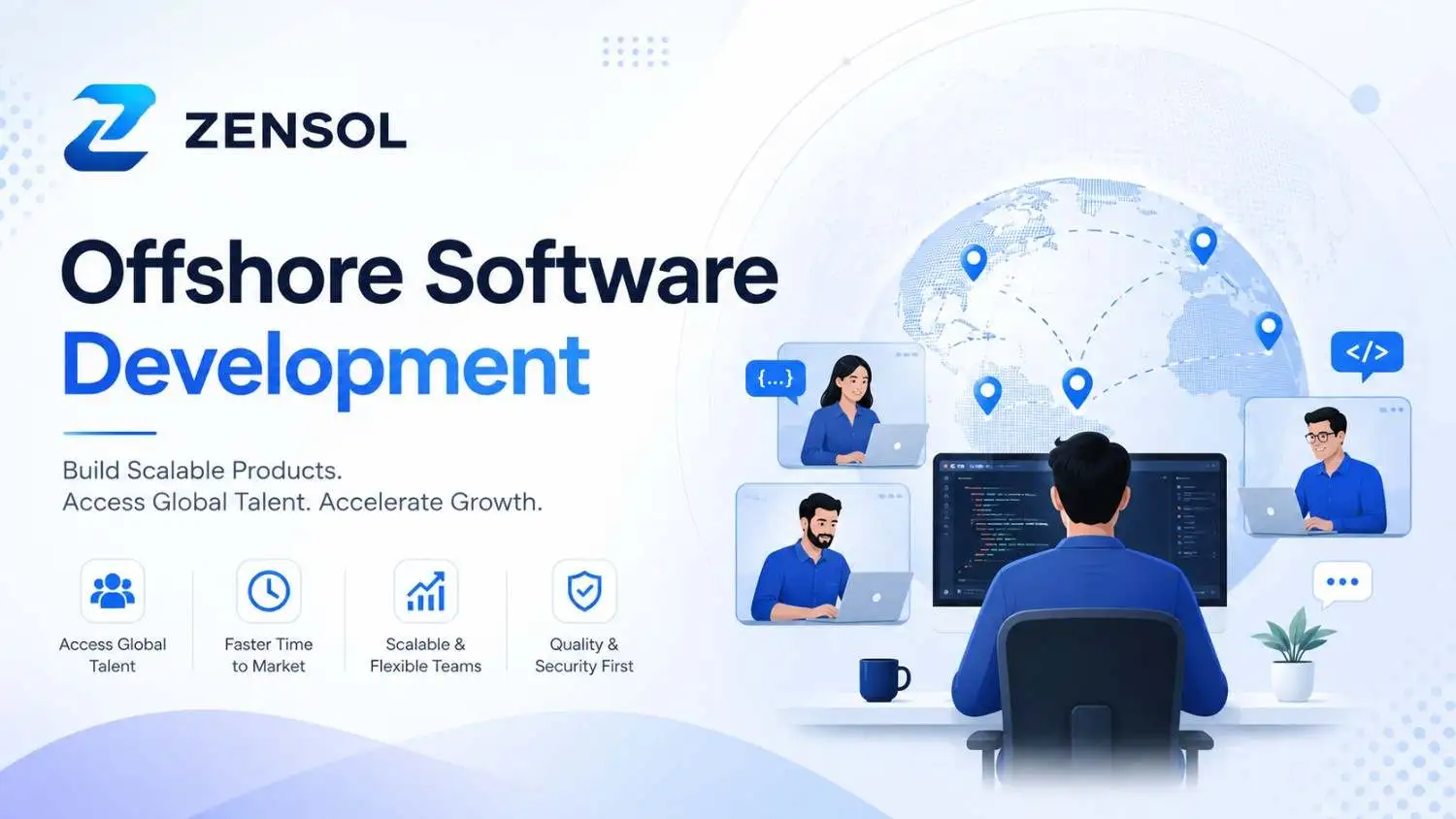
Building a scalable digital product requires the right engineering talent, but hiring and maintaining a large in-house development team can be expensive and time-consuming. Offshore software development gives startups and growing businesses access to experienced developers without the overhead of building an entire local team.
From MVP development and custom software to cloud infrastructure and ongoing product development, offshore teams can support different stages of the software lifecycle. Businesses can scale development capacity based on project requirements while keeping internal teams focused on product strategy, customers, and growth.
But offshore development is not simply about reducing costs. Choosing the right development partner, communication model, technical processes, and engagement structure can have a significant impact on product quality and project outcomes.
What Is Offshore Software Development?
Offshore software development is a way for businesses to extend their engineering capabilities by working with a software development team based in another country. Instead of hiring every developer, designer, and technical specialist in-house, a company can outsource part or all of its software project to an external team.
An offshore team can support product development, testing, deployment, and maintenance. Depending on the project, businesses may hire individual specialists, a dedicated team, or an offshore partner to manage the full development lifecycle.
The main difference between onshore, nearshore, and offshore development comes down to team location, time zones, talent availability, and cost structure.
| Sourcing Model | Location & Timezone | Key Advantage | Best Fit For |
|---|---|---|---|
| Onshore | Same country (0-hour difference) | In-person access & zero time friction | High-touch discovery & regulated internal systems |
| Nearshore | Neighboring country (1–3 hour difference) | Real-time working hours overlap | Fast-paced agile sprints with changing scopes |
| Offshore | Distant country/region (6–12 hour difference) | Maximum cost efficiency & deep talent pools | Well-scoped feature builds, SaaS MVPs, and long-term scaling |
How Modern Offshore Engineering Works
Successful offshore development in 2026 relies on modern engineering operations rather than simple cost-cutting. High-performing offshore teams operate as seamless extensions of your core team through:
- Asynchronous Collaboration: Using tools like Jira, Slack, and Loom for detailed ticket tracking and sprint handoffs.
- Shared Working Hours: Establishing a dedicated 3–4 hour daily overlap for live architecture discussions and standups.
- Automated Delivery Pipelines: Implementing automated CI/CD checks, pull request (PR) reviews, and branch protections to guarantee code quality before anything reaches production.
Why Startups Choose Offshore Software Development
Early-stage ventures operate with limited runway and narrow market windows. Rather than absorbing the overhead of permanent domestic hiring, startups leverage offshore teams to solve three distinct operational challenges:
- Instant Multi-Stack Coverage: Building modern web and mobile apps requires varied disciplines—React frontends, Go or Python backends, AWS DevOps, and QA automation. A dedicated offshore team provides these specialized skill sets on demand without running multiple parallel hiring pipelines.
- Accelerated Sprint Velocity: Traditional recruitment averages 8–12 weeks per technical role. Pre-assembled offshore engineering squads arrive with established communication protocols and CI/CD pipelines, allowing startups to start shipping code during sprint one.
- Elastic Runway Management: Offshore partnerships convert heavy, fixed payroll commitments into a flexible operational expense. Founders can scale engineering capacity up during core build phases and trim headcount after major releases.
| Operational Lever | Traditional In-House Model | Dedicated Offshore Model |
|---|---|---|
| Time to Staffing | 2–3 months per engineer | 1–2 weeks for a full squad |
| Skill Allocation | Fixed to full-time hires | Modular (frontend, backend, QA, DevOps as needed) |
| Budget Flexibility | Fixed annual payroll & benefits | Variable sprint-by-sprint capacity |
How Offshore Software Development Helps Startups Scale Faster
Scaling a startup is not just about hiring more developers. As a product moves from idea to MVP, validation, growth, and scale, the technical challenges change at every stage. Startups may need to launch quickly at first, then improve performance, strengthen architecture, and add new capabilities as more users adopt the product.
An offshore team helps startups handle changing technical requirements as their product evolves.
Idea → MVP → Validation → Growth → Scale
Build and Validate Faster
For startups planning subscription-based products, choosing the right SaaS development strategy early can help avoid costly architecture changes later. Our guide on SaaS product development explains the key stages involved in building and scaling SaaS applications.
The goal is not to create every possible feature at launch. It is to build a reliable foundation that helps validate the product while keeping future improvements easier to manage.
Adapt Quickly After Launch
The first version of a product rarely stays the same. User feedback often leads to new features, workflow improvements, performance updates, or changes to the underlying architecture.
A dedicated offshore team gives startups the ability to respond to these changes without restarting the recruitment process every time new technical skills are needed. Developers who already understand the product can focus on improving and expanding it.
Handle Technical Growth Challenges
As a startup grows, technical requirements become more complex. A SaaS product gaining more users may need better database performance, stronger security controls, subscription management, monitoring systems, and cloud infrastructure that can handle increased demand.
For example, a platform that works well with hundreds of users may require architecture improvements before reaching thousands of users. An experienced development team can identify these challenges early and help build systems that support long-term growth.
Add Specialized Skills When Needed
Startups often need different technical expertise as their products evolve. A company may require mobile development, cloud engineering, AI integrations, or third-party system connections after its initial launch.
An offshore development partner can provide access to these specialists when required, allowing startups to expand their technical capabilities without maintaining a large team across every technology area.
Why This Matters for Startup Growth
The biggest advantage of offshore software development is flexibility. Startups can increase development capacity when demand grows, bring in specialized expertise for new challenges, and keep product development moving without being limited by local hiring constraints.
By reducing engineering bottlenecks, offshore teams allow founders to spend more time on customers, product strategy, and business growth while experienced developers handle the technical execution.
Challenges of Offshore Software Development and How to Solve Them
Offshore software development can help startups access engineering talent and scale product development, but success depends on how the relationship is managed. The biggest challenges are usually not technical. They come from communication gaps, unclear processes, security concerns, and mismatched expectations.
The right systems can turn an offshore team into a reliable extension of your internal engineering function.
| Challenge | Practical Solution |
|---|---|
| Communication Gaps | Use clear documentation, regular updates, and structured feedback loops to keep everyone aligned. |
| Time Zone Differences | Establish overlapping working hours for discussions, planning, and quick decision-making. |
| Code Quality Concerns | Use code reviews, automated testing, documentation, and consistent engineering standards. |
| Security and IP Protection | Use strong contracts, access controls, secure development practices, and clear ownership agreements. |
1. Communication Gaps
Different locations can create misunderstandings around requirements, priorities, and product decisions. Small communication issues can become expensive rework if they are not addressed early.
How to solve it:
Create clear documentation for product requirements, user stories, technical decisions, and project goals. Tools such as Jira, Notion, Confluence, Slack, and Loom can help teams maintain visibility and reduce unnecessary back-and-forth.
Regular sprint reviews and short progress meetings also ensure that developers, founders, and product teams stay aligned.
2. Time Zone Differences
Time zone differences can slow decision-making when teams rely entirely on asynchronous communication.
How to solve it:
Establish a consistent overlap period between teams for important conversations, architecture discussions, sprint planning, and reviews. Even a few shared working hours each day can significantly improve collaboration.
The goal is not to eliminate time differences, but to create predictable communication windows.
3. Maintaining Code Quality
Some startups hesitate to work with offshore teams because they worry about receiving poorly structured code that becomes difficult to maintain later.
How to solve it:
Quality should be built into the development process from the beginning. Strong offshore teams typically use:
- Pull request reviews before merging code
- Automated testing and continuous integration
- Coding standards and documentation
- Regular staging releases
- Technical reviews during major architecture decisions
The focus should be on building software that remains maintainable as the product grows.
4. Protecting Data and Intellectual Property
Startups often handle sensitive information, including customer data, proprietary features, and source code. Protecting these assets is essential regardless of where the development team is located.
How to solve it:
Use clear contracts that define confidentiality and intellectual property ownership. Limit access based on team roles, secure development environments, and follow established security practices for repositories, credentials, and production systems.
A professional offshore partner should treat security as part of the development process, not as an afterthought.
How to Choose the Right Offshore Software Development Partner
Choosing an offshore development company is not only about finding developers at a lower cost. The right partner should understand your product goals, communicate clearly, and have the technical ability to build software that can grow with your business.
Use these factors when evaluating potential partners:
Review Technical Experience
Look beyond service descriptions. Review previous projects, technical case studies, and examples of applications the team has built.
A strong partner should demonstrate experience with relevant technologies, architecture decisions, testing practices, and production deployments.
Evaluate Industry and Product Experience
A team that understands your business context can make better technical decisions.
Look for experience with products similar to yours, whether that involves SaaS platforms, mobile applications, e-commerce systems, healthcare software, or internal business tools.
Assess Communication Processes
Ask how the company manages collaboration.
A reliable partner should have clear processes for:
- Sprint planning
- Progress reporting
- Task tracking
- Technical discussions
- Feedback management
Transparency matters as much as technical skill.
Check Security Practices
Before sharing product information or source code, understand how the company handles security.
Review:
- Confidentiality agreements
- Intellectual property ownership
- Repository permissions
- Development environment security
- Data access controls
Understand Their Development Approach
Good offshore teams use structured development processes rather than simply completing assigned tasks.
Look for practices such as:
- Agile planning
- Regular demos
- Code reviews
- Testing processes
- Continuous improvement
Start With a Small Engagement
Before committing to a long-term partnership, consider starting with a smaller project or discovery phase.
A pilot engagement allows you to evaluate:
- Communication quality
- Technical execution
- Development workflow
- Team collaboration
A successful short-term project often provides more insight than a sales conversation.
Why Startups Build With Zensol Technologies
Great software isn't just about clean code—it's about building products that survive real-world user growth without draining your cash runway. Zensol Tech bridges the gap between high-level product strategy and hands-on engineering execution.
We work directly with founders and CTOs to turn ambitious product roadmaps into production-ready software:
- Full-Stack & SaaS Engineering: We design and ship responsive web apps, mobile products, and multi-tenant SaaS platforms built on clean, modular architectures that won't require costly rewrites later.
- AI-First Integration: We don't just build standard apps—we embed practical AI automation, predictive features, and custom LLM workflows directly into your product to give you a competitive edge.
- Zero-Black-Box Transparency: You get direct access to your dedicated developers, daily Slack syncs, and clear two-week sprint reviews in Jira. You always know what is being built, who is building it, and when it ships.
- Flexible Squad Models: Whether you need a full dedicated pod to launch an MVP or a couple of senior engineers to augment your existing team, we scale our technical capacity around your runway and milestones.
If you are ready to cut hiring lag and start shipping, check out our custom software development services or reach out directly to contact Zensol Tech for a straightforward architecture review.
Conclusion
Building successful software requires more than writing code. Startups need the right combination of technical expertise, development speed, and operational flexibility to turn ideas into reliable products.
Offshore software development can provide access to skilled engineers, flexible team structures, and the technical support needed throughout different stages of growth.
The right development partner helps startups move from concept to product while maintaining quality, security, and long-term scalability.