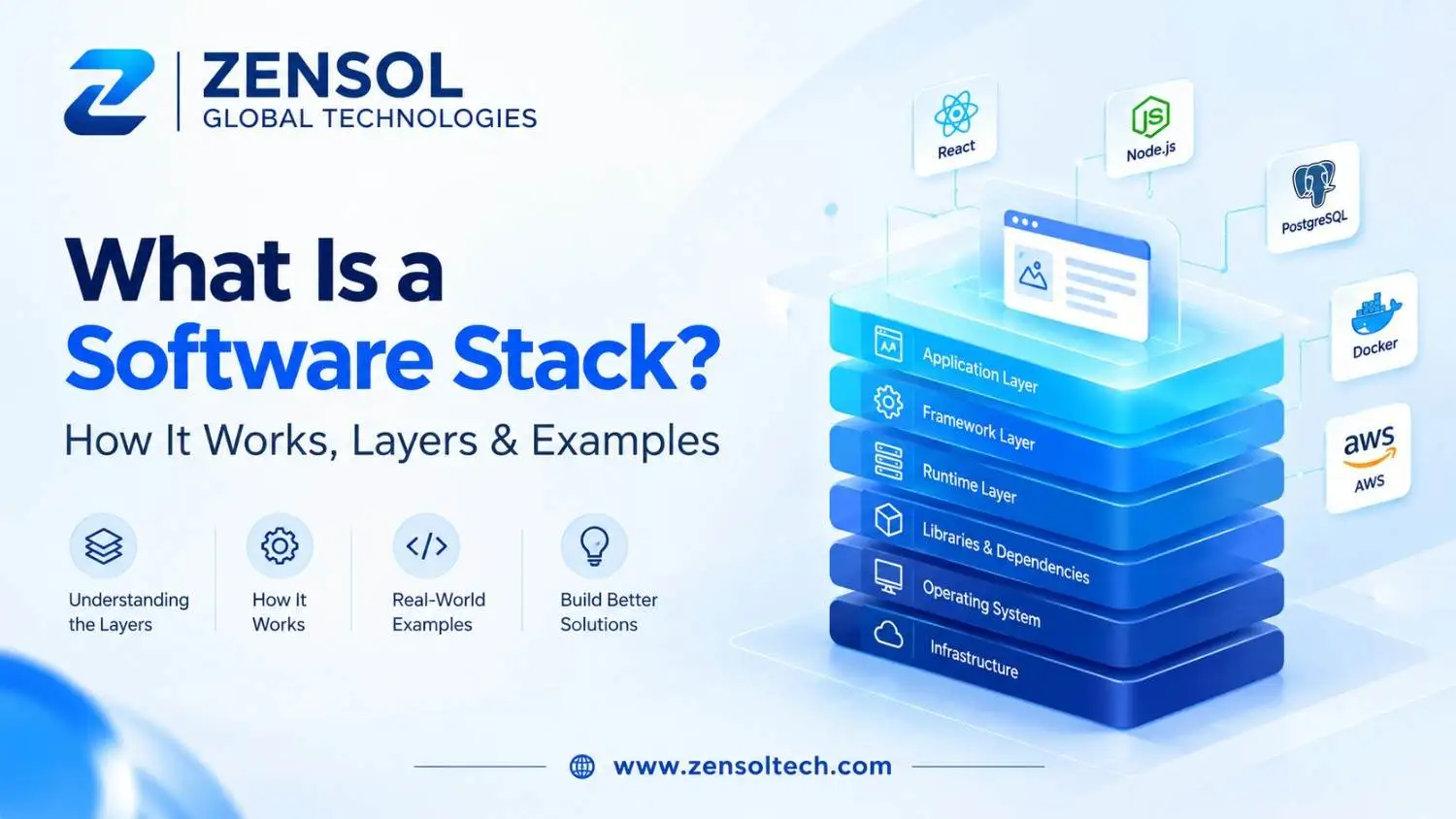
A software stack is the combination of programming languages, frameworks, databases, infrastructure, and other technologies used to build and run an application. If you are asking What Is a Software Stack, the simplest answer is: it is the set of technical components that work together to deliver a software product.
A web application, for example, may use React for its interface, Node.js for server-side logic, PostgreSQL for data storage, and cloud infrastructure for deployment. Each component has a different job, but the application depends on their interaction. Understanding that relationship makes it easier to evaluate how software is built, maintained, secured, and scaled.
What Is a Software Stack?
A software stack is a combination of technologies used to build, run, and support an application. Depending on the project, it may include the frontend, backend, database, operating system, web server, cloud services, and other supporting components.
These technologies have different responsibilities but work together through APIs, protocols, and application logic. For example, a frontend can send a request to a backend API, which processes the request, retrieves data from a database, and returns a response for the frontend to display.
The exact stack depends on the application's requirements. A small web application may use only a few components, while a larger system may add containers, caching, message queues, third-party services, monitoring, and multiple application services. A software stack is therefore not simply a list of technologies; it is the technical environment that enables an application to function.
How Does a Software Stack Work?
A software stack works by assigning different responsibilities to different technologies and connecting those components through defined interfaces, protocols, or application logic.
Consider a customer checking an order on an online store. A simplified request might move through the system like this:
Browser → Frontend → Backend/API → Database → Backend → Frontend → Browser
Each layer performs a specific task, while APIs and other interfaces allow the components to exchange information. This interaction takes place within the broader software development life cycle, where teams plan, build, test, deploy, and maintain the application.
User Request
The process starts when a user performs an action, such as opening an order page. The browser sends a request to the application, usually over HTTP or HTTPS.
The request may contain information such as the requested URL, authentication credentials or session information, and other parameters needed by the application.
Frontend Processing
The frontend is responsible for presenting the application's interface and handling interactions in the browser.
Technologies such as HTML, CSS, JavaScript, and frameworks such as React can be used to create this layer. The frontend may request data from a backend API instead of containing the application's business data itself.
Backend and Application Logic
The backend receives requests and applies the application's rules.
For an order page, it might verify the user's identity, determine which order they are allowed to access, request the required data, and return an appropriate response. Backend technologies can include Node.js, Python, Java, PHP, or .NET.
Database Interaction
If the requested information is stored in a database, the backend communicates with it to retrieve or modify data.
A relational database such as PostgreSQL or MySQL may store structured information about customers, products, and orders. A NoSQL database such as MongoDB may be appropriate for different data models and application requirements.
Response and Delivery
The backend returns the required data or result to the frontend. The frontend then uses that response to update the interface the user sees.
Real applications can be considerably more complex. They may add caching, authentication services, third-party APIs, message queues, or separate microservices between these steps.
What Are the Main Layers of a Software Stack?
There is no universal layer model that applies to every application. However, four broad areas are useful for understanding many web and application architectures.
| Layer | Main responsibility | Example technologies |
|---|---|---|
| Frontend | User interface and browser-side behavior | HTML, CSS, JavaScript, React |
| Backend | Business logic and APIs | Node.js, Python, .NET, Java |
| Database | Data storage and retrieval | PostgreSQL, MySQL, MongoDB |
| Infrastructure | Hosting, runtime, and deployment environment | Linux, Docker, AWS, Azure |
These layers can overlap or be divided further depending on the architecture.
Presentation or Frontend Layer
The frontend is the part of an application that users interact with directly. In a web application, this usually means the interface rendered by the browser.
HTML defines structure, CSS controls presentation, and JavaScript adds interactive behavior. Frameworks such as React can help developers build larger interfaces from reusable components.
The frontend is not simply a visual layer. It also manages client-side state, user interactions, form handling, and communication with backend services.
Application or Backend Layer
The backend handles server-side processing that should not be performed entirely in the browser.
It can contain business rules, authentication and authorization logic, API endpoints, data validation, integrations, and other application services. Node.js, Python, Java, PHP, and .NET are examples of technologies commonly used in this part of a stack.
For example, when a customer submits an order, the backend can validate the request, calculate applicable rules, save the transaction, and communicate with payment services.
Database Layer
The database layer stores and retrieves application data.
Relational databases such as PostgreSQL and MySQL organize information using structured schemas and relationships. MongoDB uses a document-oriented model and may be suitable for applications with different data requirements.
Database selection should follow the application's data model, consistency requirements, query patterns, scale, and operational needs rather than popularity alone.
Infrastructure Layer
The infrastructure layer provides the environment where application components run, including servers, networking, storage, containers, and cloud platforms such as AWS and Azure. These choices are closely connected to cloud application development, especially when applications need flexible deployment and scalable infrastructure.
Modern systems may also use monitoring, logging, CI/CD, caching, and managed cloud services.
Common Software Stack Examples
There is no single software stack that fits every application. Different combinations can support similar goals, but the best choice depends on the project's requirements, team expertise, integrations, and long-term maintenance needs.
MERN Stack
The MERN stack combines MongoDB, Express.js, React, and Node.js.
- MongoDB: Stores application data.
- Express.js: Handles backend web application logic and APIs.
- React: Builds the user interface.
- Node.js: Runs JavaScript on the server.
MERN can be a practical choice for teams that want JavaScript across the frontend and backend. It can also work well for applications that benefit from a widely used JavaScript ecosystem. However, its suitability still depends on the application's data, performance, and operational requirements.
LAMP Stack
LAMP traditionally consists of Linux, Apache, MySQL, and PHP.
It is a long-established web development stack and remains relevant when maintaining existing PHP applications or environments built around this architecture. Its maturity can also make it practical where established tooling and developer knowledge already exist.
MEAN Stack
The MEAN stack uses MongoDB, Express.js, Angular, and Node.js.
It follows a structure similar to MERN, but Angular replaces React for the frontend. This can suit teams that prefer Angular's structured framework approach and already have the relevant expertise.
Python-Based Stack
A Python-based stack is not a single standardized combination. A project might use Python with Django or FastAPI, PostgreSQL, and Linux or cloud infrastructure.
This approach can fit projects where Python expertise, backend framework capabilities, or integration requirements are important. The specific combination should be selected according to the application's architecture rather than simply choosing Python because it is popular.
.NET Stack
A .NET application might combine ASP.NET Core, SQL Server, and Azure or another hosting environment.
This can be a practical fit for organizations already using Microsoft technologies or applications that benefit from the .NET ecosystem. The choice should still be based on requirements such as integrations, security, team expertise, hosting, and long-term maintenance.
The key point: A software stack should be evaluated as a complete system, not by asking which individual technology is “best.” The right combination is the one that solves the project's needs with a reasonable level of complexity.
Software Stack vs. Technology Stack: Is There a Difference?
In most software development discussions, software stack and technology stack mean essentially the same thing. Both describe the collection of technologies used to build and operate an application or software product.
“Tech stack” is simply a shorter, commonly used version of “technology stack.”
There can be a slight difference in context. A technology stack may sometimes describe the broader set of technologies used across a product or organization, including infrastructure and operational tools. However, there is no strict industry-wide rule that creates a completely separate definition for each term.
Full Stack vs. Software Stack
Software stack describes the technologies that make up an application or its supporting environment. Full stack usually refers to the breadth of application development across the frontend and backend, or to a developer who can work across those areas.
For example, a software stack might contain React, Node.js, PostgreSQL, Docker, and AWS. A full-stack developer may work with the frontend and backend portions of that environment.
The terms therefore describe different things. One describes the technology environment; the other commonly describes development scope or capability.
How Do Developers Choose a Software Stack?
There is no universally best software stack. Developers and technical teams normally evaluate the application's requirements first and then choose technologies that can meet those requirements without introducing unnecessary complexity.
Several factors influence the decision:
- Project requirements: The application's functionality may favor particular frameworks, databases, or services.
- Team expertise: Familiar technologies can reduce learning and development overhead.
- Scalability: Expected traffic, data volume, and workload patterns affect architectural decisions.
- Security: Authentication, data protection, dependency management, and compliance requirements need consideration.
- Performance: Response times and resource usage may influence technology selection.
- Integrations: Existing APIs, payment systems, enterprise software, or cloud services can constrain choices.
- Maintenance: The team must be able to update dependencies, fix problems, and support the application over time.
- Hiring: Technologies with an available talent pool may be easier to support as the team grows.
- Infrastructure cost: Hosting, storage, databases, and operational tooling contribute to the long-term cost.
For an MVP, teams may prioritize development speed and familiar technologies. These considerations are particularly relevant to software development for startups, where budgets, resources, and requirements can change quickly.
A high-traffic enterprise application may instead prioritize scalability, security, governance, reliability, and long-term support. The goal is to choose a stack based on project fit, not technology popularity.
What Makes a Good Software Stack?
A good software stack fits the application's requirements without adding unnecessary complexity. It should also be practical for the team to build, secure, deploy, and maintain over time.
Key signals include:
- Maintainability: Supported technologies and manageable dependencies.
- Compatibility: Components that integrate reliably.
- Security: Appropriate authentication, updates, and security controls.
- Scalability: A practical path for handling future growth.
- Observability: Useful logs, monitoring, and performance visibility.
- Developer productivity: Tools that match the team's skills and workflow.
More technologies do not mean a better stack. Every additional component adds maintenance, security, and operational overhead, so each technology should solve a genuine project requirement.
Software Stack Challenges
Choosing a stack is only the beginning. Keeping it healthy over time can present several challenges.
Technology incompatibility can occur when libraries, frameworks, APIs, or infrastructure components do not work well together. Teams should evaluate compatibility before committing to major dependencies.
Dependency management becomes harder as applications rely on more third-party packages. Regular updates and vulnerability monitoring can reduce the risks associated with outdated dependencies.
Technical debt can accumulate when short-term implementation decisions make future maintenance more difficult. Documenting important architectural choices and reviewing outdated components helps control this problem.
Scaling complexity can emerge when an application grows beyond its original architecture. Teams should scale components based on actual bottlenecks rather than adding infrastructure simply because the product is growing.
Excessive tooling is another common problem. A smaller, well-understood stack can be easier to maintain than a collection of technologies added without a clear architectural reason.
Final Thoughts
A software stack is not simply a list of technologies. It is the technical combination that allows an application to be built, operated, maintained, and scaled. Understanding how the frontend, backend, database, infrastructure, and supporting services interact makes technology decisions easier to evaluate.
There is no universally correct stack: a practical choice depends on requirements, team skills, security, performance, integrations, cost, and long-term maintenance. For organizations such as Zensol Global Technologies, that same project-specific thinking is essential when evaluating application architecture.