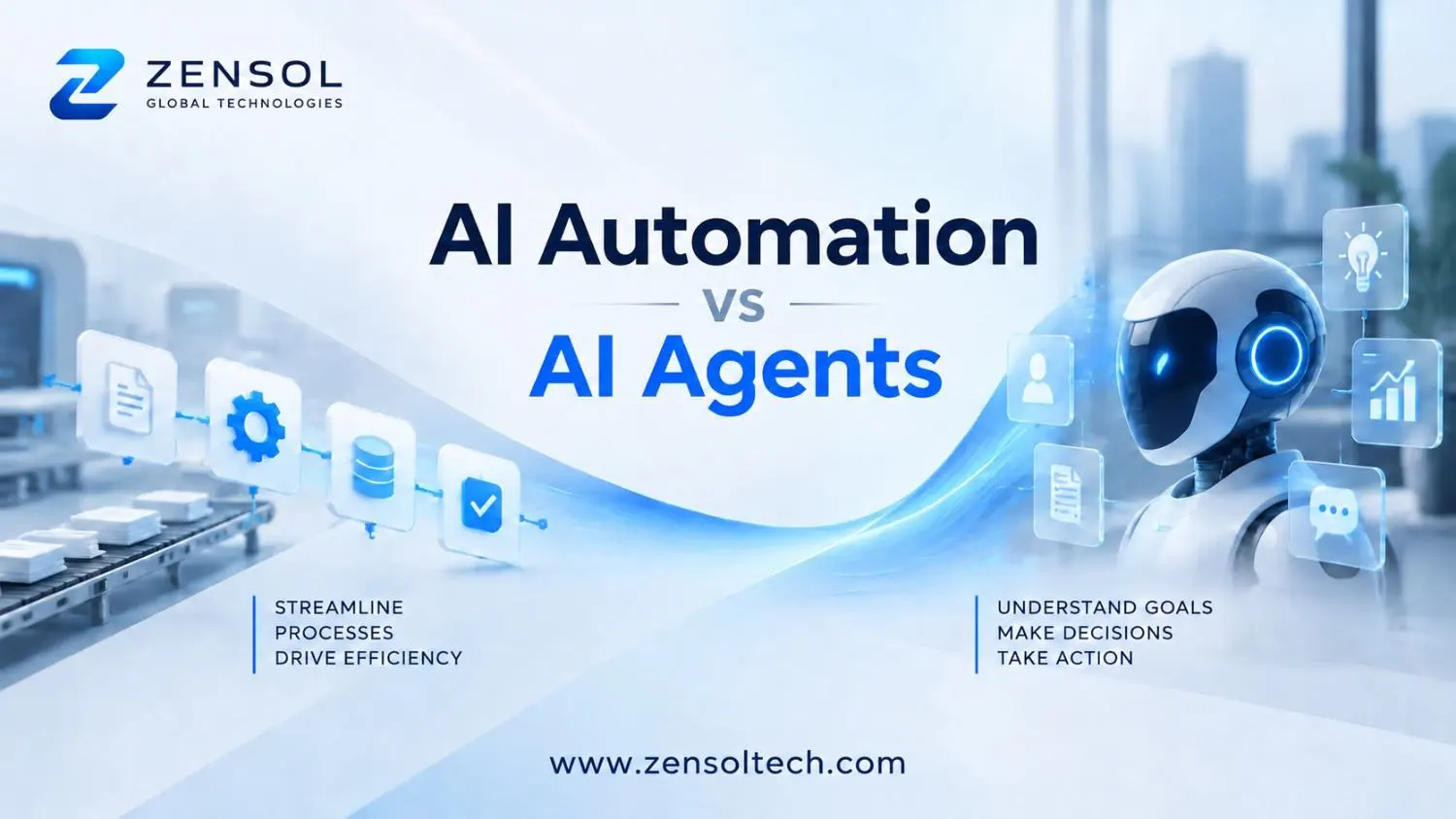
Businesses are looking for smarter ways to improve efficiency, reduce operational costs, and deliver better customer experiences through advanced artificial intelligence solutions However, choosing the right AI approach has become a challenge, especially when comparing AI Automation vs AI Agents and understanding which solution can create real business value.
The goal is no longer simply adopting AI — it is finding the right technology for the right business problem. AI automation helps companies optimize repetitive workflows, while AI agents enable more advanced tasks by understanding goals, analyzing information, and taking intelligent actions.
Choosing the wrong approach can lead to unnecessary complexity and limited results. A successful AI strategy starts with understanding business processes, identifying opportunities, and selecting solutions that support long-term growth.
In this guide, we will explore the differences between AI automation and AI agents, their practical business applications, and how companies can choose the right AI solution for their needs.
AI Automation vs AI Agents: Understanding the Key Difference
The biggest difference between AI Automation vs AI Agents is how they approach tasks.
AI automation is focused on improving existing processes. It helps businesses complete repetitive work faster, reduce manual effort, and improve operational accuracy.
AI agents take a more advanced approach. Instead of simply following a predefined workflow, they can understand objectives, analyze situations, make decisions, and complete multiple steps to achieve a specific goal.
A simple way to understand the difference:
AI automation answers:
"How can we make this process faster and more efficient?"
AI agents answer:
"How can we achieve this goal with intelligent decision-making?"
For example, an automated system can send an email after a customer submits a form. An AI agent can analyze customer information, understand their requirements, personalize communication, answer questions, and recommend the next action.
Both technologies are valuable. The right choice depends on your business needs, workflow complexity, and desired outcome.
What Is AI Automation?
AI automation combines artificial intelligence with traditional automation technologies to improve business processes.
Traditional automation works through fixed rules. It follows a specific sequence of actions based on predefined instructions.
AI automation adds intelligence to these workflows by allowing systems to:
- Analyze information
- Recognize patterns
- Classify data
- Make limited decisions
- Improve workflow efficiency
The goal of AI automation is not to replace employees. Instead, it helps teams spend less time on repetitive tasks and more time on activities that require creativity, strategy, and human judgment.
For many businesses, AI automation is the first step toward digital transformation because it provides measurable improvements without requiring a complete change in existing operations.
How AI Automation Works
AI automation solutions usually combine artificial intelligence models, workflow systems, business rules, and existing software platforms.
The process usually follows these steps:
- Information is collected from business systems.
- AI analyzes the available data.
- The system identifies patterns or actions.
- Automated workflows complete specific tasks.
For example, a company receiving thousands of customer requests every month can use AI automation to analyze incoming messages, identify customer intent, organize requests, and send them to the correct department.
This reduces response time and allows employees to focus on more important customer issues.
Practical Business Applications of AI Automation
Customer Service Automation
Customer support teams often spend significant time answering similar questions, organizing requests, and managing repetitive tasks.
AI automation can improve customer service workflows by helping companies:
- Categorize support tickets
- Suggest responses
- Route customer requests
- Retrieve customer information
- Automate follow-up communication
This allows support teams to provide faster service while focusing on complex customer problems.
Business Process Automation
Many companies still depend on manual administrative processes. These tasks consume employee time and increase the chance of errors.
AI-powered workflow automation can improve processes such as:
- Document processing
- Invoice management
- Data extraction
- Employee onboarding
- Report generation
For example, a finance department can use AI automation to extract information from documents, organize records, and reduce manual data entry.
Marketing and Sales Operations
Marketing teams can use AI automation to improve customer engagement and campaign performance.
Common applications include:
- Lead scoring
- Customer segmentation
- Email personalization
- Campaign analysis
- Customer behavior tracking
Instead of sending the same message to every customer, businesses can create more personalized experiences based on customer data.
What Are AI Agents?
AI agents are advanced AI systems designed to complete specific objectives by understanding context, making decisions, and taking actions.
Unlike traditional automation, AI agents are not limited to a fixed workflow. They can analyze situations, determine the next steps, and interact with different tools and systems.
An AI agent works more like an intelligent digital assistant that can support business operations.
Modern AI agents can help companies manage tasks such as:
- Customer communication
- Sales assistance
- Research
- Internal knowledge management
- Decision support
The key advantage of AI agents is their ability to handle situations that require flexibility and reasoning.
How AI Agents Work: Understanding, Reasoning, and Taking Action
AI agents combine AI capabilities to understand goals, analyze information, make decisions, and complete tasks with minimal human involvement.
Unlike traditional automation, AI agents can adapt to situations, evaluate information, and determine the next best action based on business objectives.
Understanding Business Context
AI agents analyze information from connected systems, such as:
- Customer records
- Internal documents
- Databases
- Business applications
This helps them provide accurate responses based on real business data instead of generic answers.
Reasoning and Decision-Making
A key difference in AI Automation vs AI Agents is the ability to make intelligent decisions.
AI agents can:
- Understand customer intent
- Analyze previous interactions
- Access relevant information
- Recommend solutions
- Handle complex cases
This makes them suitable for dynamic business environments.
Multi-Step Task Execution
AI agents can complete multiple actions to achieve a specific goal.
For example, an AI sales agent can:
- Find potential leads
- Research customer information
- Personalize outreach
- Update CRM systems
This allows businesses to automate complex workflows while maintaining flexibility and intelligence.
AI Automation vs AI Agents: Key Differences for Businesses
When comparing AI Automation vs AI Agents, businesses should not focus on which technology is more advanced. The better question is which solution matches their operational challenges and business goals.
AI automation and AI agents are designed for different situations. One improves efficiency by optimizing existing workflows, while the other helps businesses manage complex tasks that require analysis, decision-making, and adaptability.
The following comparison helps clarify where each technology creates the most value:
| Factor | AI Automation | AI Agents |
|---|---|---|
| Primary Purpose | Improve repetitive workflows | Complete complex business objectives |
| Decision-Making | Limited decisions based on rules and data | Advanced reasoning and adaptive decisions |
| Workflow Type | Structured and predictable | Flexible and dynamic |
| Complexity | Easier to implement | Requires more customization |
| Human Involvement | Needed for exceptions and approvals | Reduced for many decision-based tasks |
| Best Use Cases | Reporting, data processing, workflow automation | Sales, customer support, research, business assistance |
| Business Impact | Higher efficiency and reduced manual work | Intelligent operations and improved decision-making |
The choice depends on the type of problem a business wants to solve. Companies should avoid selecting AI technology simply because it is trending. The most successful AI projects begin with identifying operational challenges and choosing the solution that creates measurable improvement.
AI Automation vs AI Agents: Cost and Implementation Differences
One of the biggest factors businesses consider before adopting AI is implementation complexity and cost.
AI automation is usually easier to introduce because it improves existing processes with clear objectives. Companies can start with specific workflows and gradually expand automation across different departments.
For example, a business may begin by automating:
- Customer email responses
- Document processing
- Internal reporting
- Data organization
AI agents often require deeper planning because they need access to business information, software systems, and decision-making frameworks.
A successful AI agent implementation may require:
- Data integration
- Security controls
- Permission management
- System connections
- Human approval processes
- Continuous monitoring
This does not mean AI agents are always expensive or complicated. It means businesses need a clear strategy before deployment.
The most important question is not:
"How advanced is the AI technology?"
The better question is:
"Will this AI solution solve a real business problem?"
When Should Businesses Choose AI Automation?
AI automation is the right choice when businesses have repetitive processes that follow predictable patterns.
Companies should consider AI automation when they want to improve efficiency, reduce manual work, and create more reliable operations.
AI automation is especially useful for:
Reducing Repetitive Tasks
Many employees spend valuable time completing tasks that do not require complex decision-making.
Examples include:
- Data entry
- Report generation
- Document processing
- Scheduling
- Customer notifications
Automating these activities allows employees to focus on strategic responsibilities.
Improving Operational Efficiency
Businesses with structured workflows can benefit significantly from intelligent automation.
For example, a logistics company can automate:
- Shipment updates
- Customer notifications
- Delivery tracking
- Internal reports
This improves speed and consistency across operations.
Creating Scalable Processes
As businesses grow, manual processes often become difficult to manage.
AI automation helps companies handle increasing workloads without increasing operational pressure at the same rate.
This makes automation valuable for growing businesses that want to improve efficiency while maintaining quality.
When Should Businesses Choose AI Agents?
AI agents are most valuable when tasks require understanding, reasoning, and interaction.
Unlike traditional automation, AI agents can handle situations where the path to completion is not always fixed.
Businesses should consider AI agents when they need:
Advanced Customer Interaction
Customer expectations are changing. People want faster responses and personalized experiences.
AI customer support agents can:
- Understand customer questions
- Analyze customer history
- Provide relevant solutions
- Handle multiple conversations
- Escalate complex cases
This helps businesses improve customer satisfaction while reducing pressure on support teams.
Intelligent Sales Support
Sales teams can use AI agents to improve productivity.
AI sales agents can help with:
- Lead qualification
- Customer research
- Personalized communication
- Follow-up management
- CRM updates
Instead of replacing sales professionals, AI agents support them by reducing administrative work and improving preparation.
Knowledge Management
Many organizations have large amounts of internal information but struggle to make it easily accessible.
AI assistants can help employees:
- Search company information
- Summarize documents
- Find relevant knowledge
- Support daily decisions
This is especially valuable for companies with complex operations and large teams.
How Businesses Can Decide Between AI Automation and AI Agents
Choosing between AI automation and AI agents requires a clear understanding of your business process.
Before starting AI implementation, companies should evaluate the following:
1. Is the Process Repetitive or Complex?
If a task follows a predictable sequence, AI automation may be the better option.
If a task requires understanding, judgment, and adaptation, AI agents may provide more value.
2. Does the Process Require Decision-Making?
Simple tasks usually benefit from automation.
Examples:
- Sending notifications
- Updating records
- Generating reports
Tasks requiring reasoning may benefit from AI agents.
Examples:
- Customer problem-solving
- Sales recommendations
- Research analysis
3. What Business Outcome Do You Want?
Companies should start with the desired result.
Examples:
Goal: Reduce manual workload
→ AI automation
Goal: Improve customer experience
→ AI agents
Goal: Build smarter operations
→ Combination of both
Technology should support business objectives, not become the objective itself.
Can Businesses Use AI Automation and AI Agents Together?
Yes. Businesses do not always need to choose between AI automation and AI agents. Combining both creates smarter AI-powered workflows where automation handles repetitive operations, while AI agents manage tasks requiring reasoning, decision-making, and interaction.
Healthcare Business
Healthcare providers are also adopting robotic process automation in healthcare to improve operational efficiency and reduce administrative workload. AI agents can support patient communication, answer questions, and provide personalized assistance based on available information.
E-commerce Business
E-commerce companies can automate order processing, inventory updates, and notifications, while AI agents improve customer experiences through personalized recommendations, conversations, and shopping support.
SaaS Business
SaaS companies can use AI automation to streamline onboarding, reporting, and account workflows. AI agents can assist with customer success, product guidance, and technical support.
By combining both technologies, businesses can achieve greater efficiency, scalability, and more intelligent customer experiences.
Common Mistakes Businesses Make With AI Adoption
Many organizations struggle with AI implementation because they focus on technology before understanding their business requirements.
Some common mistakes include:
Automating Poor Processes
AI cannot fix inefficient workflows. Businesses should first understand and improve their processes before applying automation.
Choosing AI Without Clear Goals
Every AI project should have a measurable purpose.
Examples:
- Reduce response time
- Improve productivity
- Increase customer satisfaction
- Reduce operational workload
Ignoring Data Quality
AI systems depend on accurate information.
Poor data quality can lead to:
- Incorrect outputs
- Poor recommendations
- Inefficient workflows
Businesses should prepare their data before implementing advanced AI systems.
Expecting Complete Autonomy Immediately
AI solutions require testing, monitoring, and improvement.
Successful companies usually start with focused use cases, measure results, and gradually expand AI adoption.
How Zensol Global Technologies Helps Businesses Implement AI Solutions
Successful AI transformation requires more than selecting an AI tool. Businesses need a strategy that connects technology with real operational needs.
Zensol Global Technologies helps businesses develop AI-powered solutions, including AI automation systems, AI agent development, and intelligent workflow solutions.
By analyzing business processes, identifying automation opportunities, and building customized AI systems, Zensol helps organizations improve efficiency, scale operations, and create better customer experiences.
The focus should always be on creating practical AI solutions that deliver measurable business value.
Final Thoughts
The decision between AI Automation vs AI Agents should start with understanding your business challenges.
AI automation is an excellent choice for companies that want to reduce repetitive work, improve efficiency, and optimize existing workflows.
AI agents are valuable for organizations that need intelligent decision-making, personalized interactions, and flexible task management.
For many businesses, the future will not be about choosing one technology over the other. The strongest results will come from combining automation, AI intelligence, and human expertise to build smarter, scalable operations.
Ready to transform your business with intelligent AI solutions? Contact Zensol Global Technologies to explore AI Services.