Natural Language Processing in Customer Service helps businesses use artificial intelligence to understand customer conversations, identify intent, analyze sentiment, and provide faster, more accurate support responses. As customer expectations continue to grow across chat, email, social media, and voice channels, traditional support systems often struggle to deliver personalized experiences at scale.
By combining NLP with machine learning, conversational AI, and large language models, businesses can automate repetitive tasks, improve agent productivity, and create smarter customer support workflows. However, NLP is not about replacing human teams—it enhances their capabilities by helping organizations deliver faster resolutions and better customer experiences.
This guide explains how NLP works in customer service, its key applications, benefits, and how businesses can implement AI-powered support solutions effectively.
What Is Natural Language Processing in Customer Service?
Natural Language Processing in Customer Service is the use of artificial intelligence technology that enables computer systems to understand, analyze, and respond to human language during customer interactions.
Traditional customer support automation usually depends on predefined rules. These systems can answer simple questions but often struggle when customers use different phrases, incomplete sentences, or complex requests.
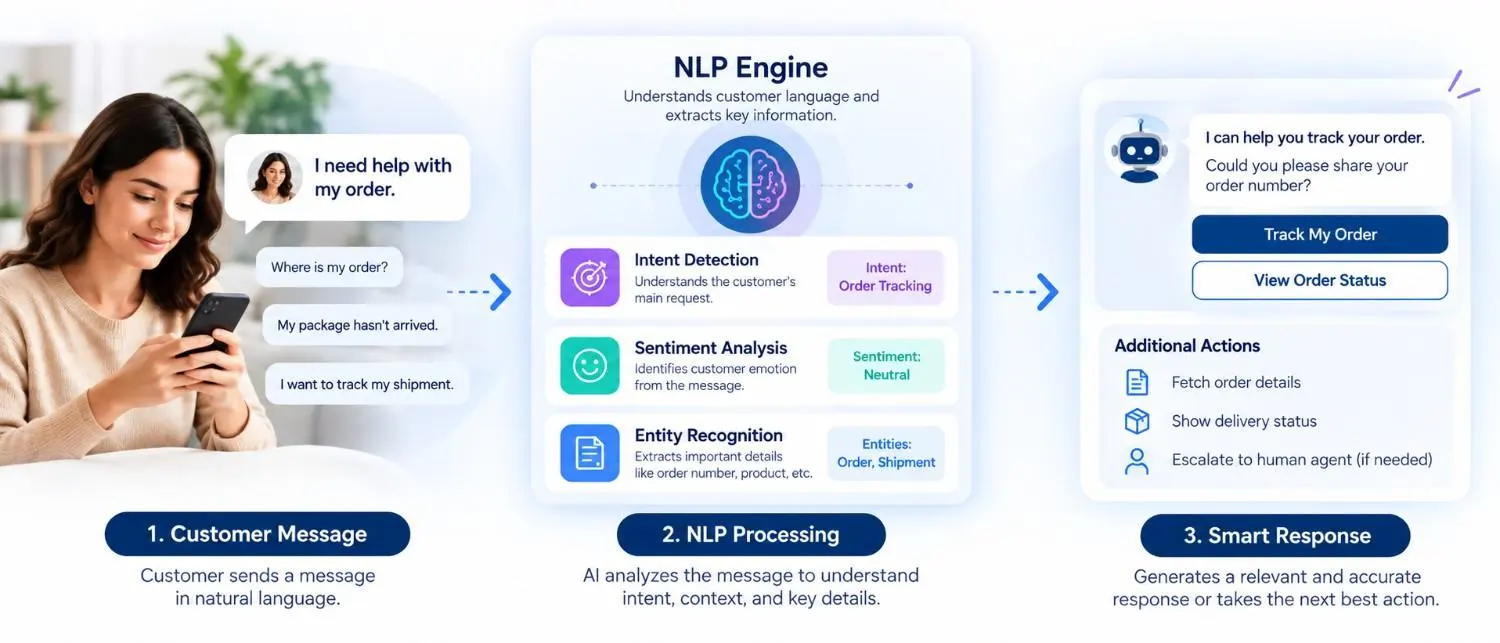
NLP solves this problem by helping AI systems understand the meaning, context, and intent behind customer conversations.
For example, customers may write:
- "My payment did not go through."
- "I cannot complete my transaction."
- "The checkout process is failing."
Although these messages use different words, an NLP-powered system understands that they represent the same issue: a payment-related problem.
By analyzing language patterns, customer history, and available business information, NLP systems can classify requests, provide relevant answers, and determine when human assistance is required.
How Natural Language Processing Works in Customer Support
NLP customer service systems work through multiple AI processes that allow machines to understand and respond to human communication.
The first stage is language understanding. When a customer sends a message, the NLP system analyzes the words, sentence structure, and context to determine the meaning behind the request.
For example, a customer saying "I want to cancel my subscription" is not only identified as a text message. The system understands the customer's intention and recognizes that an account cancellation workflow may be required.
The next stage involves intent recognition. AI systems identify what the customer is trying to achieve, whether it is requesting information, reporting a problem, asking for a refund, or needing technical assistance.
After understanding the request, the system can retrieve relevant information, generate a response, or transfer the conversation to the appropriate department.
Modern NLP systems improve over time by analyzing previous conversations, customer feedback, and response performance. This continuous learning process helps businesses improve support quality and accuracy.
Key Technologies Behind NLP Customer Service
Modern AI-powered customer support relies on several advanced technologies working together.
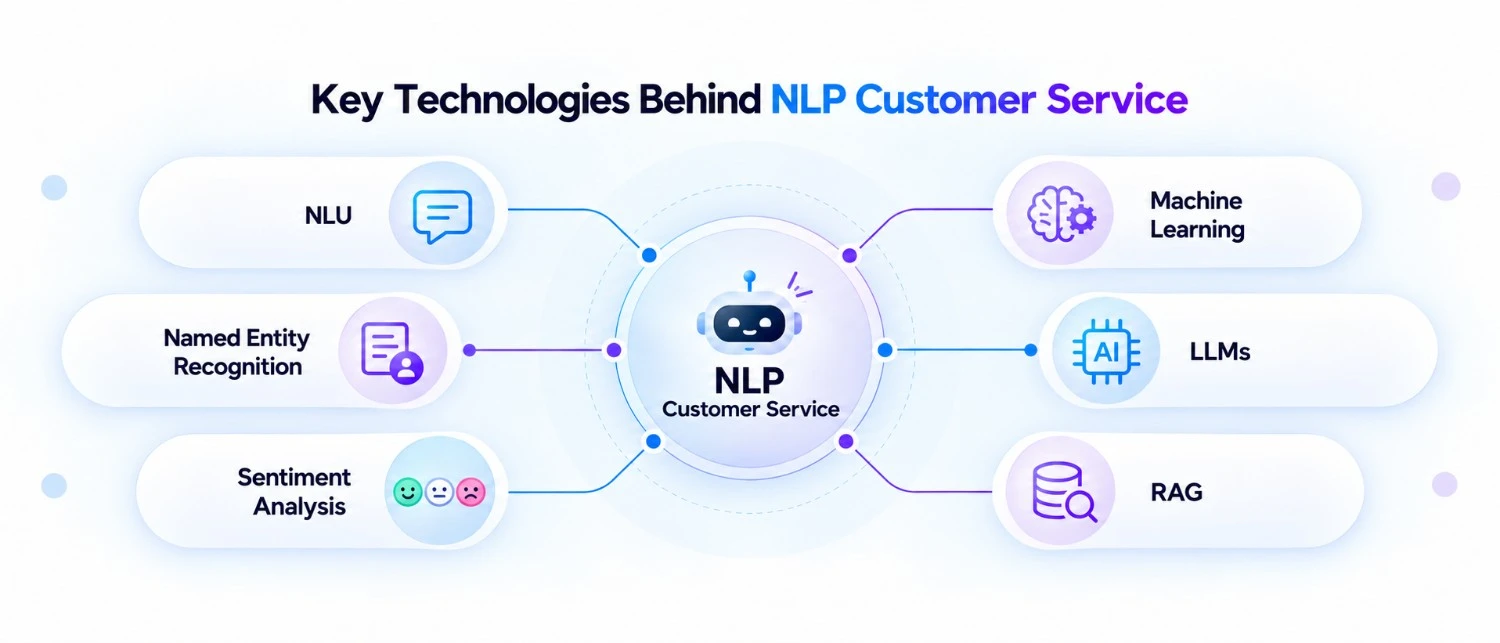
Natural Language Understanding (NLU)
Natural Language Understanding helps AI systems understand the meaning behind customer messages. Instead of only identifying keywords, NLU analyzes customer intent, context, and purpose.
For example, NLU helps distinguish between:
"I want to change my account details"
and:
"I want to close my account."
Both messages mention an account, but they require completely different solutions.
Named Entity Recognition (NER)
Named Entity Recognition allows AI systems to identify important information within customer conversations.
For example:
"My order number 45892 has not arrived."
An NLP system can identify:
- Order number
- Delivery issue
- Customer request
NER improves accuracy by extracting important details automatically and reducing manual work for support teams.
Sentiment Analysis
Sentiment analysis helps businesses understand customer emotions during conversations.
An NLP system can identify whether a customer message indicates:
- Satisfaction
- Frustration
- Urgency
- Negative experience
This allows businesses to prioritize critical issues and provide better responses.
Retrieval-Augmented Generation (RAG)
Retrieval-Augmented Generation improves AI responses by allowing systems to access company information before generating answers.
Instead of creating responses based only on general AI knowledge, RAG systems retrieve information from sources such as:
- Product documentation
- Knowledge bases
- Company policies
- Support databases
This improves accuracy and reduces incorrect AI responses.
Large Language Models (LLMs)
Large Language Models allow AI systems to understand and generate more natural conversations.
When combined with NLP, LLMs help businesses create advanced customer support assistants capable of handling complex conversations and providing more human-like interactions.
Real-World Applications of NLP in Customer Service
Businesses across different industries use NLP to improve customer support processes and create more efficient communication systems.
E-commerce Customer Support
Online businesses often receive thousands of customer questions related to orders, products, returns, and payments.
NLP helps e-commerce companies automate common support requests by understanding customer messages and connecting them with the right information.
For example, when a customer asks about an order delay, an NLP-powered assistant can identify the order issue, retrieve relevant information, and provide an immediate update.
This reduces support workload while improving customer satisfaction.
Banking and Financial Services
Financial organizations use NLP to improve customer communication while maintaining secure service processes.
NLP applications in banking include:
- Understanding account inquiries
- Processing customer requests
- Analyzing customer feedback
- Detecting urgent issues
By automating common questions, financial institutions can allow support teams to focus on more complex customer needs.
Healthcare Customer Support
Healthcare organizations use NLP to improve administrative support and communication.
Examples include:
- Appointment assistance
- Patient information requests
- Healthcare document analysis
- Support automation
NLP helps healthcare teams manage routine communication while allowing professionals to focus on patient care.
SaaS and Technology Companies
Software companies use NLP to improve technical support and customer success operations.
NLP can help with:
- Product troubleshooting
- Knowledge base assistance
- User onboarding
- Technical issue classification
This allows SaaS businesses to support larger customer bases without increasing support workload at the same rate.
Benefits of Natural Language Processing in Customer Service
NLP provides businesses with several advantages by improving both customer and employee experiences.
Faster Response Times
One of the biggest advantages of NLP customer service is faster response delivery. AI systems can instantly analyze customer requests and provide immediate answers for common issues.
This reduces waiting times and improves customer satisfaction, especially for businesses handling large volumes of inquiries.
Improved Agent Productivity
NLP does not replace customer service agents. Instead, it helps them work more efficiently.
AI systems can assist agents by:
- Summarizing customer conversations
- Suggesting responses
- Finding relevant information
- Categorizing support tickets
This allows agents to spend more time solving complex customer problems.
Personalized Customer Experiences
Modern customers expect businesses to understand their needs.
NLP systems can analyze previous interactions, customer preferences, and conversation history to provide more personalized support.
This creates smoother customer experiences and helps businesses build stronger relationships.
Better Business Insights
Customer conversations contain valuable information about customer expectations and problems.
NLP analytics can identify patterns such as:
- Common complaints
- Product issues
- Customer sentiment trends
- Service improvement opportunities
Businesses can use these insights to improve products and customer service strategies.
NLP vs Chatbots vs Generative AI vs AI Agents
Although these technologies are connected, they serve different purposes in customer support.
| Technology | Purpose |
|---|---|
| Traditional Chatbots | Handle predefined questions using rules |
| NLP Systems | Understand customer language and intent |
| Generative AI | Create natural and flexible responses |
| AI Agents | Perform complex tasks and workflows |
Modern customer service platforms often combine these technologies to create more intelligent and scalable support systems.
How Businesses Can Implement NLP Customer Support
Successful NLP implementation requires a clear strategy rather than simply adding AI technology.
The first step is identifying specific customer service challenges. Businesses should determine whether their goal is reducing response time, automating repetitive tasks, improving customer insights, or supporting human agents.
The next step involves preparing reliable business information. AI systems perform better when they have access to accurate knowledge bases, product documentation, and customer service data.
Businesses should then select the right NLP solution based on their requirements. Some organizations may need simple AI assistants, while others may require advanced systems integrated with CRM platforms and business applications.
A successful implementation process usually includes:
- Business workflow analysis
- Data preparation
- AI solution development
- System integration
- Performance monitoring
Continuous improvement is essential because customer expectations and business requirements continue to change.
How Much Does NLP Customer Service Implementation Cost?
The cost of implementing NLP customer service solutions depends on the complexity of the project and business requirements.
Important cost factors include:
- AI model selection
- Data preparation requirements
- Integration with existing systems
- Custom development needs
- Number of users and support channels
- Ongoing maintenance
A small business using an AI chatbot may require a simpler solution, while an enterprise organization may need a customized AI system connected with multiple platforms.
The best approach is to evaluate business goals first and choose technology based on actual customer service needs.
How Zensol Builds AI-Powered Customer Support Solutions
Successful AI implementation requires more than selecting an AI tool. Businesses need solutions that connect technology with real customer service challenges.
Zensol Global Technologies helps organizations develop AI-powered customer support solutions designed to improve automation, communication, and operational efficiency.
The approach focuses on understanding business workflows, identifying automation opportunities, developing suitable AI systems, and integrating technology into existing processes.
A structured AI development approach includes:
- Analyzing customer support requirements
- Preparing business knowledge sources
- Developing AI-powered workflows
- Integrating with existing platforms
- Improving system performance through monitoring
By combining AI expertise with software development capabilities, businesses can create customer support systems that improve efficiency while maintaining human-centered service.
Final Thoughts
Natural Language Processing in Customer Service is transforming how businesses communicate with customers.
By enabling AI systems to understand language, recognize intent, analyze sentiment, and automate repetitive tasks, NLP helps organizations deliver faster and more personalized support experiences.
The future of customer service will not depend on automation alone. The most successful businesses will combine artificial intelligence with human expertise to create efficient, reliable, and customer-focused support operations.