
A dental practice can provide excellent care and still struggle to appear when nearby patients search online. Referrals may be inconsistent, while paid visibility stops when the budget is paused. SEO for dentists creates a more durable path by helping the right patients find the right page.
The goal is not simply more traffic. A strong strategy should improve visibility, patient trust, and appointment actions by ranking for relevant searches, answering pre-booking questions, and making contact easy.
This guide explains how to build that system without keyword stuffing, copied location pages, or generic content written only for search engines.
What Is SEO for Dentists?
SEO for dentists is the process of improving a dental practice’s website and local presence so it can appear for searches such as “dentist near me,” “dental implants in New York City,” or “emergency dentist open today.” It combines keyword research, treatment-page optimization, local SEO, technical improvements, useful content, reviews, authority building, and conversion tracking.
Dental SEO differs from general SEO because patient intent changes by treatment, urgency, location, insurance needs, and stage of decision-making.
Use the Search–Trust–Action Framework
The most useful way to evaluate SEO for dentists is to follow three connected stages.
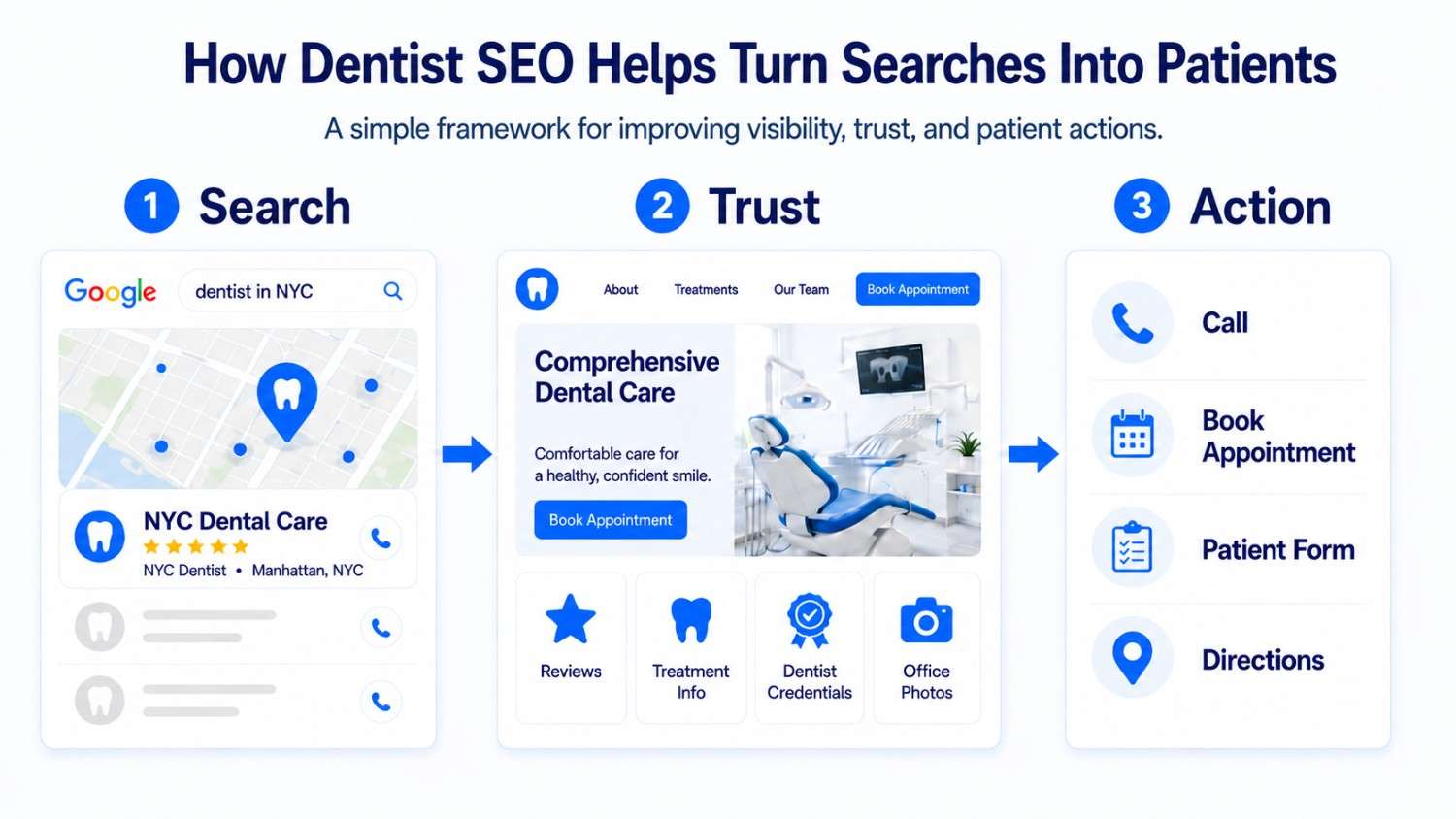
Search: The practice appears for a relevant query, such as “dentist near me” or “Invisalign provider in Manhattan.”
Trust: The page confirms the treatment, location, and expertise through clear information, credentials, authentic photos, reviews, and accurate details.
Action: The patient can quickly find the phone number, appointment form, office hours, directions, and next step.
This framework prevents a common mistake: treating rankings as the finish line. A page can rank and still underperform if it fails to answer the query or support contact.
How Do Patients Search for Dental Care?
Dental searches usually reveal a specific need:
- General local intent: “dentist near me”
- Treatment intent: “dental implants in Brooklyn”
- Urgent intent: “emergency dentist open now”
- Research intent: “how long does a root canal take?”
- Cost or insurance intent: “Invisalign cost” or “dentist accepting [insurance]”
- Trust intent: searches for reviews, credentials, photos, or a practice name
Each search type should lead to a page designed for that need. Appointment-focused searches belong on treatment or location pages. Educational questions belong in articles that support those pages. Sending every searcher to the homepage weakens relevance.
Build a Keyword Map Before Creating Content
A keyword map assigns one primary search topic to one main page. It helps prevent multiple pages from competing for the same phrase.
| Search Intent | Best Page to Target |
| “Dental implants in Brooklyn” | Dedicated dental implant service page |
| “How long do dental implants last?” | Educational article linked to the implant page |
| “Emergency dentist near me” | Emergency dentistry page with location details |
| “Dentist in North Queens” | Genuine location page for that office |
| “Invisalign cost” | Cost-focused guide or detailed pricing section |
| “Dentist accepting Delta Dental” | Insurance or payment information page |
Before publishing, check whether an existing page already satisfies the query. If it does, improve it rather than creating a near-duplicate.
Create Treatment Pages That Deserve to Rank
A thin paragraph about a procedure is rarely enough. A useful treatment page should help a patient decide whether to contact the practice.
For services such as dental implants, Invisalign, emergency dentistry, veneers, pediatric dentistry, and root canal treatment, include:
- Who the treatment may suit
- What problem it addresses
- What the process generally involves
- What patients should know about preparation and recovery
- Which factors may affect cost or insurance
- Why the practice is qualified to provide it
- How to request an evaluation
Placing every procedure on one general services page makes it harder to match specific searches and limits useful patient information.
Keep clinical explanations responsible. Marketing copy should not promise outcomes, minimize risks, or present general information as personal medical advice.
Strengthen On-Page and Technical SEO
Each important page needs a unique title tag, one clear H1, descriptive subheadings, a readable URL, relevant internal links, and a useful meta description. The title should reflect the treatment and location where appropriate.
Internal links also need a purpose. A blog about implant recovery should link to the implant service page. A location page should link to treatments available at that office. Descriptive anchor text is more useful than “learn more.”
Technical SEO keeps pages accessible. Review mobile usability, speed, broken links, duplicate URLs, crawlability, indexing, canonical tags, redirects, and HTTPS. Structured data can clarify business and location information, but it cannot replace strong content or guarantee enhanced results.
Publish Content That Supports Patient Decisions
Helpful content answers questions patients ask before booking: cost factors, recovery expectations, candidacy, insurance, treatment comparisons, and what happens during the first visit.
A strong article solves one clear problem. “What to Expect After a Root Canal” is more useful than a broad post about oral health. It also creates a natural internal link to the related treatment page.
Avoid publishing many shallow articles. One complete, carefully reviewed guide is usually more valuable than several pages repeating the same advice. Health-related content should be accurate, clear, and reviewed when it includes detailed clinical information.
Local SEO for Dentists
Local SEO for dentists improves visibility in Google Maps and geographically relevant organic results. It matters because most patients choose care within a practical travel distance, although specialists may attract people from a wider area.
Treat the Google Business Profile as a Patient Touchpoint
Use the real practice name, accurate categories, current hours, correct phone number, appointment link, service details, and authentic office photos. Review the profile after holidays, closures, relocations, or service changes.
A wrong phone number or outdated opening time can lose a patient even when the practice ranks well.
Build an Ethical Review Process
Ask patients for honest feedback at a natural point after their visit. Make the process easy, but do not offer incentives, filter unhappy patients, or arrange fake reviews.
Respond professionally while protecting privacy. Avoid confirming that a reviewer received a specific treatment or discussing personal details in public.
Keep Local Information Consistent
The practice name, address, and phone number should match across the website, Google Business Profile, major directories, insurance networks, and professional listings. Fix duplicate profiles and outdated addresses before pursuing low-quality citations.
For multi-location groups, create one useful page per real office. Include unique staff details, services, hours, directions, parking information, photos, and contact options. Do not copy one page and change only the city name.
A Practical 90-Day Starting Plan
SEO for dentists becomes easier when the work is prioritized.
Days 1–30: Confirm tracking, audit indexing and mobile performance, review internal links, verify Google Business Profile details, and correct directory inconsistencies. Identify high-value treatments and pages already receiving impressions.
Days 31–60: Improve commercially important pages that already show potential, especially those ranking near the bottom of page one or on page two. Strengthen treatment information, practitioner details, local relevance, internal links, and contact options.
Days 61–90: Publish two or three articles based on genuine patient questions, strengthen relevant local mentions, and review calls, forms, directions, and treatment-page conversions.
This sequence fixes major barriers before heavy content investment.
Common Dental SEO Mistakes
Common problems include sending every searcher to the homepage, copying location pages, publishing generic stock content, ignoring mobile conversions, leaving outdated business details online, and measuring only rankings.
Another mistake is choosing topics only because a keyword tool shows high volume. The best SEO marketing for dentists connects search demand with treatments the practice wants to grow and questions patients actually ask.
How Long Does SEO for Dentists Take?
There is no honest universal timeline. Progress depends on the website’s condition, competition, location, authority, review profile, content quality, technical health, and consistency.
A technically healthy practice with established local authority may respond faster than a new website in a competitive city. Some changes can be processed quickly, while broader improvements may take months. Anyone promising a guaranteed position by a fixed date is oversimplifying search.
Measure Patient Outcomes, Not Just Rankings
Track non-branded organic visits, local visibility, Google Business Profile actions, calls, forms, appointment requests, direction requests, treatment-page conversion rates, and qualified inquiries by service.
Review these metrics together. Traffic can fall while relevant calls increase because low-value visits were removed. That may still represent better performance. Rankings are a diagnostic signal, not the final business result.
Should a Dental Practice Hire an SEO Professional?
Basic updates may be manageable internally when a practice has one location, a healthy website, and someone who can maintain listings and content. Professional support becomes more useful when technical problems, multiple locations, competitive treatments, or unreliable tracking make the work difficult to coordinate.
A credible provider should explain priorities, show what will change, and connect reporting to patient inquiries rather than hide behind guarantees. Practices needing coordinated strategy, technical work, content, and local optimization can explore Zensol Technologies’ professional search engine optimization services.
Final Thoughts
SEO for dentists is not a checklist of keywords. It is a patient-acquisition system built around visibility, trust, and action. The practice must appear for relevant searches, provide information that supports a confident decision, and make contacting the office effortless.
Strong results require accurate local signals, complete treatment pages, technical reliability, useful content, credible authority, and conversion data. Improve pages that already show potential before expanding into dozens of topics. When every page has a clear search purpose and patient next step, dental SEO becomes easier to manage and measure.