
SEO for Dentists has quietly become the difference between a dental practice with a full appointment book and one that's still waiting for the phone to ring. Every day, patients search Google before they ever call a clinic — checking reviews, comparing prices, reading about procedures, and scrolling through Google Maps results before deciding who to trust with their teeth. If your practice isn't visible in those moments, a competitor down the street probably is.
Dental care is a local, trust-driven decision, and Google has become one of the most important front doors to that decision. This guide breaks down what dental SEO actually means in 2026, why it matters, and which strategies genuinely move the needle for practices trying to grow patient volume through organic search.
Quick Answer: What Is SEO for Dentists?
SEO for dentists is the process of improving a dental practice's website, Google Business Profile, and online reputation so it ranks higher in Google search results — helping the practice attract more local patients without relying solely on paid ads.
Why Dental SEO Matters for Growing Practices in 2026
In 2026, patients search online before choosing a dentist. They compare Google Maps listings, reviews, treatment information, and clinic websites before deciding who to trust. If a dental practice is not visible during these searches, competitors are more likely to capture those potential patients.
A strong SEO strategy helps practices improve online visibility, attract qualified patients, and build trust before the first appointment.
How Patients Search for Dentists Online
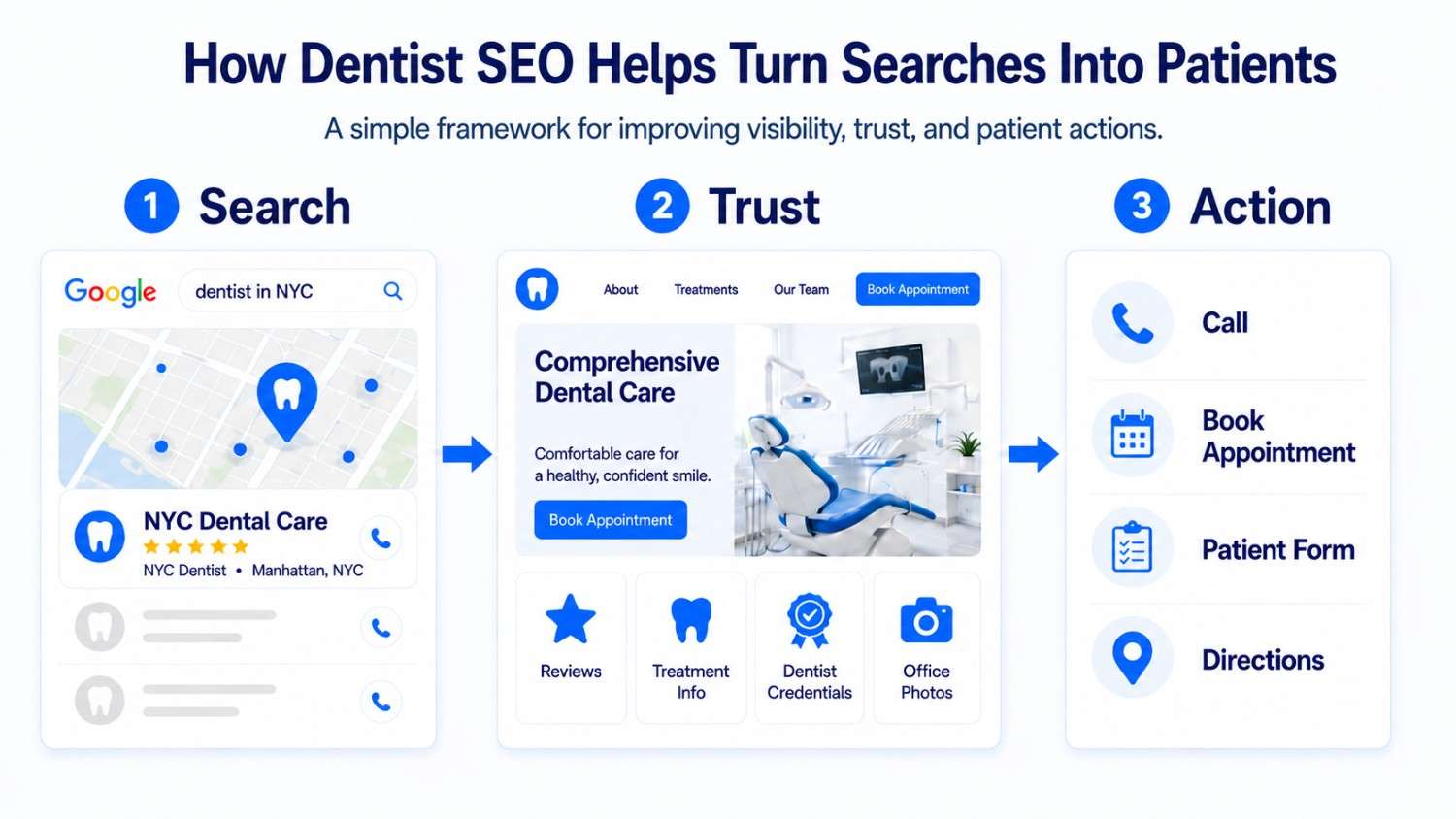
Understanding how a real search turns into a booked appointment makes SEO strategy far more concrete:
Search: "how much do dental implants cost" → Reads an educational blog post answering the question honestly → Visits the dedicated implants service page → Checks reviews and before/after photos → Books a consultation.
Every stage of that journey needs its own content: the blog post earns the click, the service page earns the trust, and the reviews close the decision. Practices that only build a single "Services" page skip the middle of this journey entirely — which is exactly why local SEO, not just general content, has to be the foundation of the strategy.
Local SEO for Dentists: The Key to Google Maps Visibility
For a dental practice, local SEO isn't a subtopic - it's the core of the strategy. Most patients aren't searching "dentist"; they're searching "dentist near me," "emergency dentist near me," or "dentist in [city]," and those queries almost always trigger the Google Maps local pack before any traditional website listing.
Optimize Google Business Profile
This is one of the highest-leverage moves available to most dental clinics. That means accurate NAP (name, address, phone) details, correct primary and secondary categories, complete service listings, updated hours, and a steady stream of high-quality photos not just of the office, but of the team and treatment rooms, which patients respond to. Practices that neglect this step are often invisible in Google Maps SEO for dentists regardless of how good their website is.
Build Reviews Consistently
Reviews function as both a ranking factor and a conversion factor. A steady, genuine flow of patient reviews responded to professionally, including the occasional negative one signals that reputation management for dental practices is being taken seriously.
Create Location Pages
Practices with more than one location, or that draw patients from several neighborhoods, benefit from a dedicated page per location rather than one generic "Contact Us" page. Each location page should carry its own address, hours, and locally relevant content.
Improve Local Authority
Accurate local citations directories, dental associations, chamber of commerce listings combined with consistent NAP data everywhere the practice is listed, build the kind of local authority Google rewards. Google Maps rankings ultimately come down to three factors: proximity, relevance, and prominence. A clinic can't change its location, but it can influence the other two by treating local SEO as an ongoing process, not a one-time setup.
Best SEO Strategies for Dentists in 2026
Create Treatment Pages
This is where many dental websites fall short. Instead of one page listing "implants, whitening, Invisalign, root canals," each major treatment deserves its own page: a dental implants page, an Invisalign page, a root canal page, an emergency dentist page, a cosmetic dentistry page. Each targets a different search, a different patient concern, and a different stage of buying intent.
Example: A cosmetic dentistry clinic targeting "teeth whitening in Austin" can improve visibility by building a dedicated treatment page for that service, optimizing the corresponding listing in Google Business Profile, and collecting reviews that specifically mention the procedure - a far more effective approach than trying to rank a generic homepage for the same term.
Publish Patient-Focused Content
Patients search with real questions: "How much does teeth whitening cost?", "What happens during a root canal?", "Best treatment options for missing teeth." Content built around these exact questions written clearly, without unnecessary jargon tends to outperform generic "About Our Services" pages. This is where dental content marketing earns its keep: it's not about stuffing keywords, it's about being the most useful answer on the page.
Improve Website Experience
A dental website optimization effort that ignores page speed and mobile usability is wasted effort. Most dental searches now happen on a phone, often from someone in discomfort who wants an answer fast. Clear appointment CTAs above the fold, fast-loading treatment pages, and visible trust signals (credentials, before/after cases, association badges) all directly affect whether a visitor converts into a booked patient.
Build Online Authority
Beyond reviews and citations, authority builds through mentions on dental association sites, guest content on relevant local publications, and consistent NAP data across every directory the practice appears in.
SEO for Dentists vs. Traditional Dental Marketing
| Marketing Method | Benefit |
|---|---|
| SEO | Long-term organic visibility, compounds over time |
| PPC Ads | Immediate traffic, stops when budget stops |
| Social Media | Brand awareness, weaker booking intent |
| Referrals | High trust, but limited scale |
SEO is one important part of a broader digital marketing strategy that combines organic visibility, paid campaigns, and audience engagement.
Dental SEO Content Strategy: Topics That Attract Patients
| Content Type | Example Topic | Patient Intent |
|---|---|---|
| Treatment Pages | Dental implants cost | High conversion |
| Educational Blogs | Root canal process | Information |
| FAQ Content | Is teeth whitening safe? | Trust building |
| Local Pages | Dentist in [City] | Local patients |
A balanced content mix across these categories covers the full patient journey - from someone just researching a symptom to someone ready to book.
Dental SEO Checklist for 2026
☑ Optimize Google Business Profile (categories, photos, services, hours)
☑ Build dedicated treatment pages instead of one generic services page
☑ Improve mobile speed and page load times
☑ Collect and respond to patient reviews consistently
☑ Publish educational content answering real patient questions
☑ Maintain consistent NAP data across directories
☑ Track rankings, calls, and appointment requests monthly using reliable SEO reporting tools to measure performance and identify opportunities.
Common SEO Mistakes Dentists Should Avoid
- Ignoring Google Business Profile after the initial setup
- Publishing generic, templated content that could apply to any clinic
- Targeting only broad keywords like "dentist" instead of specific patient questions
- Neglecting mobile experience and page speed
- Letting reviews go unanswered, especially negative ones
- Publishing content without any underlying strategy or keyword research
Most of these aren't complicated fixes — they're just easy to overlook when the front desk is busy running a practice.
Choosing the Right Dental SEO Partner
Practices generally have three options: handle SEO in-house, hire a dedicated marketing employee, or work with an outside partner. DIY works for practices with genuine bandwidth and a comfort with tools like Google Business Profile and basic analytics; an in-house hire makes sense for larger, multi-location practices; and an outside partner tends to fit smaller practices that need consistent execution without adding headcount.
Implementing dental SEO requires ongoing technical optimization, content planning, and performance tracking, work that's hard to sustain alongside running a practice. Zensol Tech helps businesses build structured SEO strategies, from Google Business Profile management to treatment page content, that improve search visibility and attract qualified patient leads.
Final Thoughts
SEO for dentists in 2026 has become one of the most important ways patients discover, evaluate, and choose a dental practice before ever picking up the phone. The clinics winning right now aren't necessarily the ones spending the most; they're the ones treating local SEO as the foundation - a fully optimized Google Business Profile, dedicated treatment pages, genuine reviews and building outward from there with helpful content and a fast, mobile-friendly website. SEO isn't a one-time project - it's an ongoing process, and the practices that treat it that way are the ones that keep their appointment books full.